Socotra

  • Socotra is located in the Indian Ocean, 150 miles (240 km) east of the Horn of Africa, and 240 miles (380 km) south of the Arabian Peninsular.
  • Socotra is the largest Island of the Socotra archipelago, which consists of four islands.

Description

  • It was known as the island of Dioscorides to the Greeks.
  • The island measures 82 miles (132 km) in length, by 31 miles (50 km) in width.
  • Its highest peak is 4,931 ft (1,503 m).
  • It is part of the Yemen.
  • Because of the unique appearance of its endemic plants and trees, visitors to Socotra feel they have landed on another planet.

Trade with the Ancient World

  • Socotra was named ‘Dioskouridou’ (Dioscurides), in the Periplus of the Erythraean Sea.
  • Almost 250 Inscriptions and drawings have been found in a large cave on the island.
  • The inscriptions were written between c. 100 BCE and c. 600 CE in several languages including Indian, Brahmi, Ethiopian, South Arabian, Greek, Palmyrene and Bactrian, revealing the origins of the merchant vessels.

Frankincense

  • Frankincense can only be harvested on either side of the Gulf of Aden. Socotra was one of the Ancient World’s major sources of Frankincense, although the wealth from this trade went to the south Arabian Kingdoms, such as the Sabaean Kingdom.
  • The Ancient Egyptians were using Frankincense for Funeral Preparations and Medicinal purposes as early as 2,500 BCE.

Incense Road

Socotra Gyre

  • The Socotra Gyre is a large rotating water mass south of Socotra, which forms as a result of the Monsoon winds, along with the Great Whirl.

Sand Banks

  • Off the eastern point of Socotra, sand banks can extend up to ten miles (16km) offshore, making navigation hazardous.

Flora and Fauna

  • Flora:
    • Due to its isolation and the intense heat, the types of Tree, plant and wildlife that have evolved are endemic (unique) to Socotra.
    • The Centre for Middle Eastern Plants found 825 different types of plant on Socotra, of which 307 do not exist elsewhere in the World. Some examples are:
      • Dragon’s blood tree, which has a red sap and was used as a dye.
      • Aloes, used for medicine and cosmetics.
      • The great succulent tree.
      • Cucumber tree
  • Fauna:
    • The Socotra Starling, Socotra Bunting, Socotra Sunbird and the Socotra Sparrow are endemic (unique) to Socotra.
    • 90% of the reptile species are endemic (unique) to Socotra.
    • The only mammals that live on the island are bats.

History of Christianity

  • Thomas the Apostle
  • Marco Polo
    • In ‘The Travels of Marco Polo’ where he describes his voyages between 1276 and 1291 CE, he describes the local population of Socotra as still being Christian.


Socotra
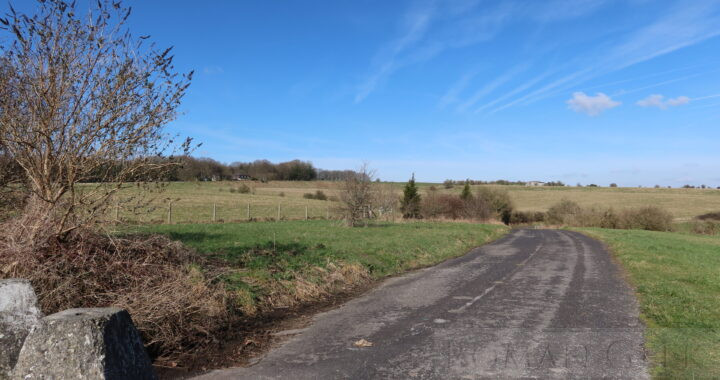
Durrington Walls is a Bronze Age Henge Monument which had a population of c. 4,000 and was active around 2,300 BCE, the period of construction of Stonehenge.

Durrington Walls

  • Durrington Walls was a Bronze Age settlement of around 1,000 houses, 2 miles north east of Stonehenge in Wiltshire.
  • The community had a population of around 4,000, and was active from around 2,300 BCE, the period of construction of Stonehenge.

Description

  • Henge Monument
    • It was a circular area, 0.3 mile (500m) in diameter, surrounded by a Henge monument consisting of a circular Ditch and earth Embankment.
  • Astronomical Alignment
    • At the centre was a large Timber circle pointing towards sunrise at the Winter Solstice.
  • Circles
    • Within the main circle, there were four more concentric circles,
  • An Avenue
    • An avenue led to the River Avon oriented towards sunset at the Summer Solstice.

Nearby Monuments


Durrington Walls Henge Monument, Wiltshire

Andautonia

  • Andautonia was a Roman settlement on the banks of the River Sava near modern Zagreb in the Province of Pannonia Superior.
  • It is now an Archeological Park located 8 miles (14km) southeast of Zagreb in Croatia.

Andautonia Archeological Park

Museums

  • Archeological Museum in Zagreb
    • Located at 19 Nikol Subic, Zrinski Square, Zagreb
    • In the Antiquity Section, the museum holds artefacts excavated from all over Croatia including statues, military items, artwork and a large collection of Roman coins.

Roman Roads

  • A Roman Road connected:
    • Poetuvia-Andautonia-Siscia


Andautonia Archeological Park, Croatia

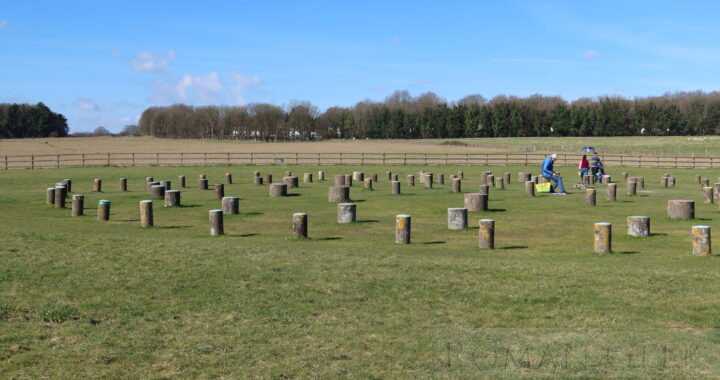
Woodhenge is a Henge Monument located 2 miles from Stonehenge built in 2,500-2,000 BCE. It consists of six concentric oval rings made from 168 timber postholes.

Woodhenge

  • Woodhenge is a henge monument located 2 miles northeast of Stonehenge in Wiltshire and dating from between 2,500-2,000 BCE.
  • Woodhenge consists of six concentric oval rings made from 168 timber postholes. Its purpose remains the subject of debate.

Similarities to Stonehenge

  1. The Diameters of the timber circles
    • At Woodhenge the diameters are similar to the diameters of the Stone circles at Stonehenge.
  2. The entrance
  3. The post holes
    • These are arranged in a similar way to the Bluestones at Stonehenge.

Bronze Age Town

  • The Bronze Age community of 4,000 people at Durrington Walls is located 230 feet (70 m) north of Woodhenge.

Nearby Monuments


Woodhenge, Wiltshire

Bishapur

  • Bishapur was an ancient city whose Ruins are located in modern Faliyan in the Province of Fars, Iran
  • In 266 CE, the captured Roman Legionaries from the Battle of Edessa built the nearby city of Bishapur where they and Valerian lived.

Roman Ruins

  • Palace of Shapur I
    • with Roman Mosaics.
  • Temple of Anahita.
  • The Dam of Band-e Kaisar.


Bishapur Ruins, Iran

Equator

  • The Equator is an imaginary line which divides the World exactly into two halves, the Northern Hemisphere and the Southern Hemisphere.
  • The Earth is further subdivided into Parallels of Latitude which, when used in combination with Longitude, help determine the position of a location on Earth.

Description

  • The Equator is the zero Parallel of Latitude.
  • Each parallel of Latitude then extends North or South from 0° to 90°.
  • The 90° North Parallel passes through the North Pole, and the 90° South Parallel, passes through the South Pole.
  • At the Equator, the length of Day and Night are always exactly equal: Day is 12 hours long and Night is 12 hours long, every day of the year.
  • On the Equinoxes, the Sun is directly overhead the Equator at Midday.

Ancient Geographers

Celestial Equator

  • The Celestial Equator is a Great Circle or disc that divides the Earth’s Sphere into exactly two Hemispheres.
  • It is on precisely the same plane as the Equator.


Equator

Barygaza

  • Barygaza is modern Bharuch in India. It is the oldest city in Gujarat, with a continuous history spanning 8,000 years.
  • It was a famous Port that the ancient Greeks and Romans traded with.

Periplus of the Erythraean Sea

  • Barygaza is mentioned in the Periplus of the Erythraean Sea, a first century CE guide to navigation in the Indian Ocean.
  • It was described as a port heavily involved in trade with the Roman Empire.
  • The Periplus states that Greek coins were used there, and describes the existence of Greek style buildings and defensive walls. It is probable that a Greek community lived there.


Bharuch (Barygaza), India

Santorini

  • Santorini is a Greek island, also known as Thera, which is located to the north of Crete in the Aegean and is the southernmost member of the Cyclades.
  • It has been proposed as one of the locations for Atlantis, although this was supposedly destroyed by a Flood, and not a Volcanic eruption.

Former Volcano

  • Santorini is one of the islands which form the circular Santorini Archipelago, this being the submerged caldera of a former volcano.
  • Between 1627 and 1600 BCE, Santorini erupted, devastating the entire region with tsunamis and ejected material. It is thought this may have led to the demise of the Minoan Civilisation on nearby Crete.

Ancient Thera

  • The ancient city of Thera was located on the island of Santorini.
  • It was founded in the ninth century BCE, and remained inhabited until 726 CE. It was built on top of a ridge of the Messavouno mountain 1,180 ft (360m) high.
  • Herodotus says there was a drought here that lasted seven years in circa 630 BCE. During this time colonists were sent to found Cyrene in Libya, making Thera the mother city.
  • Santorini was used as a fleet base for the Egyptian Ptolemaic navy, between 250-150 BCE. There was a garrison of 300 men in the city.
  • Thera remained occupied during the Roman Empire and was attached to the Province of Asia.
  • In 726 CE, an eruption by Santorini’s volcano, covered the city, after which it ceased to be inhabited.

Ruins of Thera

  • The ruins of Thera date from the Ptolemaic occupation (250-150 BCE).
    • Basilica
    • Stoa
    • Theatre (with seating capacity for 1500)
    • Grotto
    • Temples
    • Gymnasium
    • An building that may have been the Admiral’s house

Possible description of the Eruption from Ancient Egypt

  • Recently discovered in the Ramesseum in Egypt, were a series of medical texts dating from the around the 18th century BCE which are numbered III, IV and V.
  • The Text was written in vertical Hieratic Script, except for Text V which was written in Egyptian Hieroglyphs.
    • Text III covers an eruption of a volcano, possibly Santorini, and how to deal with burn victims.
    • Text IV covers gynaecological issues, childbirth, new-born babies, and methods of contraception.
    • Text V covers relaxation exercises.


Santorini:

Gobekli Tepe

  • Gobekli Tepe (Potbelly Hill in Turkish) is a Monument of Standing Stones that are T-shaped and date from 9,500 BCE. The pillars are linked by walls to form circular enclosures with linking rooms.
  • It is a hilltop sanctuary located on the highest point of a mountain ridge, 10 miles (16km) from Sanliurfa in Turkey, 35 miles from the border with Syria.

Description

  • Gobekli Tepe probably had a similar function to the later Greek Sanctuary at Mount Olympus.
  • It was active between 11-9,000 BCE. Every few years the Stones were buried and a new circle of stones positioned inside the old circle.
  • Around 8,000 BCE the area was deliberately buried under a thick layer, and forgotten.
  • It predates Stonehenge by around 7,000 years.


Gobekli Tepe

Tarshish

  • Tarshish was an ancient port city with a fleet, mentioned in The Bible, whose location is unknown.

The Bible

  • Tarshish is mentioned in The Bible:
    • Isaiah 2:16 mentions the ‘ships of Tarshish’.
    • Isaiah 23:10 Tyre was considered to be the ‘daughter of Tarshish’.

Other Sources

  • Annals of the Assyrian King Esarhaddon (681-669 BCE)
    • The cuneiform texts refer to Tarshish as an island far to the west of the Levant, possibly Sardinia.
  • Septuagint
  • Ephorus
    • the Greek Historian (400-430 BCE), mentions Tartessos as a wealthy market for Tin, shipped by river, and Copper and Gold from Celtic Lands.
  • Herodotus

Other possible locations

  • Cilicia
  • Tartessos
    • The word Tarshish is also similar to the semi-mythical city of Tartessos in southern Spain. located at the estuary of the River Guadalquivir. The Tartessians traded with the nearby Phoenician city of Gades, modern Cadiz.
  • Atlantis
    • Tarshish is also one of the possible locations for the island of Atlantis.


‘Tartessos’, estuary of the Guadalquivir