Thornborough Henges

Thornborough Henges

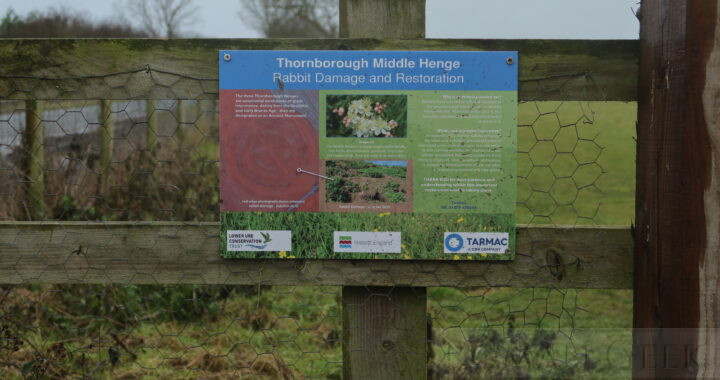
  • The Thornborough Henges are Scheduled Ancient Monuments located in North Yorkshire which were constructed during the Bronze Age between 3,500 – 2,500 BCE.
  • They are very similar to the Cursus and Henges located at Stonehenge and Avebury in Wiltshire.

The Site

  • The Henges extend for approximately one mile (1.6km), in a northwest-southeast direction.
  • They consist of an alignment of three Henges with a slight kink, reminiscent of Orion’s Belt.
  • It is thought that the banks of the Henges were covered in Gypsum which would have produced a white reflection visible from many miles away.
  • A Cursus also extends for approximately one mile (1.6km) east-west, starting at the village of Thornborough, passing under the centre Henge and ending close to the River Ure.

Devil's Arrows

  • These are the three Standing Stones located at nearby Boroughbridge, which are also aligned northwest-southeast.

The Stone Axe and Flint Road

  • Until recent times, rows of Bronze Age Stones existed on the other side of the Pennines in eastern Cumbria.
  • The Bronze Age sites on both sides of the Pennines appear to have been linked by the Stone Axe and Flint trading route.


Photo and map: Thornborough Henges
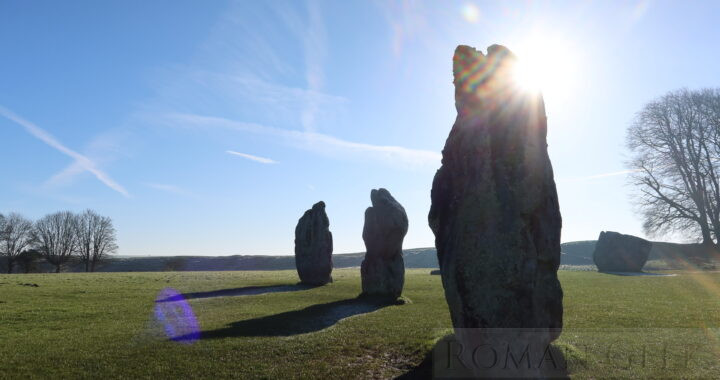
Avebury is a Henge Monument that contains the largest circle of Standing Stones in Britain, with 98 Sarsen Stones, some weighing up to 40 tons.

Avebury

  • Avebury is a Henge Monument in Wiltshire, England, constructed around 2,600 BCE.
  • It is a Scheduled Ancient Monument and a Unesco World Heritage Site.

The Site

  • Henge
    • Avebury consists of a Henge with an internal ditch.
  • Stone Circle
    • It contains the largest circle of Standing Stones in Britain, with 98 Sarsen Standing Stones, some weighing up to 40 tons. Sarsen Stones were also used at Stonehenge.
  • Sarsen Stones
    • Sarsen stones are mostly found lying naturally upon Salisbury Plain and upon the Marlborough Downs in Wiltshire.
  • Circles
    • Inside the outer ring are two smaller inner circles of Standing Stones.
  • The Avenue
    • From the southeast of Avebury, an Avenue of paired Standing Stones leads down to the river Kennet.
    • Another Avenue appears to have led from the western entrance.

Nearby Sites

Similar Bronze Age Monuments


Avebury National Trust Car Park, Wiltshire:

Terebinth Tree

  • Pistachia Terebinthus, also known as the Turpentine Tree, is usually found close to the Mediterranean Sea, and emits a strong smell of resin. It is the earliest known source of Turpentine.
  • It grows all around the Mediterranean Sea and reaches the Canary Islands.

Terebinth Resin

  • The Resin from Terebinth trees was used to make Turpentine which, in Classical antiquity, was used in Medicine for internal as well as external applications.
  • Blocks of Terebinth Resin were found in the Uluburun Shipwreck dating around 1300 BCE.


Terebinth Tree, Cyprus


Villa of the Papyri

  • The Villa of the Papyri was a villa in Herculaneum, which was buried in 79 CE, during the eruption of Vesuvius.

Description

  • In the villa library were found 2,000 scrolls. Many were Works by Epicurus (341-270 BCE).
  • The scrolls were burnt by the 300° temperature of the eruption and the villa buried under 70 feet (20m) of lava.
  • The owner of the villa and its library was either Lucius Calpurnius Piso Caesonius, who was Consul of Rome in 58 BCE, father-in-law of Julius Caesar and Patron of Philodemus, or to his son of the same name.
  • Piso was the Patron of the poet Philodemus (c.110-c.35 BCE), who was a follower of Epicurus. The library also contained a large number of Works by Philodemus.

Works of Art

  • The Villa contained Frescoes, Marble Sculptures and Bronze Works of Art, as well as the Library.
  • Many of these are now in the National Archeological Museum Naples including
    • The Seated Hermes
    • The Drunken Satyre
    • The Bust of Thespis.

Library of Scrolls

  • It is the only library from Ancient Rome to have survived intact.
  • Although the scrolls are all burnt into carbonised cylinders, some restoration has been possible.
  • The 1,700 scrolls that have been opened were mostly written in Greek.

Discovery of Lost Works

  • ‘On Nature’
    • A third of this Lost Work by the philosopher Epicurus has been recovered.
  • ‘Faenerator’ or ‘The Usurer’
    • A comedy in Latin by the comic playwright Caecilius Statius.
  • There may be other Lost Works from Classical Literature yet to be found.

Getty Villa

  • The Villa was commenced in 1954 and inspired by the Villa of the Papyri at Herculaneum.
  • Notable Works are the Landsowne Heracles marble statue (125 CE) and the Victorious Youth bronze statue (c.300-100 BCE).
  • The Villa occupies a site of 64 acres (26 hectares) with four Roman Gardens, filled with fountains and statues, that are planted with herbs, shrubs and bushes from the Roman Era.


Villa of the Papyri, Herculaneum

The Curse of the rains

  • The Curse of the rains is the name for the Desert Locust
  • After the long awaited heavy rainfall, the Locust starts to rapidly reproduce in millions and then swarm, devastating all agriculture in the region.

Locust Lifecycle

  • Normally, the Desert Locust lives alone.
  • It has a three stage Lifecycle lasting 3-5 months: Egg, Hopper, Adult.
  • However, after heavy rainfall, the rapid growth of vegetation encourages the female Locust to lay its eggs, and the young Hoppers or Nymphs, hatch and feed together.
  • This mass congregating triggers the change from solitary behaviour to swarming. As the Nymphs become adults, they change colour from the usual brown to become red or yellow.

Locust Swarms

  • Adult Locusts that swarm can fly hundreds of miles when carried by the wind.
  • They eat during the day and fly at night.
  • Locust Swarms regularly cross the Red Sea from Africa to Arabia.
  • They can travel up to 200 miles (320km) per night and fly up to an altitude of 6,000 feet (1800m) but cannot go over mountain ranges.
  • One swarm can cover 400 square miles (1,000 square kilometres) and will contain millions of Locusts.
  • They eat entire crops and vegetation in a whole area, destroying food supplies and bringing Famine.
  • Swarms from Ethiopia and Somalia cross the Red Sea and northwestern Indian Ocean using the Monsoon and arrive in the Arabian Peninsular, Iran, Pakistan and northwestern India
  • All crops, vegetables, trees and plants are ravaged.

The Ten Plagues of Egypt

  • Swarms of Locusts formed the eighth Plague of the Ten Plagues of Egypt, recorded in the Book of Exodus in The Bible.


Egypt

Stromboli

  • Stromboli is a volcanic island, one of the Aeolian Islands, off the north coast of Sicily.
  • It has been erupting almost continuously since the Roman period.

Description

  • Stromboli is one of the three active volcanoes in Italy. It is the same size as Mount Etna and twice the size of Mount Vesuvius.
  • Stromboli reaches a height of 3,3031 feet (924m).

Lighthouse of the Mediterranean

  • The eruptions take place in a series of small explosions every 20 to 30 minutes.
  • At night, the eruptions are visible for miles which is why the Romans referred to it as the ‘Lighthouse of the Mediterranean’.
  • During the day a plume of smoke can always be seen above the island.
  • The island is visible from up to 30 miles away, day or night.
  • A vessel sailing from Naples could head straight for Stromboli at night, knowing that the Straits of Messina, lie just 40 nautical miles beyond it.

Active Volcanoes


Stromboli

Barygaza

  • Barygaza is modern Bharuch in India. It is the oldest city in Gujarat, with a continuous history spanning 8,000 years.
  • It was a famous Port that the ancient Greeks and Romans traded with.

Periplus of the Erythraean Sea

  • Barygaza is mentioned in the Periplus of the Erythraean Sea, a first century CE guide to navigation in the Indian Ocean.
  • It was described as a port heavily involved in trade with the Roman Empire.
  • The Periplus states that Greek coins were used there, and describes the existence of Greek style buildings and defensive walls. It is probable that a Greek community lived there.


Bharuch (Barygaza), India

Via Sacra, Rome

Via Sacra

Description

  • The road passed through all the most Religious Sites in Rome.
  • It was also the Financial Centre of Rome.
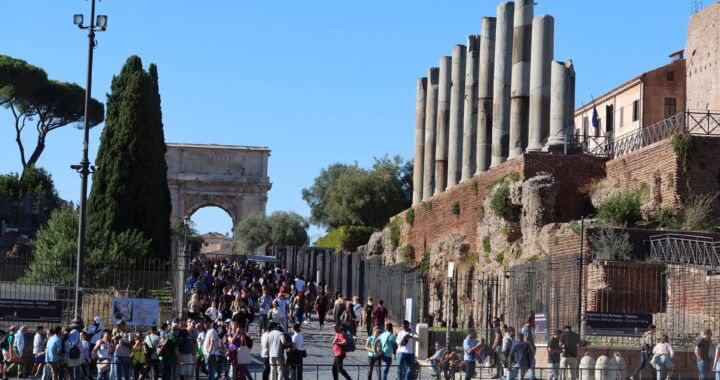
  • The Roman Triumph would pass along the Via Sacra.
  • It was covered over during the 5th century BCE, then paved and during the reign of Nero (54-68 CE) it received colonnades.


Photo and Map: Via Sacra, Rome

Ankara

  • Ankara is the capital city of Turkey located on the Ankara river and is located in the Central Anatolia Region of Turkey.
  • After the Galatian War (189 BCE) it became part of the Roman Empire, and after 25 BCE, Ancyra became the capital of the Roman Province of Galatia.

Roman Sites

  • The Roman Baths of Ankara.
    • The Baths date to Domitian (81-96 CE) and were in use for 500 years. Only the foundations are visible.
    • The Site is open to the public as an open air museum.
  • The Temple of Augustus and Rome.
    • Built c. 25 BCE, only the side walls and the door frame are still standing.
    • The Ruin holds an inscription called the ‘Monumentum Ancyrum’ which displays a copy of the Res Gestae Divi Augusti, relating the achievements of Augustus.

Museums

  • Museum of Anatolian Civilisations
    • Gozcu Street No:2, Ulus, Ankara.
    • The museum holds Finds from the Hittite, Hellenistic, Roman, Byzantine and Ottoman periods.

Roman Roads


Temple of Augustus, Ankara

Mount Olympus

  • Mount Olympus is the highest mountain in Greece, at 9,570 ft (2,917m) high and is located 100 miles (160 km) west of Thessaloniki.
  • In Greek Mythology it was a sacred mountain which was home to the Twelve Olympians, the most important Gods in the Greek Pantheon (Temple of all Gods).

Mount Olympus and Olympia

  • It is easy to confuse the two, but they are very different and very far apart.
    • Mount Olympus
      • This was the home of the Greek Gods, the Twelve Olympians.
      • The Mountain is located in central Greece, 100 miles (160 km) west of Thessalonica.
    • Olympia
      • This was the home of the Sacred Grove of Elis and the Ancient Greek Olympic Games.
      • It is located in the Peloponnese of southern Greece.


Mt. Olympus, Greece