Orkney Islands

  • The Orkney Islands are an archipelago of 70 islands that lie 10 miles (16km) across the Pentland Firth opposite Caithness in Northern Scotland.
  • They are also known as the Orkneys and were referred to by Tacitus as the ‘Orcades’.

History

  • The Norwegian King Harald the Fair Hair annexed the Orkney and Shetland Islands in 875 CE and they remained Norwegian possessions until they were officially ceded to the Scottish Kings in 1472 CE.

Orkney Monuments

There are many Megalithic Stones from the Bronze Age located on the islands.

  • Knap of Howar (c.3,700 BCE)
    • A stone building probably a farm, it was built in 3,700 BCE on the island of Papa Westray.
  • Skara Brae (c.3,200-2,500 BCE)
    • A Neolithic village of eight stone houses forming a village built earlier than the Pyramids, and occupied between 3,100-2,500 BCE, also on Mainland.
  • Standing Stones of Stenness (c.3,000 BCE)
    • The remains of a circular Henge Monument with originally 12 standing stones formed into an ellipse, of which only 4 stones remain today.
  • Maeshowe (c.2,800 BCE)
    • A Passage Grave inside a large Mound, where the Sun aligns into the inner chamber on the Winter Solstice.
  • Ring of Brodgar (c.2,500-2,000 BCE)
    • This is the remains of a Henge Monument with originally 60 stones set in a circle, of which only 27 remain today. It is the largest Stone Circle in Scotland, located on the biggest island called Mainland.

Iron Age Sites

Ancient Sources

  • The Orkney Islands (Orcades) are mentioned by:
    • Diodorus Siculus (c.90-30 BCE)
      • First mention of Orkas as the third point of the triangular island of Britain jutting into the ocean.
    • Pomponius Mela (d.c.45 CE)
      • First to use the name ‘Orcades’ on his maps. He quoted Pytheus of Massilia who circumnavigated Britain in c.325 BCE.
    • Pliny the Elder (23-79 CE)
    • Tacitus (56-120 CE)
      • Mentions the Orcades as being discovered and conquered in 84 CE, after the Battle of Mons Graupius.
    • Ptolemy's Geographia (c.150 CE)
      • He marked ‘Tarvedrum quod Orcas’ as a headlong at the top of the map of Britannia.


Orkney Islands

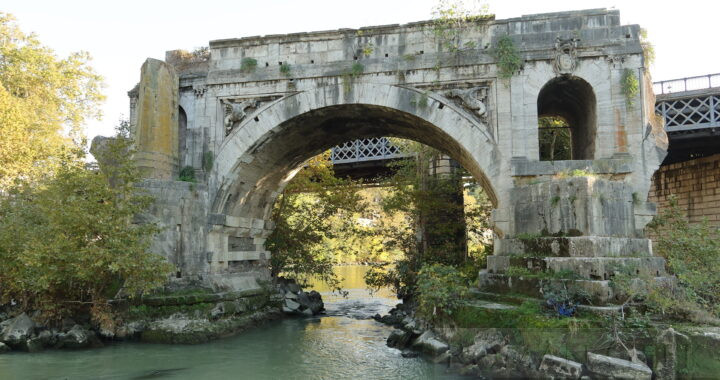
The Last remaining Arch of the Aemilian Bridge over the Tiber in Rome

Aemilian Bridge

Getting There

  • Only one Arch remains standing in front of the Ponte Palatino.
  • It is best viewed either from this bridge or from the south of Tiber Island.

History

  • Built in timber in 179 BCE, the stone arches were added in 142 BCE.
  • It carried the Via Aurelia to Pisa and Gaul, and connected the Forum Boarium with the Trastevere area.
  • The bridge became the first stone bridge in Rome.
  • Only one Arch is visible today, south of Tiber Island.
  • The Cloaca Maxima emerges between the Pons Aemilius and the Pons Sublicius.

Roman Roads (starting at this bridge)


Back to Bridges of Ancient Rome


Pons Aemilius

Dolphin

  • The Dolphin was considered to be a symbol of Divine protection by Ancient Greek and Roman sailors.
  • This was because Dolphins often rode the bow wave of vessels at sea, as they still do today.

History

  • Ancient fishermen often cooperated with Dolphins, because of their extraordinary ability to act as a team together and round up entire schools of fish.
  • The Greek God of the Sea, Poseidon, had four symbols: the Trident, the Fish, the Horse and the Dolphin.
  • The Dolphin was considered to be his Messenger, and was also associated with Aphrodite and Apollo.
  • The coins of the Ancient sea power of Tyre, some dating from around 450 BCE often portrayed a Dolphin.

Sea God Portunus

  • Roman Mosaics often portrayed the Greek Child Sea God Palaemon, who the Romans called Portunus, riding on the back of a Dolphin.
  • The sculpture known as the Prima Porta Augustus (c. 20 BCE), portrays Augustus, with a boy on a Dolphin beside his right foot. This symbolised his great naval victory over Mark Anthony at the Battle of Actium (31 BCE).


Mediterranean

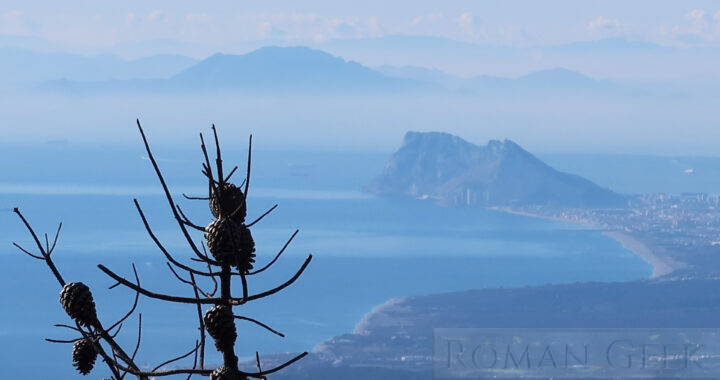
Gibraltar and Jebel Musa from Los Reales de Sierra Bermeja, Estepona

Strait of Gibraltar

  • The Strait of Gibraltar is the sea between Gibraltar and Morocco.
  • The distance at the narrowest point is 8.1 miles (13km) and the winds blow predominately from the east (the Levante) or the west (the Poniente).

Rock of Gibraltar

  • Gibraltar is a 1,396 ft (426m) mountain on the southwestern tip of Spain.

Pillars of Hercules

  • Gibraltar and the Atlas Mountains opposite were known in the Ancient World as the Pillars of Hercules. The Strait of Gibraltar was known to the Romans as Fretum Herculeum.

Carteia

  • The ruins of the Roman town of Carteia are located between the town of San Roque and Gibraltar.
  • Strabo wrote that it was founded by the Phoenicians in 940 BCE.
  • In 190 BCE Carteia finally fell to the Romans and it became a Roman naval base from 67 BCE onwards.
  • The site holds the Ruins of Roman Temples, Kilns and a Forum


Strait of Gibraltar

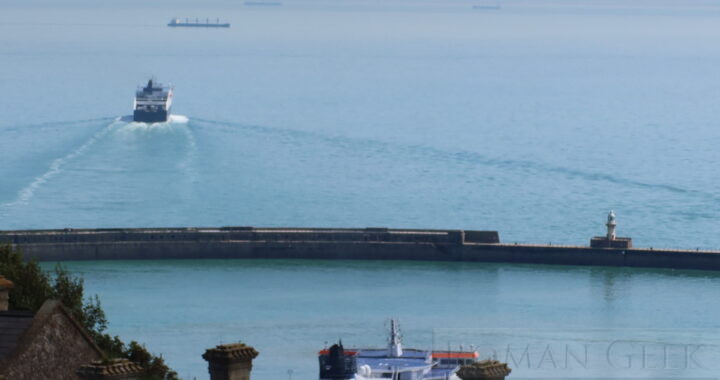
Straits of Dover looking towards Cap Gris Nez, France

Strait of Dover

  • The Strait of Dover was known to the Romans as the ‘Fretum Gallicum’ which separated Roman Britannia from Roman Gaul.
  • The two Provinces were linked by the Roman port of Boulogne in Gaul with the Roman Port of Richborough, the entry point for Britannia.

Roman Lighthouses

  • Dover Roman Lighthouse
    • The Dover Roman Lighthouse or ‘Pharos’ is a well preserved octagonal building on five floors and is located next to Dover Castle in Dover, Kent in the South East Region of England.
    • The Lighthouse was built shortly after the Roman Conquest of Britannia in 43 CE.
    • It was one of a pair of Roman Lighthouses, the other being on the other side of the Dour valley, on the western heights.
    • Both Lighthouses were 80 feet high (24m).
  • Boulogne Roman Lighthouse
    • Built in 46 CE by Caligula after his aborted attempt to invade Britania, and switched off in 475 CE.
    • Location: Known as the Tour de l’Ordre or Le Phare de Caligula, it collapsed on the 29th July 1644 CE.
    • A seventeenth century engraving is kept in the Boulogne Castle Museum. It shows a 12 storey octagonal tower 55-60m high, similar to the Dover lighthouse, with which it was intervisible.


Strait of Dover

Pentland Firth

  • The Pentland Firth is a 14 mile (22km) wide Strait in the North of Scotland, between the Caithness and the Orkney Islands.
  • It has some of the fastest Tidal Races in the world with speeds of up up to 16 mph (26 kph), making navigation by sailing vessels difficult. There are also two islands in the Firth, Stroma and Swona.


Pentland Firth

Broch

History

  • There are approximately 570 Brochs in Scotland, the majority of which were built between 100 BCE and 100 CE.
  • The Brochs were lived in as homes and may have had a defensive role, although archeologists are not agreed on their purpose.

Construction

  • The Brochs are circular buildings made of a double lined dry stone wall with a gap between the walls which held Galleries.
  • The inner and outer walls are often linked by large stones, that sometimes form part of a spiral staircase that linked the Galleries and led to the roof.
  • Some surviving Brochs have walls with a height above 21 feet (6.5m).
  • The internal diameter varies from 16-50 feet (5-15 m), with the walls being 10 ft (3m) wide.
  • Access to the Broch was by a single doorway and it is thought that they had a timber roof.
  • Inside the Broch, there were buildings built against the inner wall.

Broch of Mousa

  • Possibly the best preserved Broch in Scotland, it is located on the shore of the island of Mousa, in the Shetland Islands.


Broch of Mousa, Shetlands

Crannogs

  • A Crannog is an Iron Age wooden roundhouse built on an artificial island in a Loch in Scotland.
  • Around 600 have been identified in Scotland. They are the Iron Age equivalent of a Roman Villa.

Description

  • The access was either by a wooden causeway or by boat.
  • Several families lived on a Crannog.
  • It was built on giant wooden piles of alder, about 26-32 feet (8-10m) long, which were sunk into the Loch to create an artificial island, and then roofed with thatch.

The Scottish Crannog Centre

  • The centre has reconstructed a Roundhouse on piles with a wooden causeway and logboats on Loch Tay, Kenmore, Perthshire.

Links


The Scottish Crannog Centre on Loch Tay

Azores

  • The Azores (Lat.37.74°) is an archipelago of nine volcanic islands located in the Atlantic Ocean, 870 miles (1,400km) west of Lisbon (Lat. 38.72°).
  • It is in the Autonomous Region of the Azores which is part of the Republic of Portugal. The largest city is Ponta Delgada on San Miguel Island.

Macaronesia

  • Macaronesia is a group of four volcanic archipelagos located in the Atlantic Ocean near to the coasts of Europe and Africa.
  • Each archipelago is a separate political system. Poitically, the islands that belong to Spain and Portugal are part of the European Union, while Cape Verde is a member of the African Union.


Ponta Delgada, Azores