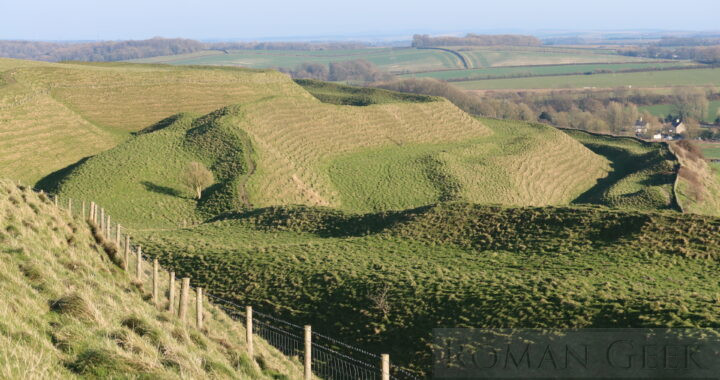
Maiden Castle is an Iron Age Hill Fort, considered to be the largest Hill Fort in Europe. It is located 1.5 miles (2.6km) from Dorchester.

Maiden Castle

  • Maiden Castle is an Iron Age Hill Fort and a Scheduled Ancient Monument maintained by English Heritage.
  • It is considered to be the largest Hill Fort in Europe and is located 1.5 miles (2.6km) southwest of Dorchester in Dorset.

History

  1. A Neolithic Causewayed Enclosure was the first structure on the Site, dating from c. 4,000 BCE.
  2. Around c. 3,350 BCE, a long 1,790 feet (500m) Bank Barrow with parallel ditches was built inside the Enclosure.
  3. The Hill Fort was built in c.600 BCE, and by 450 BCE it had been expanded to become the largest Hill Fort in Europe,  surrounded by a triple Ditch defensive system.

Other Hillforts

  • Whitehawk Camp (3,700-2,700 BCE)
    • Whitehawk Camp is a Scheduled Monument which holds the remains of a Neolithic Causewayed Enclosure and is located on Whitehawk Hill next to Brighton Racecourse in Brighton.
  • Cissbury Ring (c. 400 BCE)


Maiden Castle, near Dorchester

Aten

  • Aten was a Lost city until its discovery in Egypt in 2019.
  • The Site is 3,400 years old, and revealed the life of ordinary Ancient Egyptians whose houses and artefacts contrasted starkly with previous Finds which were from Royal Pharaonic Tombs and Burials.


Aten, near Luxor

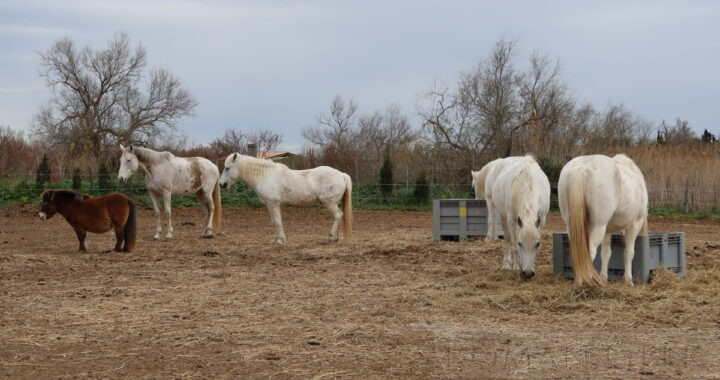
Camargue Horses

Camargue

  • The Camargue is a natural region located south of Arles between the two arms of the Rhone Delta which consists of marshes. It forms part of the Department of Bouches-du-Rhone.
  • The ‘Parc naturel regional de Camargue’ is a protected regional park and nature reserve inside the Camargue.

Description

  • The Camargue is Western Europe’s largest river delta and is made up of wetlands and lagoons which are home to the Camargue Pink Flamingos, Camargue Horses and Camargue Cattle, which are still used in bull fighting. All the animals roam free and are indigenous to the region.
  • The capital of the Camargue is Arles. Other towns include Saintes-Maries-de-la-Mer and Port-Saint-Louis-du-Rhone.
  • Another marsh called the Petite Camargue lies to the west of the Petite Rhone which is the location of the medieval walled city of Aigues Mortes.

Pink Flamingo

  • The Flamingo, meaning flame-coloured in Spanish, is a large pink long-legged wading bird which makes a distinct honking sound.
  • The Greater Flamingo is one of six species of Flamingo and is native to Southern Europe, parts of Africa and south and southwest Asia.
  • The best sites for viewing Flamingos in the Camargue are the Parc Ornithologique du Pont de Gau at Saintes-Maries-de-la-Mer and in the surrounding marshes and lagoons near Salin-de-Giraud.

Parc Ornithologique du Pont de Gau

  • The best site for viewing Flamingos in France is the Ornithological Park at Saintes-Maries-de-la-Mer in the Camargue.
  • Visitors can walk along platforms surrounding the lagoons and easily see and photograph the groups of flamingos.
  • Website: Parc Ornithologique du Pont de Gau


Photo and map: Camargue Regional Natural Park

Pozzuoli

  • Pozzuoli was the Roman Resort town of Puteoli located in the Bay of Naples, Italy.
  • It was the main harbour for the Roman Republic and early Empire and had two Amphitheatres.

History

  • Puteoli was the main harbour for the Roman Republic and Early Empire. The Grain Fleets arrived here from North Africa and Egypt.
  • The wealthy Romans kept summer villas in Puteoli, including the Dictator Sulla who died in his Villa in 78 BCE.

Roman Concrete

  • Pozzolana, meaning the dust of Pozzuoli (Puteoli), was a volcanic ash which was used to form Roman Concrete.
  • Pozzolana was exported all over the Roman Empire.

Roman Sites

  • Flavian Amphithatre
    • The third largest Amphitheatre in Italy.
  • Macellum of Pozzuoli or ‘Temple of Serapis’, is a marketplace.
  • Villa Avellini, a Park with Roman Remains, water tanks and a working Roman Fountain.
  • Necropolis of the Via Puteolis Capuam.
  • Necropolis of the Via San Vito.
  • Lake Avernus is 2.5 miles (4km) west of Pozzuoli.
  • Lake Lucreno lies 0.5 km south of Lake Avernus.

Roman Roads

Straits of Corfu

  • The Straits of Corfu, also known as the Corfu Channel, lie between the Greek Island of Corfu and the Albanian coast.


Straits of Corfu

Tutankhamun’s Tomb

Tutankhamun

  • Tutankhamun was the Pharaoh of Egypt between c.1332-1323 BCE.
  • His Tomb was discovered in 1922 by Howard Carter in the Valley of the Kings at Luxor.
  • ‘King Tut’ has become the most famous of all the Pharaohs, popularising the ‘Curse of the Pharaohs’, with his Mummy being the inspiration behind many horror movies.

Museum of Cairo

  • The Museum holds the Finds from the Tutankhamun’s Tomb. Included in the Finds were:
    • A Funerary Gold Mask pf Tutankhamun.
    • A Wooden bust of Tutankhamun.
    • Tutankhamun’s Mummy in a Golden Sarcophagus.
    • Two Royal daggers:
      • One dagger blade was made of Gold, for royalty.
      • The other blade was made of Iron. This was unusual as there was no iron in Egypt, and Daggers were usually made of Bronze or Copper.
    • An Iron Pillow found under his head. The iron has subsequently been identified to have come from a Meteorite.
      • A Pectoral with a winged Scarab and Lotus flowers.
      • A Pair of Slings.


Tomb of Tutankhamun

Akkad

Akkadian Empire

  • The Akkadian Empire (c.2334-2154 BCE) was the first Empire of Mesopotamia which emerged from the Sumer Civilisation (c. 5500-c.1800 BCE).

Sargon of Akkad

  • Sargon of Akkad (c.2334-c.2284 BCE), also known as Sargon the Great, was the first Ruler of the Akkadian Empire (c.2334-2154 BCE) with its Capital at Akkad (now lost).
  • He conquered the Sumer Empire and created the Akkadian Empire which ruled Mesopotamia. He is not the same person as Sargon I (c.1856-c.1817 BCE) of the later Old Assyrian Empire.


Possible location for ‘Akkad’

Iron Gate of Transylvania

  • The Iron Gate or Gates of Transylvania is a mountain Pass between the Tarcului mountains and the Poiana Rusca mountains located in Roumania.
  • The Pass is at an altitude of 2,297 feet (700m) and is located 24 miles (39km) east of Caransebes and 8 miles west of Sarmizegusta. A Fort called Tapae defended Sarmizegusta, the Capital of Dacia.

Battle of Tapae (101 CE)

  • The Battle of Tapae (101 CE) was fought between the Dacians and the Romans at this Pass during the Dacian Wars (85-106 CE).


Iron Gate of Transylvania

Ggantija Temples

  • The Ggantija Temples are a Megalithic Stone complex located on the island of Gozo near Malta and date from the Neolithic Period (3,600-2,500 BCE).
  • The site is the second oldest Megalithic structure after the Gobekli Tepe structure in Turkey.


Ggantija Temples, Gozo

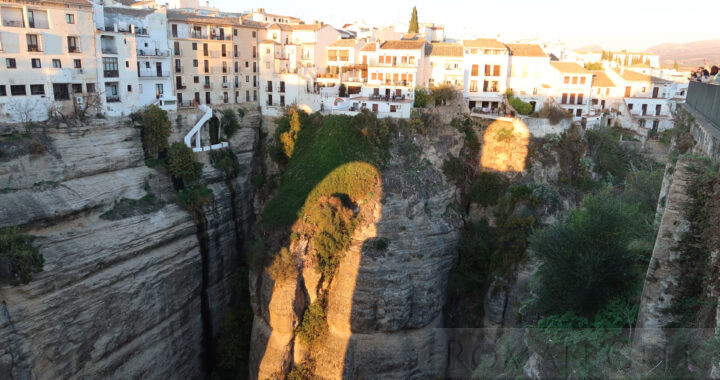
Silhouette of the Puente Nuevo at sunset, Ronda

Ronda

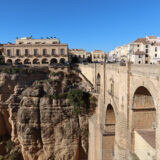
  • Ronda is a cliff top town located in the Andalucia Region of southern Spain. It is built next to a 390 feet (120m) deep gorge which carries the Guadalevin river and is crossed by three bridges.
  • The three bridges are the Puente Romano or Roman Bridge, which is a Moorish bridge built on Roman foundations, the Puente Viejo or Old Bridge (1616) and the Puente Nuevo or New Bridge (1793).


Puente Romano, Ronda

Puente Romano, Ronda


Puente Viejo, Ronda

Puente Viejo, Ronda


Puente Nuevo, Ronda

Puente Nuevo, Ronda


Silhouette of the Puente Nuevo at sunset, Ronda