Jupiter Column, Wiesbaden

Wiesbaden

  • Wiesbaden is a Spa town with 14 hot springs on the opposite bank of the Rhine to Mainz located in the State of Hesse in western Germany.
  • It was the Roman Spa town of Aquae Mattiacorum in the Province of Germania Superior.

History

  • It’s location opposite the double fortress of Mogontiacum, meant it had a constant army clientele using the Hot Springs.
  • A permanent Roman Bridge crossed the Rhine between Mainz and a fortified bridgehead located in Mainz Castel, a suburb of Wiesbaden, providing easy access to the Spas.
  • Near to Wiesbaden was a section of the Limes Germanicus known as the Upper Germanic Limes. This ran from Rheinbrohl across the Taunus mountains to the river Main, down the Main to Miltenberg, then overland to Lorch.

Roman Sites

  • Roman Theatre
    • Located on Salvatorstrasse behind Wiesbaden Railway Station.
  • Jupiter Column
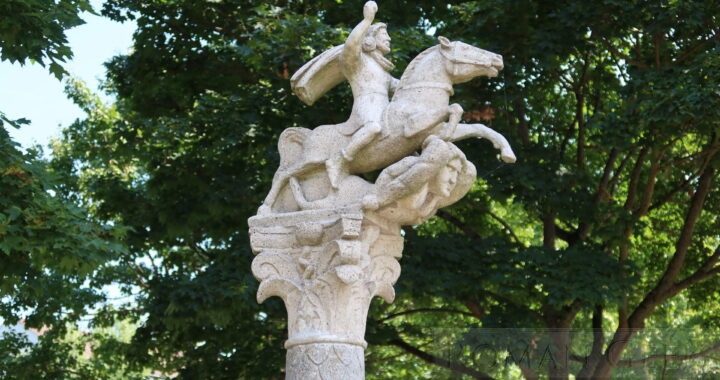
    • This is a Replica of a Roman Column, which stands on the promenade at Schierstein Harbour, Wiesbaden.
    • Viccius Seneca, a cavalryman of the Legio XXII Primigenia erected a monument to Jupiter on his estate on February 28, 221 CE.
Jupiter Column, Wiesbaden

Jupiter Column, Wiesbaden

Roman Roads

  • Roman Road
    • A Roman road connected Wiesbaden via the bridge with Mainz.
  • Rhine Military Road


Jupiter Column, Wiesbaden

Besancon

  • Besancon is a cathedral city on a horseshoe bend of the river Doubs and is located in the Bourgogne Franche-Comte Region of eastern France.
  • It was Roman Vesontio in the Province of Germania Superior.

History

  • It was the capital of the Sequani Gallic Tribe and became the Roman city of Vesontio during the Gallic Wars (58-51 BCE).
  • Modern Besancon is noted as the watchmaking capital of France, and has a cathedral with a 70 dial astronomical clock. There are also Fortifications by Luios XIV’s engineer, Vauban.

Roman Sites

  • Porte Noire Triumphal Arch (2nd century CE)
  • Square Castan
    • This is a garden with various Archeological Remains, including 8 Corinthian columns.

Museums

  • Besancon Museum of Fine Arts and Archeology
    • Located on Rue Claude Goudimel, near the Quai Vauban, Strasbourg.
    • The museum holds many Roman Artefacts including the Mosaic of Neptune, the Mosaic of Medusa and the ‘Bull of Avrigney’, a Bronze statue of a bull with three horns.

Roman Roads

  • Roman Road
    • Besancon – Chalons-sur-Saone


Besancon

Edirne

  • Edirne is a city in Turkey on the river Tunzha Tunca Nehri, which was known in Antiquity as Adrianople. It is located near the Turkish border with Greece and Bulgaria.
  • Founded as Hadrianopolis by Hadrian (117-138 CE), it was on the Via Egnatia and the Via Militaris and was in the Province of Thracia. It has been the site of many battles.

History

  • Battle of Adrianople (378 CE)
    • The Battle of Adrianople (378 CE), also known as the Battle of Hadrianopolis, occurred between the Army of the Goths under Fritigern and the army of the Eastern Roman Emperor, Valens, who was defeated.

Museums

  • Edirne Museum
    • Located at Kadir Pasa mektep sok, Edirne.
    • The museum holds Finds from all Periods including the Greco-Roman period.

Roman Roads


Edirne (Adrianople)

Karpathos

History

  • During the Roman Empire Karpathos and the Dodecanese were ruled from Rhodes.
  • After 395 CE, the Provincia Insularum was placed under the Eastern Roman Emperor in Constantinople.
  • The Dodecanese Islands were eventually joined with Crete under the control of Karpathos.

Roman Sites

  • Lefkas
    • Roman Cistern cut from the rock.
  • Pigadia
    • Acropolis of Peseidio
    • Sanctuary of Dimitra
    • Chapel of Agio Fotini, some standing columns from the 6th century CE building.

Museums

  • Archeological Museum of Karpathos
    • A small museum located in the town centre.
    • It holds Finds from all over the island which date from the Greco-Roman period.


Karpathos

Polyrrhenia

  • The Ruins of Polyrrhenia, also spelt Polyren or Polyrrhenium, are an Archeological Site located near Selti, 30 miles (49km) west of Chania.
  • It was an Ancient Greek city on the northwestern part of Crete. which continued to develop under the Roman Empire in the Province of Crete.

Roman Sites

  • City Walls
  • Acropolis
  • Roman Aqueduct
    • built during the reign of Hadrian (117-138 CE)

Museums

  • Archeological Museum of Kissamos
    • Located at Stratigou Tzanakaki Sq, Kissamos.
    • This museum holds the Finds from Polyrrhenia.


Polyrrhenia

Sofia

  • Sofia is a cathedral city and capital of Bulgaria located on the river Iskar.
  • After 27 BCE it became the Roman city of Serdica in the Province of Thracia.

History

  • Two Roman Emperors were born in Serdica:
  • Edict of Serdica (30 April 311 CE)
    • Galerius enforced the Diocletianic Persecution (303-313 CE), oppressing the Christians until just before he died, when he issued an Edict of Toleration at Serdica on 30 April 311 CE ending the Persecution.

Roman Sites

  • Sofia Ancient Serdica Archeological Complex
    • Located at ul. “Serdika” 5, 1000 Sofia Center, Sofia, in two Zones:
    • The Buildings of Roma Serdica have been excavated and put on display in the centre of Sofia.
      • Largo Area (under domes)
        • Roman Road
        • Lapidarium
        • Large Residential Building (Insula)
      • Knyaginya Maria Luiza Boulevard (below ground)
        • Several Insulae
        • Two Early Christian Basilicas
        • Baths
        • 5 Residential Buildings

Museums

  • National Archeological Museum
    • Located at Pl. Atanas Burov, Sofia.
    • The Treasury and the Main Hall of the museum hold Artefacts from the Greco-Roman period.

Roman Roads


Sofia

Modena

  • Modena is a cathedral city located in the Po Valley on two rivers, the Secchia and Panaro, which are tributaries of the river Po and is in the Emilia-Romagna Region of northern Italy.

History

  • Dating from before the 3rd century BCE, the city was refounded by the Romans as Mutina in 183 BCE in Italia.
  • Mutina was famed for factories that exported terracotta lamps across the Roman Empire.
  • Today Modena is famous for the manufacture of Balsamic Vinegar.
  • It also the location of the Head Offices for the sports car manufacturers, Ferrari, De Tomaso and Maserati.

Battle of Mutina (43 BCE)

  • Pliny the Elder specifically mentions the use of messenger Pigeons at the Battle of Mutina (Modena) on 21 April, 43 BCE. Pliny describes how the besieged city used Messenger Pigeons to communicate with the relief army.
  • Brutus himself, besieged inside Modena, attached the messages to the legs of the Pigeons to contact his allies Hirtius and Decimus.

Roman Sites

  • Novi Ark Archeological Park
    • Located on the surface of the underground Novi Ark Car Park, all the artefacts were excavated at 16 feet (5m) below surface level and then reassembled on the surface and put on public display.
    • On display are parts of a cobbled Roman Road, a Necropolis which held 493 burials and a collection of Amphorae.

Museums

  • Palazzo dei Musei (Palace of the Museums)
    • Located at ex S. Agostino hospital, Viale Vittorio Veneto, 9, 41121, Modena, it holds several museums:
      • Roman Lapidary Museum
        • The museum is on the ground floor, and holds Roman Funerary Monuments such as Sculptures, Reliefs and Inscriptions found during excavations of Mutina’s various Necropolises.
      • Estense Lapidary Museum
        • The museum holds stone coffins and tombstones on display.
  • Civic Museum of Modena
    • Located at Piazza Sant’ Agostino, Modena.
      • The museum holds Finds from the Pre-history to the Middle Ages, including some artefacts from the Roman period, in particular, Amphoras, oil lamps and the Lastra dei Nobidi. This is the Marble slab of the Niobids, a bas-relief depicting a scene with several figures from the Greek myth of the Niobids.

Roman Roads


Modena

Templeborough

  • Templeborough is a suburb of Rotherham located on the river Don in the County of South Yorkshire.
  • It was assumed to be the site of a Roman Temple, and named after it, but is in fact the site of a Roman Auxiliary Fort whose name is unknown. No Remains exist today.

History

  • There are no remains of the Roman Fort as the site was built over in 1917.
  • However, excavations prior to the redevelopment produced a tile stamped with Cohors IV Gallorum.
  • The unit arrived in Britannia in c.122 CE and stayed until 410 CE.
  • It is known to have been based in several forts, before it ended up at Vindolanda on the Stanegate, just south of Hadrian's Wall.

Museums

  • Clifton Park Museum
    • Located in Clifton Park, Rotherham.
    • Finds from the Fort are on display in the museum, including three tombstones, two of which bear inscriptions dedicated to veterans of the unit. The third inscription is dedicated to a female.
    • Stone columns from the Roman Granary have been reassembled in the Park.

Roman Roads


Clifton Park Museum, Clifton Park

Roman Walls of Lugo

Lugo

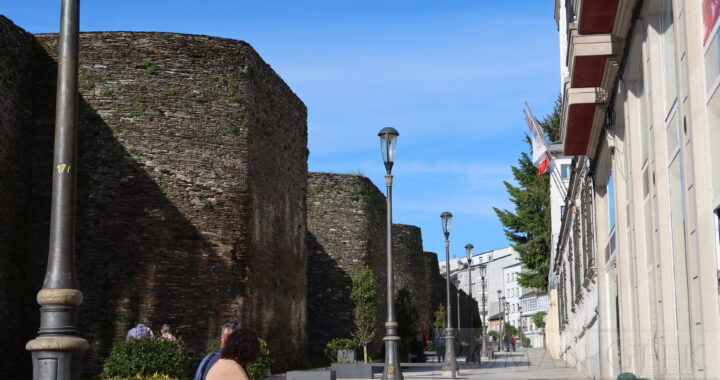
  • Lugo is a city in the Autonomous Region of Galicia in northwestern Spain. It is noted for its intact circuit of Roman Walls with 71 Towers and 10 Gates. It is a UNESCO World Heritage Site.
  • It was founded by the Romans as Lucus Augusti in 13 BCE and was in the Province of Hispania Tarraconensis.

Roman Sites

  • City Walls
    • Lugo is the only city to still have its circuit of Roman Walls intact. The walls are up to 49 feet (15m) high in places.
  • Roman Bridge
    • over the river Minho.

Museums

  • Provincial Museum of Lugo
    • Located at Pl. de la Soledad, Lugo.
    • The museum holds the Archeology and Finds from the Roman period.
  • Interactive Museum of the History of Lugo
    • Located at Parque da Milagrosa, Av. Infanta Elena, Lugo.
    • The museum uses images and films to display the history of Lugo.

Roman Roads


Roman Walls of Lugo

St. Georges Channel

  • The St. Georges Channel connects the Irish Sea with the Celtic Sea.
  • It is defined as the narrowest point between Carnsore Point in Ireland and St. David’s Head in Wales.

North Channel

  • The North Channel, also known as the Straits of Moyle or the Irish Channel, is the Channel connecting the Irish Sea with the Atlantic Ocean. It lies between Northern Ireland and Scotland.


St. Georges Channel