Andaman and Nicobar Islands

  • The Andaman and Nicobar Islands are two Island groups consisting of 572 islands, which are located in the east of the Bay of Bengal.
  • They form the western edge of the Andaman Sea with Burma, Thailand and the Malay peninsular to the east. The two island groups are separated by the Ten Degree Channel on the 10° North Parallel of Latitude.

Other Island chains


Andaman and Nicobar Islands, India

Aqua Virgo

  • The Aqua Virgo was a Roman Aqueduct built in Rome in 19 BCE.
  • It was restored to working order in 1463 and is now the Aqua Vergine.

Getting There

  • Location: Via del Nazareno, Rome.
  • Nearest Metro Station: Barberini, Line A.
  • Admission: The Aqueduct is not open to the Public but can be seen below ground through a grill.

The 11 Aqueducts of Ancient Rome

Cloaca Maxima

  • The Cloaca Maxima was the Sewer of Ancient Rome, through which all the used water from the aqueducts flowed into the River Tiber.

Sources

  • Frontinus:
    • ‘De Aquaeductu’, ‘The Aqueducts of Ancient Rome’, (c.95-99 CE).
  • Vitruvius:
    • De Architectura (c.15 BCE)  It includes a general section on Aqueducts.


Aqua Virgo

Aqua Marcia

  • The Aqua Marcia was a Roman Aqueduct completed in 140 BCE in Rome.
  • A Fountain on the Aqua Marcia still stands today.

Getting There

  • Location: Basilica of Sant’ Agnese outside the Walls, Via Nomentana, 49, Rome.
  • Nearest Metro: S. Agnese-Annibaliano, Line B.

The 11 Aqueducts of Ancient Rome

Cloaca Maxima

  • The Cloaca Maxima was the Sewer of Ancient Rome, through which all the used water from the aqueducts flowed into the River Tiber.

Sources

  • Frontinus:
    • ‘De Aquaeductu’, ‘The Aqueducts of Ancient Rome’, (c.95-99 CE).
  • Vitruvius:
    • De Architectura (c.15 BCE)  It includes a general section on Aqueducts.

Fountain of the Aqua Marcia, Rome

Zadar

Zadar, Croatia – UNESCO World Heritage Port City

Overview

Zadar is a historic port city on Croatia’s Adriatic coast in north Dalmatia. Located in the Ravni Kotari Region within the County of Zadar, it is a UNESCO World Heritage Site, recognised for its exceptionally well-preserved Venetian Defensive Walls, gates, and bastions surrounding the old town.

Originally known as Roman Ladera, Zadar became an important Roman port city in 59 BCE, serving the Province of Noricum.

Why Zadar Is a UNESCO World Heritage Site

Zadar forms part of the UNESCO-listed group “Venetian Works of Defence between the 16th and 17th Centuries”. Its fortifications demonstrate the strategic importance of the city as a maritime and military hub of the Venetian Republic on the eastern Adriatic.

Key UNESCO features include:

  • Venetian city walls
  • Historic gates
  • Defensive bastions enclosing the old town

Geographic and Historical Context

Zadar is situated on a peninsula along the Adriatic Sea and has functioned as a major port city for over two millennia.

  • Ancient name: Roman Iadera (also recorded as Ladera)
  • Roman status: Important port city from 59 BCE
  • Administrative role: Part of the Roman provincial system, connected to regional trade and governance

Early History of Zadar

Zadar was founded by the Liburnians in the 9th century BCE and first appears in written historical sources in 384 BCE under the name Ladasinoi.

In 384 BCE:

  • Zadar allied with the indigenous population of Hvar
  • The alliance opposed the Greek colony of Pharos
  • Zadar launched a major naval expedition of 300 ships and approximately 10,000 men
  • The siege of Pharos ended after intervention by a Greek fleet from Syracuse

This episode highlights Zadar’s early naval power and regional influence in the Adriatic.

Roman Zadar and the Old Town

Zadar’s modern old town stands directly atop the former Roman city. Several Roman-era structures remain visible and accessible today, reflecting the city’s importance as a regional administrative and commercial center during antiquity.

Notable Roman Sites

  • Roman Forum
  • Roman Tower
  • Roman Aqueduct

Museums in Zadar

Archaeological Museum Zadar

Located at Trg opatice Čike 1, Zadar, the Archaeological Museum Zadar holds one of Croatia’s most important collections of ancient artifacts.

The museum features material from:

It provides essential context for understanding the city’s continuous occupation and cultural development.

Link:


Roman Forum, Zadar

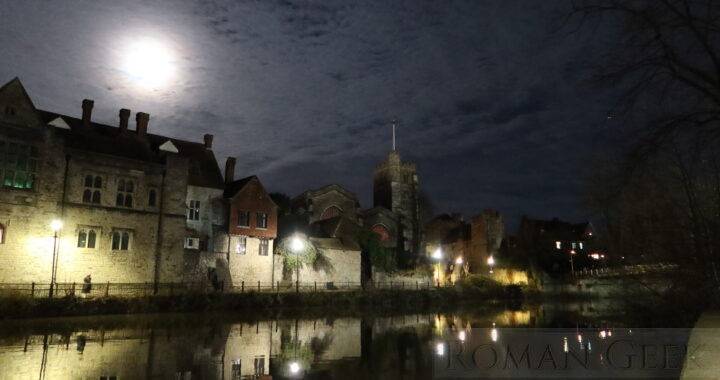
Archbishop's Palace, Maidstone

Maidstone

  • Maidstone is located where the Tidal Medway meets the River Medway, and appears to have first become a settlement after the Norman Invasion.
  • Although it was not a Roman town, the area was of great significance to the Romans due to the quarrying of Kentish Ragstone nearby at Tovil. A Roman Road ran from Rochester, through Maidstone, to Hastings.

History

  • Kentish Ragstone
  • Tidal Medway
    • Maidstone is at the point where the Tidal Medway meets the River Medway. The Medieval Archbishops Palace complex is located at this point.
    • Today the Tidal Medway meets the River Medway further downstream at Allington Lock.

Museums

  • Maidstone Museum
    • Located in St. Faith’s Street, Maidstone.
    • The museum holds examples of Roman Glassware.
  • The Carriage Museum
    • Located in the Tithe Barn of the Archbishop’s Palace (14-16th century CE)
    • The museum holds a collection of over 60 horse drawn vehicles from the Victorian period to 1945.

Roman Roads


Kentish Ragstone Quarry, Tovil, Maidstone:

Lapis Lazuli

  • Lapis Lazuli is a blue Gemstone mined since Antiquity from as early as 7,000 BCE.
  • It came from Mines in Northeastern Afghanistan, which are still the main producers today.

History

  • Lapis Lazuli beads have been found in Pakistan dating from c.6,000 BCE, in Mesopotamia dating from c.3,000 BCE, and in the Royal Tombs of Ur dating from c.2,000 BCE.
  • Lapis Lazuli was used to make amulets shaped as Scarabs in Ancient Egypt,and as Cylinder Seals in Mesopotamia.
  • Queen Cleopatra VII (51-30 BCE) used powdered Lapis Lazuli as blue eyeshadow.
  • Other sources today are Mines in the Andes in Chile, Russia, Italy, USA and Canada.


Afghanistan

Caspian Sea

  • The Caspian Sea is the world’s largest inland Sea and is fed by the River Volga and the River Ural.
  • It was known to the Greeks and Romans as the Hyrcanian Sea, and the area around modern Baku was known as Caucasian Albania, which was on the Silk Road to China.

Roman influence in Caucasian Albania

  • The Romans attempted to control the Trade Route through the Caspian Sea by making Caucasian Albania a Roman Client Kingdom. But the Parthian Empire had similar plans so that Roman influence waxed and waned over the centuries.
  • In 65 BCE Pompey arrived with an army in Caucasian Albania.
  • In 36 BCE Mark Anthony sent an Army to bring Albania back to Rome from Persian influence.
  • Between 30 BCE and 14 CE Augustus is reported to have received Ambassadors from Albania.
  • In 35 CE, King Pharasmanes was supported by Rome against Parthia.
  • In 67 CE Nero planned to conquer the northern Black Sea kingdoms but died before his plans could be put into effect.
  • 69-79 CE Vespasian again extended Roman influence as far as the Caspian Sea.
  • 114 CE Trajan invaded the region as part of his invasion of Parthia.


The Caspian Sea

Great Sphinx

  • The Great Sphinx, also known as the Great Sphinx of Giza, is the largest Sphinx in the world and is a Unesco World Heritage Site.
  • It is located to the east of the Pyramids in Giza, Egypt, and faces due East.

Description

  • The Sphinx is a mythological creature having the body of a Lion and the head of a Man.
  • Pharaoh Khafre (c. 2,558-2,532 BCE) is thought to have built the Great Sphinx around the same time as he built the second largest Pyramid, the Pyramid of Khafre.
  • The face of the Sphinx is thought to be that of Khafre, also known as Cephren, who was the son of Khufu, builder of the Great Pyramid. The head of the Sphinx wears the headdress of the Pharaoh.
  • Its Egyptian name in the Old Kingdom is unknown as no reference to it has ever been found in any inscription. However, in the New Kingdom it was known as Hor-em-akhet (Horus of the Horizon).
  • Pliny the Elder commented in his ‘Natural History’ that King Harmais was buried inside it (not under it).

The Sphinx in Mythology

  • In Greek Mythology, the Sphinx had the body of a lion, the wings of a bird, the head of a woman and a tail ending in a snake’s head. The Greek Sphinx was female, showed no mercy and was treacherous.
  • In Egyptian Mythology, the Sphinx was male, had the head of a man, and was considered to be benevolent.
  • In both Mythologies, the Sphinx had enormous strength and acted as the Guardian of Temples.

Egypt

  • In Luxor, 900 Sphinxes with Ram heads still form a 2 mile (3km) avenue.
  • The Avenue of the Sphinxes linked the Luxor Temple with The Temple of Mut at Karnak.
  • Originally, 1,350 Sphinxes lined the 3 km route, built by Nectanebo I (380-363 BCE) and his name was inscribed on each Sphinx.

Sri Lanka

  • In Southeast Asia, India, Sri Lanka and Myanmar, the Sphinx continues to exist as part of the culture, and can be found in many Temple entrances. The Sphinx is usually referred to as the ‘man-lion’.
  • In Sri Lanka, the Sphinx forms part of the Buddhist tradition, and acts as the guardian of the North.

Philippines

  • In the Philippines, the Sphinx is portrayed as half man, half eagle. It lives and defends the Bicol region, and if visitors cannot answer its riddles, they are carried off to the Mayon volcano and given to the God of the volcano as an offering.

Myanmar

  • In Myanmar, the Sphinx is shown on the corners of the Buddhist Temples known as a Stupa. In legends, it was created to protect a Royal baby from female monsters.

Thailand

  • In Thailand, the Sphinx is shown as walking upright, with the lower body of a lion or deer, and the upper body of a man.

Riddle of the Sphinx

  • In Greek Mythology, Hesiod in the Theogony, describes how Hera sent the Sphinx from Ethiopia to Thebes in Greece, who then sat on the Acropolis and brought Drought and Famine. The Sphinx would only leave if the Thebans could answer her riddle. Those who failed to answer correctly were strangled in the same way that a lion kills its prey by biting its neck and eating it.
  • The Riddle was: ‘What creature speaks with one voice, yet walks first on four legs, then two legs then three legs?’
  • Prince Oedipus gave the correct answer: ‘Man, who walks on four legs as a baby, on two legs as a man, and with a walking stick, three legs in old age’.
  • The Sphinx then destroyed herself by leaping off the Acropolis.
  • Legend tells of a second Riddle: ‘There are two sisters. The second sister is born by the first, then the first is born by the second. Who are they?’ The answer is ‘day and night’.


The Great Sphinx of Giza

Riddle of the Sphinx

  • In Greek Legend, the Sphinx was a female being who guarded the entrance to Thebes in Greece.
  • She strangled all the unfortunate souls who failed to give the correct answer to her famous Riddle.

The Sphinx

  • The Sphinx had the head of a human, the body of a lion and sometimes the wings of a bird.
  • In Greek mythology the Sphinx was a woman, and considered to be ruthless.
  • In Egyptian mythology the Sphinx was a man, and considered to be benevolent.

The Myth

  • In Greek Mythology, Hesiod in the Theogony, describes how Hera sent the Sphinx from Ethiopia to Thebes in Greece.
  • The Sphinx sat on the Acropolis, and brought Drought and Famine.
  • The Sphinx would only leave if the Thebans could answer her riddle. Those who failed to answer correctly were strangled (in the same way that a lion kills its’ prey by biting its neck and eating it).

The Riddle

  • The Riddle according to Apollodorus of Athens (born c. 180 BCE): ‘Library and Epitome’ Book 3, Chapter 5, Section 8:
    • ‘What creature speaks with one voice, yet walks first on four legs, then two legs then three legs?’.
  • Prince Oedipus, the son of the King and Queen of Thebes, gave the correct answer:
    • ‘A Man: he walks on four legs as a baby, on two legs as a man, and with a walking stick, three legs in old age’.
  • The Sphinx then destroyed herself by leaping off the Acropolis.

Oedipus

  • On his way to Thebes, Prince Oedipus got into an argument over who had the right of way with a man in a chariot. In the ensuing fight, Oedipus killed the man.
  • After the Sphinx destroyed itself, the Thebans invited Oedipus to become King, and he married the Queen.
  • What he didn’t know was that the man in the chariot was his father, and the Queen he had married was his Mother.

The Second Riddle

  • Legend tells of a second Riddle:
    • ‘There are two sisters. The second sister is born by the first, then the first is born by the second. Who are they?’
  • Answer:
    • ‘Day and night.’

Source

  • Apollodorus of Athens (born c. 180 BCE): ‘Library and Epitome’ Book 3, Chapter 5, Section 8.


Thebes, Greece

Seahorse

  • The Seahorse was known to the Romans and Greeks as the Hippocampus.
  • The word comes from the Greek ‘Hippo’ meaning ‘horse’ and ‘kampos’ meaning ‘seamonster’.

Description

  • The Seahorse is a tiny fish that has a long snout giving it a horse-like head and unlike other fish it has a snake-like tail with no fin, an exoskeleton and it can move its eyes independently, like those of a chameleon.
  • The female seahorse places its eggs in the pouch of the male, who then fertilises them and develops the babies until they are ready to leave his pouch.
  • They are to be found in Tropical and Temperate seas, such as the coral reefs of the Red Sea, the Indian Ocean, and they are also found in the Mediterranean.

Pliny the Elder

  • Pliny the Elder described the Seahorse as the ‘Hippocampus’ in his Natural History.


Red Sea