Marden Henge is the largest Neolithic Henge in the British Isles, and was built in c. 2,400 BCE. However, nothing is visible today. It is located between Avebury and Stonehenge in Wiltshire.

Marden Henge

  • Marden Henge is the largest Neolithic Henge in the British Isles, and was built in c. 2,400 BCE. However, nothing is visible today.
  • It is located between Avebury and Stonehenge in Wiltshire, England.

Description

  • The Henge
    • is an oval shaped embankment with a ditch, covering 35 hectares.
  • Hatfield Barrow
    • A large mound, called the Hatfield Barrow, existed within the Henge, but has now collapsed after early excavations in the nineteenth century.
  • Timber Circle

The Site today

  • There are no visible remains.
  • No standing stones have been left, and the Site has been ploughed under over the centuries.
  • The Site was examined through Aerial Surveys and Field Surveys.

Nearby Sites


Marden Henge, Wiltshire
Dor

  • Dor was an ancient Phoenician Port on the Levant coast, founded in c. 2000 BCE.
  • It is now an archeological site 19 miles (30km) south of Haifa in Israel.

Via Maris


Tel Dor Archeological site, Israel

Arwad

  • Arwad is the only populated Island off the coast of Syria and the town occupies the whole island. It was in the Roman Province of Syria.
  • It is located 2 miles (3 km) from the coastal town of Tartus, which is Syria’s second biggest Port.

History

  • 2nd millenium BCE:
    • Arwad was founded in the 2nd millenium BCE, as a well fortified island city off the coast of Phoenicia.
    • It was one of the three powerful Phoenician maritime cities, along with Sidon and Tyre.
    • It was known to the Greeks and Romans as Arados, near the city of Antarados (Tartus) which meant ‘opposite Arados’.
  • Navy:
    • Arwad had a powerful Phoenician navy whose ships are mentioned on Monuments in Egypt and Assyria.
    • The city dominated the area south as far as the sphere of influence of Sidon.
    • Inland, it controlled the trade with the East, along the Orontes valley.
  • 1,472 BCE
    • Arwad was occupied by the Egyptians under Thutmose III.
  • c.1,200 BCE
    • Arwad was sacked, probably by the Sea Peoples, but it recovered.
  • 332 BCE
    • Alexander the Great invaded Syria, and Arwad became an ally. Arwad sent her ships to help the Greek siege of Tyre along with the ships of Sidon who also became an ally.
  • 35 BCE
    • Arwad became a Roman city after unsuccessfully resisting a siege.


Arwad

Catacombs of Domitilla

  • The Catacombs of Domitilla are a series of tunnels in Rome containing Christian burials covering 17 hectares.
  • It was one of the Catacombs of Ancient Rome owned by Flavia Domitilla, as recorded by an inscription inside the Catacombs.

Getting There

Description

  • The galleries were dug out of the volcanic stone called ‘Tufa’ that Rome is built on.
  • There are four levels of galleries laid one above the other, running for 17 km and down to a depth of 30 m.
  • They contain Christian burials in stone Sarcophagi.
  • The Catacombs became densely occupied because Christians wanted to be buried next or near to the Martyrs.
  • Around 390 CE an underground Basilica was built in honour of St Nereus and St Achilleus.

The Tombs

  • The body was wrapped in a sheet and deposited in the Tomb.
  • The tomb was then sealed with tiles or a marble slab, which was then fixed against the wall using lime.
  • Onto the Lime or marble would be written the name of the Deceased, date of death, a brief memorial and often one of the Early Christian Symbols.


Catacombs of Domitilla

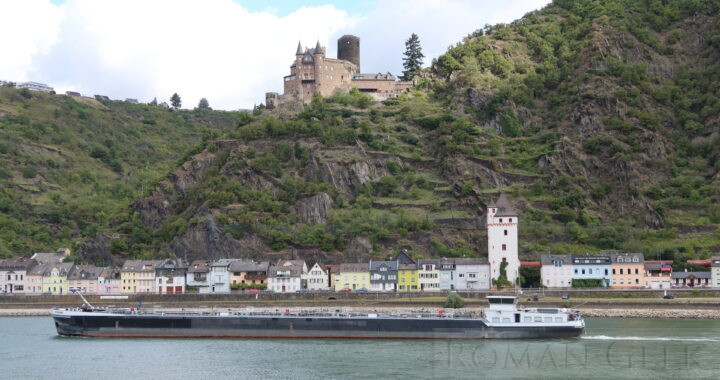
Burg Katz near Lorelei Rock

Rhine Gorge

  • The Rhine Gorge is a 40 mile (65km) section of the Rhine valley between Bingen and Koblenz in Germany.
  • There are no bridges between Mainz and Koblenz and all crossings are by ferry.

Unesco World Heritage Site

  • In 2002 the Rhine Gorge became a Unesco World Heritage Site.
  • This is because of the large number of medieval castles, villages and world famous vineyards along the valley.
  • The Gorge is part of German Folklore and provided the setting for Wagner’s Opera, Gotterdammerung.

Bingen

  • There is a rock barrier at Bingen which historically divided the Rhine into two navigable sections.
  • Until 1834, the river was unnavigable past Bingen without a pilot, and most barges transhipped their cargo by road around the reef to Lorch.
  • The Classis Germanica, the Roman Navy in Germany, operated two separate fleets on the Rhine, one based above Bingen at Mainz, and the other below Bingen at Cologne.
Drusus Bridge, Bingen

Drusus Bridge, Bingen

Lorelei

  • The Lorelei Rock on the east bank of the Rhine, is the most famous landmark on the Rhine Gorge.
  • It is a 393 ft (120m) high rock overlooking dangerous rocks and strong currents.
  • The legend of the Lorelei rock maiden is an integral part of German Folklore, Literature and Music.
Lorelei Rock, Rhine Gorge

Lorelei Rock, Rhine Gorge


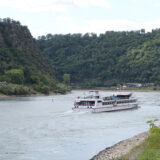
Rhine Gorge at St Goar, Germany

Salona

  • Salona is a Roman archeological Ruin which is located next to modern Solin, 3 miles (5km) northeast of Split in Croatia.
  • It became the capital of the Province of Dalmatia in 9 CE.

History

  • Salona was originally in the Roman Senatorial Province of Illyricum, formed in 27 BCE.
  • By 9 CE the Province was split into Dalmatia (the coast), and Pannonia (Inland).
  • Salona had a Mint.
  • The Via Argentaria followed a Roman Trade Route which connected the Mint in Salona via mountain Passes with the Silver Mines in the Dinaric Alps. It also connected to the Mint at Sirmium in Pannonia Inferior.
  • Diocletian (284-304 CE) was born in Salona.

Roman Sites

  • Archeological Park of Salona
    • Public Baths
    • Caesar’s Gate
    • Amphitheatre
    • Basilicas
    • City Walls (originally there were 90 towers)
    • Tusculum Museum

Museums

  • Tusculum Museum
    • Located on the Archeological Park of Salona.

Roman Roads


Salona

Periplus of the Erythraean Sea

  • The Periplus of the Erythraean Sea (Arabian Sea) is a Sea guide for sailors in the Western Indian Ocean written during the 1st century CE.
  • The document describes two sea routes from Egypt, one across to India and the other down to Africa, with all distances measured from Berenice. The Sea Distances were measured in Stadia, 625 feet or 1/8th of a Roman mile.

Description

  • The Periplus was written in the first century CE, by an unknown author who appears to have been from Alexandria, Egypt.
  • The name is derived from the Greek ‘Erythra Thalassa’, meaning Red Sea. Red is the colour which is produced by a type of bacteria in the Arabian Sea and associated Gulfs, which is visible to the eye, and can stretch in ‘blooms’ for hundreds of miles.
  • The name ‘Erythraean Sea’ was used to describe the northwest Indian Ocean, and included the Red Sea, the Gulf of Aden, and the Persian Gulf. Today, it is known as the Arabian Sea.
  • Written in Greek, the Periplus consists of 66 chapters, describing how to navigate and trade between Ports in the Red Sea, the Gulf of Aden, the Indian Ocean, India and East Africa known as Azania.
  • All distances to foreign ports are taken with Berenice as the starting point.

Manuscripts

  • A tenth century edition from Byzantium is held in the Heidelberg University Library.
  • A fifteenth century inaccurate copy of the tenth century edition is held in the British Museum.

Books by Agartharchides

  • ‘On the Erythraean Sea’
    • 5 books by Agatharchides, four books are lost, the fifth book has survived intact, describing the lands around the Red Sea and the Horn of Africa.
  • Affairs in Asia
  • Affairs in Europe

Pliny's Description of the Route to India

The Southwest Monsoon

  • The author names a first century CE Greek Navigator called ‘Hippalus’ as the discoverer of the Southwest Monsoon wind, also known as the ‘Hippalus’ in Roman spelling, and thus the direct route to India, without following the Arabian and Indian coastlines.
  • However, the Ancient Greeks already knew the Southwest Monsoon, which they spelt as ‘Hypalus’.
  • Strabo in his ‘Geography’, credits ‘Eudoxus of Cyzicus’, commissioned by Ptolemy VIII of Egypt, of first discovering the Southwest Monsoon. He travelled direct to India twice, first in 118 BCE using an Indian pilot, then again in 116 BCE unaided. Hippalus may have been his navigator.

The Route to India

The Route to Africa

  • Chapters 1-18 describe the Route from Berenice down to the East Coast of Africa, known as Azania.
  • The Periplus describes Rhapta as the last port of Azania, being two days south of the Menouthias Islands, which was most probably the Zanzibar Archipelago.
    • Berenice (The Start)
    • Adulis, and Avalites
    • Opone
      • Somalia, known as the centre of the Cinnamon trade.
    • Malao
      • Somalia.
    • Rhapta (The Terminus)
      • The capital of Azania, the area including the coasts of Tanzania, Kenya and Somalia.
      • Azania is mentioned by the Periplus as being subject to the Sabaean Kingdom, an Ally of Rome.
      • Sailing time was c. 90-140 days from Berenice.

Other Roman Documents relating to Roman Trade with India

  • Alexandrian Tariff
    • The Tetarte (quarter tax) was paid in Alexandria on Imports from the East.
    • The Alexandrian Tariff was a list of 54 Items from the East that were subject to Duty.
    • It was issued by the Roman Emperor Marcus Aurelius between c. 176-180 CE.
  • Coptos Tariff
    • This was a listing of the people and the animals that had to pay road tolls between the Nile and the Red Sea.
  • Pliny’s Description of the Route to India
  • Muziris Papyrus
    • It is a contract between a Merchant of Alexandria and an Alexandrian Financier, regarding a cargo of Pepper and Spices from Muziris.
    • The contract describes a Loan Agreement for a cargo worth approximately 9,000,000 sesterces carried from Muziris in India, on a Roman vessel called the ‘Hermapollon’.
  • Diocletian's Price List
    • Issued in 310 CE, Diocletian’s Price List was an Edict proclaiming the Maximum Prices, ‘Edictum de Pretiis Rerum Venalium’, which was designed to stop runaway inflation.
    • It is a useful tool for historians to appreciate the cost of Roman goods and services.

Links


Indian Ocean

Homs Pass

  • The Homs Pass, also known as the Homs Gap, lies in the valley of the River Orontes and carries the road from the Mediterranean sea to Homs in Syria. It is the only Pass that is open all year round to traffic.
  • There are five Crusader Castles, including the Krak des Chevaliers, built in 1031 CE to control this Pass during the First Crusade (1090-1095 CE).


Homs Pass, Syria

Bostra

History

Roman Ruins

  • The Roman city of Bosra is a major archeological site containing multiple ruins:
    • Roman Theatre, almost intact.
    • The West Gate
    • Kharaba Roman Bridge (nearby)
    • Gemarrin Roman Bridge (nearby)

Museums

  • Bosra Museum
    • It is located in the Roman Theatre of Bosra.
    • It holds a collection of artefacts excavated from Bosra including mosaics and tombstones.

Roman Roads


Bostra Roman Ruins, Bosra

Wadi Faynan

  • Wadi Faynan, also spelt Wadi Feynan or Wadi Finan, is a valley in Jordan which is associated with the Biblical Kingdom of Edom.
  • It has copper deposits which have been the site of archeological excavations showing mining activity dating as far back as 4,500 BCE.


Wadi Faynan, Jordan