Zero Meridian

Zero Meridian (Prime Meridian)

The Zero Meridian, also known as the Prime Meridian, is the zero degree of Longitude that passes through Greenwich in London.

The Roman Prime Meridian

Roman Prime Meridian

In Ptolemy's Geographia (c. 150 CE), the Roman Prime Meridian, also known as Zero Degrees Longitude, was based in the Canary Islands and centred on Mount Teide in Tenerife.

This meridian served as the reference point for longitude in the ancient Roman world long before the modern Greenwich standard was adopted.

Roman Astronomy and Ptolemy

Roman Astronomy

The greatest Roman astronomer was Ptolemy (c. 90–168 CE), who produced a revolutionary star catalogue known as the Almagest. This work predicted the position of any planet at any time of day or night on any day of the year and identified 48 Constellations.

Legacy of Ptolemy’s Astronomical System

Despite modelling the Solar System with the Earth at the centre rather than the Sun, Ptolemy’s ideas dominated astronomy for nearly 1,400 years. His geocentric system remained authoritative until 1543 CE, when Copernicus introduced the heliocentric system, fundamentally changing humanity’s understanding of the cosmos.


Greenwich Prime Meridian

Hesperides

  • The Hesperides, or ‘Ladies of the West’, were a group of islands in the Atlantic whose location is unknown but is referred to by Roman Historians.
  • Pliny the Elder stated that the time taken to sail from the Gorgades to the Hesperides was 40 days.

Possible Locations in the Atlantic

  • The Hesperides may have been further around the Cape of West Africa in the Gulf of Guinea, or across the Atlantic in the Caribbean:
  • Sao Tome and Principe
    • These islands lie in the Gulf of Guinea to the east of the Cape Verde Islands.
  • Caribbean Islands
    • These islands lie to the west of the Cape Verde Islands.

Gorgades

  • Cape Verde Islands (Gorgades)
    • Pliny the Elder also quotes the Greek Zenophon of Lampsacus sas saying that the Gorgades were two days sail from Hesperu Ceras (Cap-Vert, the most western point of Africa).
    • This would tend to identify them with the Cape Verde Islands.

Fortunate Islands

  • Known to the Romans as the ‘Insulae Canarius’, they were also thought to be the ‘Fortunate Islands‘ or ‘Islands of the Blessed’ in Greek Mythology.
  • During 1 BCE Augustus planned a circumnavigation of Africa from Egypt to Mogador, but it was not undertaken.
  • According to Pliny the Elder, ten years later in 10 CE during the reign of Augustus, a Roman Expedition from Mogador in Morocco, explored the Canary Islands, Madeira and possibly the Cape Verde Islands.
  • Pliny the Elder wrote that they found no people only dogs. ‘Canarius’ is dog in Latin, and so he called them the ‘Insulae Canarius’.
  • Ptolemy used Mount Teide, in the Canary Islands as the Roman Prime Meridian or Zero Meridian of the Roman World Chart in c. 150 CE.


Sao Tome and Principe


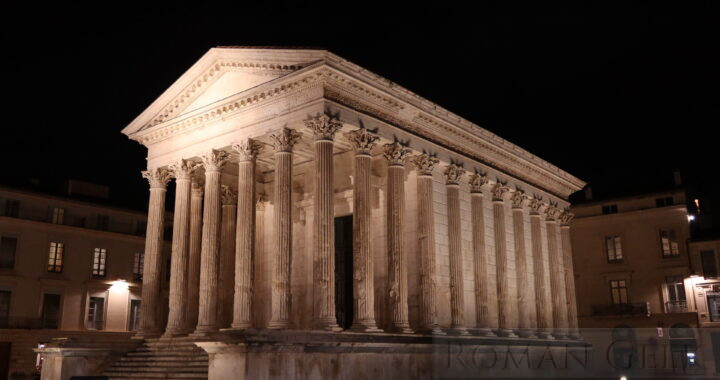
La Maison Carre, Nimes

La Maison Carre

  • La Maison Carre is a perfectly preserved Roman Temple located in Nimes, France, built in c. 20 BCE by Agrippa.
  • It is one of the few Roman Temples located in the Roman Empire to have survived intact and has been the inspiration for several Neoclassical buildings.

L'Eglise de la Madeleine

  • The Church of Saint Mary Magdalene, also known as La Madeleine, is a Catholic Church located at the far end of Rue Royale opposite La Concorde in Paris.
  • It was commissioned in 1806 CE by Napoleon Bonaparte and was designed by Pierre Alexandre Vignon in the Neo-Classical Style based on La Maison Carre in Nimes. Vignon died in 1828 and was succeeded by Jacques-Marie Huve who completed the project.

Virginia State Capitol

  • The Virginia State Capitol in Richmond, USA, is the seat of state government of the Commonwealth of Virginia. It houses the oldest elected legislative body in North America, the Virginia General Assembly, first established in 1619.
  • Completed in 1788, the design of the present Capitol building was developed by Thomas Jefferson and the French architect Charles-Louis Clerisseau who based it on the Maison Carre in Nimes. The building served as the Confederate States Capitol during the American Civil War (1861-1865).


Photo and map: Maison Carre, Nimes

Sargasso Sea

  • The Sargasso Sea is a Gyre in the North Atlantic, permanently rotating in the same area.
  • It is bordered by the Gulf Stream, the North Atlantic Current, the Canary Current and the North Atlantic Equatorial Current.

Etymology

  • The name ‘Sargasso’ is derived from Sargassum, the seaweed that floats in great quantities in this Sea.

Ancient Sources

  • As early as the fifth century BCE, the Periplus of Himilco the Carthaginian, described part of the Atlantic as being covered in seaweed. It was referred to by Avienus writing in the fourth century CE.
  • In 1492 CE Christopher Columbus crossed the Sargasso Sea and commented on the large quantities of seaweed in it.

Eels

  • Aristotle (c.384-322 BCE) was the first to write about eels and guessed that they were born from the earth and not the sea.
  • The origin of Eels was a mystery in the Ancient World because nobody could ever found young eels.
  • It wasn’t until the twentieth century that the search was narrowed down to the Sargasso Sea.
  • Atlantic Eels only reproduce in the salt water of the Sargasso sea.  The young then migrate to coastlines carried by the Currents, where they collect in a mass and climb into fresh water streams and rivers. They live there for years, before eventually returning as mature adults to spawn in the Sargasso Sea.
  • Pacific Eels have similar eel spawning grounds in the Pacific Ocean near the Mariana Islands for the Japanese Eel.
  • Southern African Eels have spawning grounds in the Indian Ocean north of Madagascar.

Bermuda

  • The Island of Bermuda lies on the western fringe of the Sargasso Sea.


Bermuda

Tower of Winds

  • The Tower of Winds (or Horologium) is an octagonal tower in the Roman Agora of Athens that was built by Andronicus of Cyrrhus in c.50 BCE as a weather station.
  • It was an Anaphoric Clock that featured a Sun Dial, Water Clock and Wind Vane which pointed to eight named winds and acted like a modern weather station.

The Monument Today

  • The octagonal Tower of Winds is still standing intact and located in the Roman Forum of Athens at Aiolou.

The Eight Winds of Eratosthenes

  • The Tower was built on Eratosthenes system of eight not twelve winds.
  • The Eight Winds on the Tower were:
    • N Boreas (not Aparctius)
    • NE Caecias
    • E Apeliotes
    • SE Eurus
    • S Notus
    • SW Lips
    • W Zephyrus
    • NW Sciron (not Argestes)
  • Boreas (not Aparctias, N), Caecias (SE), Apeliotes (E), Eurus (SE), Notos (S), Lips (SW), Zephyrus (W) and Sciron (NW, variant of Argestes).

Vitruvius

  • Vitruvius (c.88-c.26 BCE) describes an Anaphoric Clock located in Alexandria in his ‘Architectura’, Book IX, Chap.8. 8-15.
    • It was probably a waterclock, identical or certainly very similar to the Tower of Winds in Athens.
    • The clock had a rotating field of stars behind a wire frame which indicated the time of day.
    • The wire frame and star map were constructed using Stereographic Projection.
    • Other examples have been found in the Roman Empire dating to the first to third century CE.


The Tower of Winds, Athens

Ugarit

  • Ugarit was a Port of Phoenicia on the Levant coast in northern Syria. It’s first Wall dates back to 6,000 BCE.
  • The city reached its greatest period of influence between 1450-1200 BCE, until it was destroyed in c. 1190 BCE by the Sea Peoples.

Finds

  • The Ruins of Ugarit were rediscovered in 1928 close to the Port City of Latakia.
  • Several hundred Cuneiform clay tablets have been excavated from the Site. They are written in Sumerian, Hurrian, Akkadian and Ugaritic.


Ruins of Ugarit, Latakia:

Behistun Inscriptions

  • The Behistun Inscriptions are cuneiform inscriptions written on a rock face on Mount Behistun in Iran, and were ordered by Darius the great (522-486 BCE) to describe his achievements.
  • The inscriptions became the Rosetta Stone of Cuneiform Clay Tablets, because they were written simultaneously in Old Persian, Babylonian and Elamite text.

The Rock Relief

  • Mount Behistun is 326 miles (525km) west of Tehran.
  • The Inscription is written in Cuneiform and describes Darius and his Battles to achieve power.
  • Written in three languages, it is the first known use of the word ‘Magi’ to describe the Priests of Zoroastrianism.

Decoding Cuneiform

  • In 1835, an East India Company Army Officer, Henry Rawlinson, visited the ‘Behistun Inscriptions’ in Iran.
  • He climbed up the rock face and copied the cuneiform Old Persian Text, then compared it to Herodotus’ King List to get the symbols and names. Using a part translation of the syllables already undertaken by the German Epigraphist Georg Friedrich Grotefend, he was able by 1838 to decipher the texts for the first time in almost two thousand years.
  • He later returned and made paper-mache casts of the other inscriptions, and using the Old Persian Text was then able to decipher the Babylonian and Elamite Text..
  • Further help in the decipherment of Cuneiform came in 1842, when the city of Nineveh in Iraq was uncovered, revealing the Library of Ashurbanipal which contained tens of thousands of Cuneiform Clay Tablets.


Mount Behistun, Iran

Nineveh

  • The Ruins of the city of Nineveh are located in modern Iraq
  • It was in ancient Mesopotamia and dates back to 3,000 BCE.

History

  • Nineveh was the Capital of the Neo-Assyrian Empire (911-609 BCE), until it was sacked in 612 BCE by an Allied army dominated by the Persians.
  • Nineveh was mentioned many times in The Bible.

Ancient Sites

  • Ruins of Nineveh
    • These were uncovered in 1842, opposite Mosul on the eastern Bank of the Tigris.
  • Library of Ashurbanipal at Nineveh (c. 650 BCE)


Nineveh, Iraq


Zadar

Zadar, Croatia – UNESCO World Heritage Port City

Overview

Zadar is a historic port city on Croatia’s Adriatic coast in north Dalmatia. Located in the Ravni Kotari Region within the County of Zadar, it is a UNESCO World Heritage Site, recognised for its exceptionally well-preserved Venetian Defensive Walls, gates, and bastions surrounding the old town.

Originally known as Roman Ladera, Zadar became an important Roman port city in 59 BCE, serving the Province of Noricum.

Why Zadar Is a UNESCO World Heritage Site

Zadar forms part of the UNESCO-listed group “Venetian Works of Defence between the 16th and 17th Centuries”. Its fortifications demonstrate the strategic importance of the city as a maritime and military hub of the Venetian Republic on the eastern Adriatic.

Key UNESCO features include:

  • Venetian city walls
  • Historic gates
  • Defensive bastions enclosing the old town

Geographic and Historical Context

Zadar is situated on a peninsula along the Adriatic Sea and has functioned as a major port city for over two millennia.

  • Ancient name: Roman Iadera (also recorded as Ladera)
  • Roman status: Important port city from 59 BCE
  • Administrative role: Part of the Roman provincial system, connected to regional trade and governance

Early History of Zadar

Zadar was founded by the Liburnians in the 9th century BCE and first appears in written historical sources in 384 BCE under the name Ladasinoi.

In 384 BCE:

  • Zadar allied with the indigenous population of Hvar
  • The alliance opposed the Greek colony of Pharos
  • Zadar launched a major naval expedition of 300 ships and approximately 10,000 men
  • The siege of Pharos ended after intervention by a Greek fleet from Syracuse

This episode highlights Zadar’s early naval power and regional influence in the Adriatic.

Roman Zadar and the Old Town

Zadar’s modern old town stands directly atop the former Roman city. Several Roman-era structures remain visible and accessible today, reflecting the city’s importance as a regional administrative and commercial center during antiquity.

Notable Roman Sites

  • Roman Forum
  • Roman Tower
  • Roman Aqueduct

Museums in Zadar

Archaeological Museum Zadar

Located at Trg opatice Čike 1, Zadar, the Archaeological Museum Zadar holds one of Croatia’s most important collections of ancient artifacts.

The museum features material from:

It provides essential context for understanding the city’s continuous occupation and cultural development.

Link:


Roman Forum, Zadar

Laccadives, Maldives and Chagos Islands

  • The Laccadives, Maldives and Chagos Islands are located in the Indian Ocean to the southwest of India and Sri Lanka.
  • Sri Lanka was known to the Romans as Taprobane and these islands as the ‘Twelve Thousand Islands’.

Sources

  1. According to Pliny the Elder (23-79 CE), the inhabitants did not use the stars when navigating to them.
  2. They are mentioned in the first century CE document, the Periplus of the Erythraen Sea.

Laccadives

  • The Laccadives are called the ‘Lakshadweep’ which means ‘one hundred thousand islands’ in Sanskrit, Hindi and Tamil. The most southerly island is Minicoy.

Maldives

  • The Maldives are separated from the Laccadives by the Eight Degree Channel on the 8 degree N Parallel of Latitude, which is south of Minicoy. North of Minicoy lies the Nine Degree Channel.

Chagos

  • The Chagos islands consist of 60 islands, and are situated 310 miles (500km) south of the Maldives, on the Chagos-Laccadive Ridge.

The Andaman and Nicobar Islands

  • These consist of 572 islands and are located in the east of the Bay of Bengal. They form the western edge of the Andaman Sea with Burma, Thailand and the Malay peninsular to the east.
  • The two island groups are separated by the Ten Degree Channel on the 10 degree North Parallel of Latitude.