Camel

  • The Camel is an ungulate which stores food as fat in humps on its back.
  • It is known as the ‘Ship of the Desert’. For millennia, the only method of moving through the Sahara desert or across the Arabian Desert was by Camel Caravans.

The Unique Abilities of the Camel

  • Move fast and silently through waist high sand. Its feet are pads which act like snowshoes on the sand.
  • Travel for three days without water. The camel stores food as fat in its hump. The camel is a ruminant and after swallowing its food which goes to the first stomach, it later returns to the mouth to be chewed as cud, like a cow.
  • Travel up to 25 miles (40km) per day walking at 3 mph (5kmh).
  • Speed and durability, it can gallop or ‘pace’ (similar to a horse trotting).
  • Kneel down and lie on its stomach, making it easier to mount.
  • Carry goods and supplies up to 250 kgs.
  • Survive Sandstorms: The camel can adjust its body temperature by six degrees Celsius either way. It has two sets of eyelashes to protect its eyes, and can close its slitted nostrils. It’s thick leathery skin protects it from the sand, and it has a thick coat of hair protecting it from the sun.
  • It uses its hump as a store for fat, not water.

The Advantage over the Horse, Mule and Donkey

  • The camel can survive sand storms and adjust its body heat.
  • It can travel more than 25 miles (40 km) a day without water and carry 240 kg.
  • It can carry upwards of 250 kg, compared to horses, mules and donkeys who can carry 60 kgs.
  • It has a life span of 50 years, compared to a donkey (30-40 years) or a horse (25-30 years).

The Routes of the Camel Caravans

  • King's Highway
  • Incense Road
    • from the Yemen to the Levant Coast.
  • Sahara
    • along the trade routes between the Mediterranean and the Sahel African Kingdoms
    • The main routes went from the Niger Bend to Morocco and Tunisia, with other Routes to Libya and Egypt.
    • Carthage and Leptis Magna became the main Ports in the Mediterranean for the Routes from the Sahel.
  • Darb el-Arba Caravan Route
    • meaning ‘the Way of the Forty’, it took 40 days from Kobbei in Darfur, Sudan, via the Kharga Oasis and Wadi Howar in the Libyan Desert and into Egypt.
    • The Romans built a chain of mud brick Forts to protect the Route.
  • Mali to Morocco Salt Road
    • From Mali in Africa, a Medieval Salt Road from Timbuctu ran across the Sahara to Morocco until the 1950’s with hundreds of Camels in the caravan.
  • Silk Road
    • used Camel Caravans from Beijing across the Taklamakan Desert and the Gobi Desert between Northern China and Mongolia.

Roman Camel Corps


Arabian Peninsular

Thessalonica

  • Thessalonica, also known as Thessaloniki, is a Port city in the Central Macedonia Region of eastern Greece.. The Old Town, Ano Poli, is a UNESCO World Heritage Site noted for its buildings from the Byzantine Empire and the Ottoman Empire.
  • After 146 BCE it became the capital of the Roman Province of Macedonia.

History

  • In 315 BCE, Thessalonica was founded by King Cassander of Macedon who named it after his wife, Thessalonike.
  • In 146 BCE, after the Roman conquest, it became the capital of the Province Macedonia.
  • Thessalonica was an important commercial Port and city on the Via Egnatia, the Roman road between the Aegean and the Adriatic, and it was on another road that ran north into the Balkans.
  • Edict of Thessalonica (380 CE)
    • The Edict of Thessalonica banned all religions in the Roman Empire as being incompatible with Christianity which now became the State Religion.
  • Massacre of Thessalonica (390 CE)
    • The Massacre of Thessalonica occurred when 7,000 of its inhabitants were slaughtered by order of Theodosius I.
  • Byzantine Empire (395-1453 CE)
    • Thessalonica was the second most important city in the Empire after Constantinople.

Roman Sites

  • Rotunda of Galerius (305-311 CE)
    • part of the Roman Imperial Palace in Navarinou Square.
  • Roman Forum
    • The Incantadas, a Caryatid Portico of female sculpted columns supporting the portico, are in the Louvre Museum in Paris.
  • Roman Baths
  • Greek Theatre
  • Arch of Galerius (305-311 CE)
  • Ano Poli (Old Town)
  • Venizelou Metro Station
    • This is a Thessalonica Metro Station which is still under construction until 2023, which will hold an Archeological Park inside the Station.
    • It is the location of the Decumanus Maximus (main road) running along the Via Egnatia with its marble floors and columns lining the road. Rather than move the Site, the Metro was relocated underneath the road.

Museums

  • Archeological Museum of Thessaloniki
    • Located at M. Andronikou 6, GR -54621, Thessaloniki.
    • The Museum holds Artefacts from the Classical, Hellenistic and Roman Periods:
      • Statue of Harpocrates (2nd century CE)
      • Gold of Macedon (350-325 BCE)
        • Gold Diadems, gold discs and gold Medusa heads.
      • Derveni Krater (large pottery vase from the 4th century BCE)
      • Derveni Papyrus (5th century BCE)
      • Mosaics

Roman Roads


Thessalonica

Colossus of Barletta

  • The Colossus is a giant Bronze statue of an Eastern Roman Emperor, 16ft 7in tall (5.11m) located at C.so Vittorio Emanuele II, 20, in Barletta.
  • It was found washed up on the beach from a Venetian shipwreck, after the Sack of Constantinople during the Fourth Crusade (1204 CE).

Attribution


Colossus of Barletta, Barletta

Basilica Cistern

  • The Basilica Cistern is an underground cathedral-like structure in Istanbul, Turkey.
  • It is located under the Stoa Basilica, from which it derives it’s name, on the First Hill of Constantinople.

Description

  • The Basilica was completed in c. 378 CE and was supplied by the Aqueduct of Valens (373 CE).
  • It was then greatly expanded by Justinian I in c.537 CE.
  • The Cistern was the largest of all the underground cisterns in Constantinople, being approximately 450 x 210 feet (138 x 65m), with a capacity for 100,000 tons of water.
  • It has 336 marble columns (each 30 ft (9m high) arranged in 12 rows, supporting a ceiling of vaults and arches. The ceiling can be viewed in the reflection on the water. The cistern is lined by a brick wall sealed with waterproof mortar.
  • There is a stone staircase descending into the cistern consisting of 52 steps.
  • Some of the masonry appears to have been reused from other buildings, including two Medusa Heads and a column with a peacock feather design.
  • There is a Coffee Bar with tables to sit down and admire the architecture.

In Film and DVD


Basilica Cistern

Obelisk of Theodosius

History


Obelisk of Theodosius, Istanbul

Mont Cenis Pass

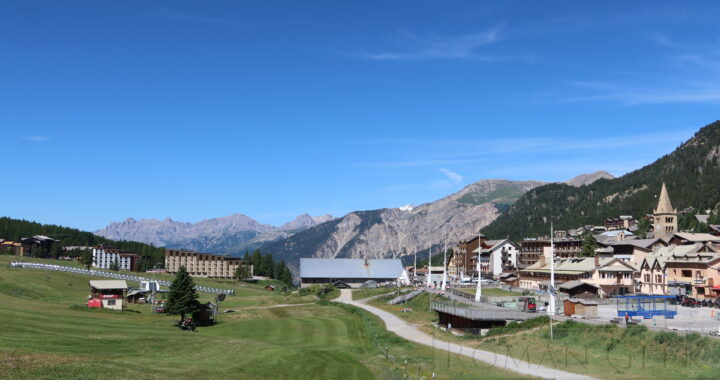
  • The Mont Cenis Pass is one of the highest mountain passes in the Alps and has an Altitude of 6,834 ft (2,083m).
  • The Pass connects Susa and Turin in Italy, with Grenoble (Cularo) and Chambery in France.

History

  • The Pass was situated in the Roman Province of Alpes Cottiae.
  • It was the route used by Constantine I to invade Italia from Gaul in 312 CE.
  • More recently in 1794, Napoleon Bonaparte used the Mont Cenis Pass to invade Italy. Napoleon built a road in 1806 and the route is now part of the Route Nationale 6.
  • In 1868, the Mont Cenis Pass Rail tunnel was opened, but closed in 1871 when it was replaced by the Frejus Rail tunnel.

Other Passes in Alpes Cottiae

  • Mont Genevre Pass
    • This was officially opened in 77 BCE.
    • It carried the Via Domitia from Gaul into Italia.
    • It was kept open for longer than other Passes as it was lower and therefore possibly the likely route taken by Hannibal in 218 BCE.
  • Maddalena Pass was in Alpes Maritimae which separated the Cottian Alps from the Maritime Alps
  • Little Mont Cenis Pass, and several others.


Mont Cenis Pass, France

Adrianople

  • Adrianople is the old name for the city of Edirne in Turkey, on the river Tunzha Tunca Nehri. It is located near the Turkish border with Greece and Bulgaria.
  • Founded as Hadrianopolis by Hadrian (117-138 CE), it was on the Via Egnatia and was in the Province of Thracia. It has been the site of many battles.

History

  • Battle of Adrianople (378 CE)
    • The Battle of Adrianople (378 CE), also known as the Battle of Hadrianopolis, occurred between the Army of the Goths under Fritigern and the army of the Eastern Roman Emperor, Valens, who was defeated.

Museums

  • Edirne Museum
    • Located at Kadir Pasa mektep sok, Edirne.
    • The museum holds Finds from all Periods including the Greco-Roman period.

Roman Roads


Adrianople (Edirne, Turkey)

Montgenevre Pass, France

Mont Genevre Pass

  • The Mont Genevre Pass is one of the lowest Passes in the Alps with an Altitude of 6,083 ft (1,854m).
  • The Pass is in France and links Susa and Turin in Italy with Briancon (Brigantium), Gap (Vapincum) and Valence (Valentia) in France (Gaul).

Via Domitia

  • The Pass carried the Via Domitia between Italy and France.
Montgenevre Pass, France

Montgenevre Pass, France

Alpes Cottiae

  • Control of the Pass was under the Procurator of the Alpes Cottiae

History

  • The Mont Genevre Pass was officially opened in 77 BCE.
  • It was in the Roman Province of Alpes Cottiae.
  • It carried the Via Domitia from Gaul into Italia.
  • The Pass was kept open for longer than other Passes as it was lower and therefore possibly the likely route taken by Hannibal in 218 BCE.

Other Passes in Alpes Cottiae


Mont Genevre Pass

Qattara Depression

  • The Qattara Depression is located in the northwest of Egypt and forms part of the Western Desert.
  • It is below sea level, with its lowest point at 436 ft (133m) below sea level.

Description

  • The Depression consists of Sand dunes, salt pans, salt marshes and dried up lake beds, covered in a thick crust with mud underneath.
  • There are lines of high cliffs and escarpments.
  • The winds are predominantly from the North.

Wildlife

  • The Qattara Depression has remote oases and acacia groves that are home to the Cheetah, who prey on the Gazelles who also live there.
  • Other animals include Egyptian Jackals, sand foxes and Barbary sheep. The extinct Sahara Oryx used to inhabit the Depression.

WW II

  • During the War, the Afrika Corps and the Long Range Desert Group operated patrols in the Depression. Due to the cliffs, salt marshes and fine sand, the Depression was considered unusable by tanks.

Siwa Oasis

  • The Siwa Oasis lies in a smaller Depression, which is below sea level, 12 miles (20 km) to the west of the Qattara Depression.

Jaghbub Oasis

  • The nearby Jaghbub Oasis lies in a Depression, which is below sea level, in the Eastern Libyan Desert.

In Film


Qattara Depresion, Siwa Desert, Egypt:

Battle of Frigidus

  • The Battle of the Frigidus River was between the western Roman Emperor Eugenius and the Eastern Roman Emperor Theodosius I, whose victory resulted in Theodosius ruling both halves of the Empire.
  • This was really a battle between the old Pagan Senators of Rome and the new Christian Roman Emperor.

Date and Location

  • 5-6th September 394 CE on the River Frigidus, possibly the present day river Vipava in Slovenia.

The Reason for the Battle

  • Theodosius I was also obliged to accept the settlement of the Goths south of the Danube, and use them as recruits in the Roman Army.
  • However, they acted as Foederati under their own Commanders. As their loyalty varied in battles against other Germanic invasions, this ultimately weakened the Roman Empire’s ability to defend itself.

The Commanders

The Strength of the Forces under Eugenius

  • 35-50,000 Romans
  • Losses: unknown but devastating

The Strength of the Forces under Theodosius I

  • Total: c.50,000 soldiers
  • 20-30,000 Romans
  • 20,000 Goths
  • Losses: 10,000 Goths

The Battle

  • The two armies lined up in a river valley surrounded by mountains.
  • Theodosius committed his 20,000 Goths in a frontal assault that cost him the lives of 10,000 Goths on the first day. The two sides withdrew for the night with Eugenius convinced that he had won.
  • On the second day, the two sides lined up opposite each other again. However, a strong wind, probably the Bora, blew with great intensity from behind Theodosius’ army, deflecting the arrows from Eugenius’ army and blowing dust into their eyes.
  • Eugenius’ army broke and was routed by the Theodosian army. Eugenius was executed and Arbogast committed suicide a few days later.

The Outcome

  • It was the last battle between a Pagan Emperor and a Christian Emperor.
  • The battle’s importance is rated on a par with the Battle of Milvian Bridge (312 CE) and represents the end of the influence of the Pagan Senatorial class.
  • It also is seen as having undermined the military strength of the Western Empire, accelerating its decline.


The River Vipava, Slovenia