Mount Othrys

  • Mount Othrys is a mountain in central Greece whose highest peak is 5,662 feet (1,726m). It is located in its own National Park.
  • In Greek Mythology, Mount Othrys was the home of the older generation of Greek Gods known as the Titans.


Mount Othrys, Greece

Temples of the Valley

  • The Temples of the Valley, also known as the Valley of the Temples, or in Italian, Templi dei Vallei, are seven Ancient Greek Temples built in the Doric style, located in Agrigento, Sicily. They have been a UNESCO World Heritage Site since 1977.
  • The Temples were built in a holy area on top of a hill and represent some of the greatest Doric architecture from fifth century BCE Magna Graecia.

Agrigento

  • Agrigento was the ancient Greek city of Akrigas, known as Agrigentum to the Romans.
  • The fortress city was the location of the Battle of Agrigentum in 262 BCE, during the First Punic War (264-246 BCE).

The Seven Temples

  1. Temple of Concordia
    • This is the best preserved Temple, built in c.440 BCE.
  2. Temple of Juno Lacinia
    • Built c.440 BCE.
  3. Temple of Asclepius
    • Built c.430 BCE.
  4. Temple of Heracles
    • Built circa 470-510 BCE.
  5. Temple of Vulcan Lacinia
    • Built in c.430 BCE.
  6. Temple of the Dioscuri
    • Built in c.450’s BCE.
  7. Temple of Zeus in the Olympeion Field
    • Possibly built in c.480 BCE.
    • The Tomb of Theron is in the same Temple complex.

Museums

  • Archeological Museum of Agrigento
    • Located at Contrada San Nicola. 92100 Agrigento.
    • The museum is divided into two sections and holds artefacts from the Roman and Greek period.


Valle dei Templi, Agrigento, Sicily

Xiphias

Xiphias: Habitat

  • Xiphias means Swordfish in Latin and in Ancient Greek.
  • The Swordfish lives between Latitudes 60°N to 45°S in the Tropical and Temperate waters of the Atlantic, Pacific and Indian Oceans.
  • In the North Atlantic they spawn in the Sargasso Sea.

Description

  • The females are larger than the males, and Pacific swordfish grow bigger than their Atlantic and Mediterranean cousins.
  • Maturity is reached by five years of age, and their lifespan is around nine years old.

Hunting Technique

  • It is the fastest fish, relying on speed and agility to hunt its prey.
  • Swordfish use their nose (sword) to slash at their prey and inflict injury, rather than skewer it, as is generally believed.
  • They swim alone, not in schools.


Indian Ocean

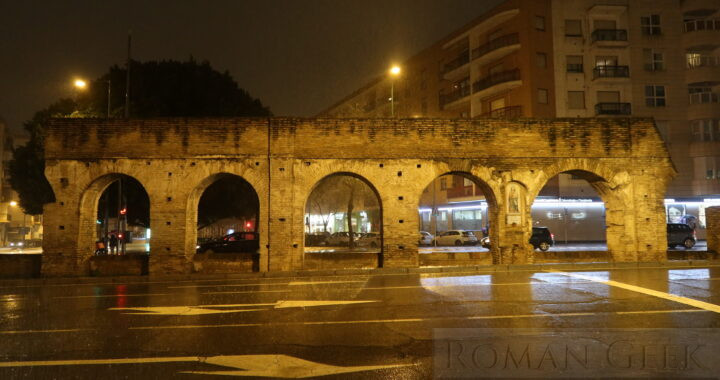
The Roman Aqueduct at Seville brought water from 11 miles (18km) away.

Hispalis

  • Hispalis was the Roman city which is now Seville in Spain.
  • Along with the nearby Roman towns of Italica and Carmona, they were all in the Roman Province of Baetica, conquered in 197 BCE.

History

  • Seville was known to the Romans as Hispalis and was in the Province of Baetica.
  • Hispalis was an important Roman port city on the river Guadalquiver, along which Goods such as Olive Oil were exported to Rome.
  • It was also on the Via Augusta, the strategic Roman Road which ran from Cadiz to Gaul.
  • Nearby were two Roman towns, Carmona and Italica, where the Emperors Trajan and Hadrian were born.
  • Hispalis grew in importance in the 2nd century CE, after the River Guadalquivir changed its course away from Italica.

Roman Sites

  • Aqueduct ‘Canos de Carmona’
    • Four arches remain from the 1st century BCE aqueduct.
  • Columns of a Roman Temple (possibly dedicated to Hercules)
    • Three 30 feet high (9m) granite columns in Marmoles Street.
  • Roman Columns
    • Located in La Alameda de Hercules, a garden square.
    • Two Roman columns were moved from the Marmoles street Roman Temple, and are topped by modern statues of Julius Caesar and Hercules.
  • Roman Walls
    • reconstructed under the Moors.

Museums

  • Archeological Museum of Seville
    • Located in Plaza de America, Seville.
    • The museum holds the Finds from the Roman Ruins of Italica.
  • Antiquarium
    • An Archeological Museum located in the basement of a structure known as the Metropol Parasol, in the Plaza de la Encarnacion, Seville.
    • It holds Roman Mosaics from: the House of the Nymph, the House of Bacchus, the 10 foot (3m) Mural of the Ocean Courtyard, House of the Column (Medusa and jellyfish mosaic), House of the Bases, the House of Sigma, the House of the Ferris Wheel and the Hospitium of the Dolphins.

Roman Roads

Nearby Sites

  • Italica
    • Located at Santiponce, 7 miles (11km) to the north of Seville.
  • Carmona
    • Located 20 miles (33km) northeast of Seville in Andalucia, Spain.


Archeological Museum of Seville

Battle of Marathon

  • The Battle of Marathon in 490 BCE was a Greek victory by the allied armies of Athens and Platea over the Persian Army. Their success was due to the use of the Hoplite Phalanx despite the Greeks being outnumbered by 10 to 1.
  • It was a turning point in Greek History and in Western Civilisation as the Greeks realised for the first time that the Persians could be beaten.

Prelude

  • Darius sent Ambassadors in 491 BCE.
  • In 491 BCE Darius sent ambassadors to every Greek City demanding submission to Persia.
  • Based on the Persian success in Thrace and Macedon, they all complied, except for Athens and Sparta, who executed the Persian ambassadors.
  • The Persian Fleet takes the Cyclades in 490 BCE
  • In 490 BCE, a Persian fleet arrived in the Cyclades under the Persian Commanders, Datis and Artaphernes. Starting with Naxos, the fleet then proceeded to occupy the entire group of islands, absorbing them into the Persian Empire.
  • After this the Persian Fleet arrived at Eretria where they enslaved the population and burnt the city to the ground.
  • The fleet then arrived off Marathon, intending to besiege and raze Athens.

Battle of Marathon

  • A small army left Athens and was joined by the Plataeans, but the Spartans declined to fight with them until they had finished celebrating a religious festival.

The size of the Forces at Marathon:

    • Persia:
      • 600 Triremes and between 100,000 to 200,000 men according to Herodotus.
    • Greeks:
      • 9,000 Athenians and 1,000 Plataeans. Plutarch.

General Miltiades Strategy

  • The Athenian army arrived in the Plain of Marathon and proceeded to close the land exits to prevent escape or encirclement.
  • Miltiades then selected a marshy battleground that the Persian Cavalry would be unable to operate in.

The Battle

  • Miltiades proceeded with a frontal attack which had the effect of enticing the Persian Infantry-Bowmen to move forward.
  • As they advanced the Greek soldiers on the flanks started to close in around them in an unplanned pincer movement.
  • With no Persian cavalry to defend the infantry-bowmen, the enclosing flanks cut down their ranks, and the survivors were massacred as they tried to escape back to their boats.

Athenian victory

  • The result was an Athenian triumph, however, the Persian Fleet set sail with the survivors, intending to attack Athens, which had no army to defend it.
  • Miltiades understood the threat, and quickly withdrew his army from Marathon and raced back in time to prevent the Persians from disembarking.
  • The Persian fleet gave up and sailed back to Asia Minor, ending the first Persian Invasion of Greece.

Conclusion

  • The Persian navy still retained control of the Cyclades.
    However, the Persians were unable to return due to a major rebellion in Egypt
  • The Battle of Marathon was a turning point in Greek History, and in Western History.
  • The Athenians realised for the first time that they did not need the Spartans to win in battle.
  • Marathon generated a belief amongst all Greeks that the Persians could be beaten.

The rise of the Hoplite Phalanx

  • It was the first time the Hoplite Phalanx formation was seen to be devastating.
  • Although vulnerable to cavalry, the Hoplight Phalanx became the dominant force in Greek Warfare during the Greek Classical Period.
  • The Hoplight Phalanx went on delay the Persians at Thermopylae 480 BCE, and defeat them completely at Plataea 479 BCE.


Trophy of the Battle of Marathon

Thermopylae

  • The Battle of Thermopylae took place in August-September of 480 BCE and is one of the most famous Battles in western history because of the heroic Last Stand of a handful of men.
  • Although the Battle was lost by the Spartans, Thermopylae was the first heroic Last Stand in history. For this reason, Thermopylae has come to symbolise the self sacrifice of a few for the greater good of many.

The Persian Strategy

  • In 492 BCE, an earlier Persian force had attacked Greece based on overwhelming numbers, but was defeated at the Battle of Marathon in 490 BC, and the Persians were forced to withdraw.
  • In 480 BCE, determined to defeat the Greeks, King Xerxes returned to invade Greece again, with an even bigger Persian army and navy, outnumbering the Greeks by over 10 to 1.
  • To enter Greece, Xerxes built a pontoon bridge across the Hellespont consisting of ships cabled together, and marched his army across from Asia Minor. His fleet closely followed the army.

The Greek Strategy

  • The strategy of the Athenian General Themistocles, was to block this invading Persian Army at the Pass of Thermopylae, and block the Persian Navy in the Straits of Artemisium. This would prevent the Persian army and navy from invading Greece and the Peloponnese.

Size of the Forces at Thermopylae

  • Persian Force:
    • The size of the Persian Force is considered to have been between 100,000 to 150,000 men.
  • Greek Force:
    • The size of the Greek Forces at Thermopylae was 7,000.

The Battle of Thermopylae

  • The Battle lasted for seven days. The Greeks were outnumbered by more than 10 to 1.
  • After three days of battle, the Greek General Leonidas, became aware that the Persian army had found a secret path and was threatening to encircle his defending army.

Last Stand of the Spartans

  • Leonidas sent most of the Greek army south and remained to defend the Pass to the death with 300 Spartans, 700 Thespians and 400 Thebans.
  • They held off the Persians for two days before being annihilated to the last man.
  • However, despite losing the battle, the delay gave the Greeks time to withdraw and regroup at Salamis.

The Battle of Artemisium

  • The Greek navy was outnumbered at Artemisium and despite the Persian navy losing considerable part of its fleet in storms, the Greeks could not hold the Straits and had to withdraw.

The Persians occupy Greece

  • After winning the Battles of Thermopylae and Artemisium, the Persian army occupied Greece and Athens, and Xerxes I appeared to have become victorious.
  • However, he needed to occupy the Pelopponese in order to complete his conquest. To succeed, he had to defeat the Greek navy based at Salamis.

Battle of Salamis

  • Themistocles, having realised that the Pass at Thermopylae was about to be lost, withdrew the army to the Peloponnese, and the fleet from Artemisium to Salamis.
  • The size of the Persian Fleet did not help the Persians in the narrow strait, and after 200 Persian triremes had been lost, the Persian fleet withdrew and was routed.

The Battle of Plataea and Mycale

  • Xerxes then withdrew the majority of the Persian army from Greece leaving an army of occupation in a fortified base at Plataea. The following year an overwhelming force of Greek soldiers left the Peloponnese and after 11 days routed the Persian army at the Battle of Plataea in 579 BCE. At the same time the remnant of the Persian Navy was routed at the Battle of Mycale.

Conclusion

  • Themistocles’ initial strategy of defence of the Thermopylae Pass and Strait of Artemisium had to be changed after these were lost.
  • However, the heroic last stand at Thermopylae gave the Greeks enough time to fall back and regroup to fight again at Salamis.
  • Thermopylae has come to symbolise a small force heroically sacrificing themselves in a last stand against an overwhelming force, for the greater good.
  • After this the Persians never invaded Greece again. Instead, it was to be the Greeks who later invaded Persia under Alexander the Great.


Pass of Thermopylae


Fall of Troy

Homer’s Iliad and Odyssey

  • The Iliad covers the Fall of Troy (dated by Eratosthenes to 1184 BCE), in the final few weeks of the ten year Siege of Troy.
  • The Odyssey describes the ten year Journey of Odysseus (Ulysses, in Roman mythology) to return to his home at Ithaca after the Fall of Troy.

Eratosthenes

  • Eratosthenes was the chief librarian at the Great Library of Alexandria. He dated the Fall of Troy between 1194-1184 BCE.
  • The Ancient Greeks and Romans believed the War against Troy to have been a real historical event.

Lost Tomb of Achilles

  • After Paris killed Achilles in Troy, his body was taken away, but accounts vary of where he was buried.
  • The Emperor Caracalla (211-217 CE) is reported to have visited the Tomb in 216 CE on his way to Parthia.

Roman Grand Tour

  • The Roman Grand Tour included a visit to Troy, followed by a visit to the Grave of Achilles.

Heinrich Schliemann

  • The Iliad was considered to be a Myth until the German pioneer of Archeology, Heinrich Schliemann, excavated the Ruins of Troy in May 1873.
  • He discovered the treasures of the ancient city buried under a hill at the village of Hisarlik. The village is 18 miles (30 km) southwest of the modern city of Canakkale.

Ruins of Troy

Storax

  • Storax is a resin that oozes from the bark of the Styracacaea family of shrub, tree and plant which grows predominantly in Asia Minor (Turkey). The tree is also known as the Turkish Sweetgum or Oriental Sweetgum.
  • It was widely used in the ancient world as an ingredient in Perfume and in Medicine.

Ancient Sources

Roman Perfume

  • Roman Perfume was widely used by the Ancient Egyptians, the Ancient Greeks and across the Roman Empire.
  • Aphrodite, the Goddess of Love, was associated with Perfume.
  • The Temples used large quantities of perfume as Incense and often had perfume workshops nearby.
  • The Romans used Perfumes in their Bathhouses.
  • Perfume was also worn by Royal Families, the Aristocracy and by Politicians.
  • Perfumes were used in Medicine.


Mugla Province

Djerba

  • Djerba is an island in the Bay of Syrtis Minor off the coast of Libya.
  • It was Roman Girba located in the Province of Tripolitana.

History

  • Pliny the Elder stated that the town of Meninx on the south east coast, was the second greatest producer of the purple dye Murex, after Tyre.
  • Djerba has the oldest known continuous Jewish population dating back 2,500 years. They date their arrival from the Destruction of the First Temple of Solomon in 586 BCE by Nebuchadnezzar II.


Djerba