Battle of Mons Graupius

  • The Battle of Mons Graupius (83 CE) took place during the Roman invasion of Scotland.
  • It was fought between the Caledonian Confederacy led by Calgacus, and the Roman Legions led by the Governor of Britannia, Agricola.

Description

  • The location is unknown, but may have been Inverurie, Aberdeenshire.
  • Prior to the Battle, Tacitus recorded a moving speech made by Calgacus to his armies in which he exhorted them to fight the invader.
  • The speech is famous for using the phrase where Calgacus described the Roman Empire as They make a desert and call it peace'.
  • The Battle resulted in a Roman Victory over the Caledonii.
  • Tacitus wrote in his Work, ‘Agricola’, that up to 10,000 Caledonian tribesmen were killed, but at least 20,000 escaped to fight in later battles.

Inchtuthil Legionary Fortress (82-87 CE)

  • Inchtuthil Legionary Fortress is located near Perth and was built for the Campaign between 82-83 CE by the Legio XX Valeria Victrix, and the Legio II Adiutrix, who stayed at the Fortress until 86-7 CE.
  • It was part of Gnaeus Julius Agricola‘s invasion of the Scottish Highlands in 82-83 CE.
  • The Legions here would almost certainly have fought at the Battle of Mons Graupius.

Sources


Inverurie

Lorch

  • Lorch, possibly known as Lauriacum, was a Roman Fort established between 138-161 CE under Antonius Pius (138-161 CE), as part of the Limes Germanicus.
  • It lay on the road between Augsburg and Mainz.

Roman Sites

  • Replica Wooden Roman Watchtower
    • This has been constructed next to the Lorch monastery buildings.

Roman Roads


Lorch

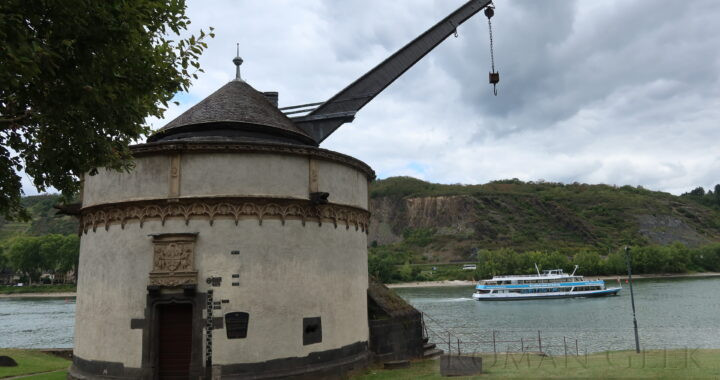
Andernach Medieval Treadwheel Crane

Andernach

  • Andernach is a town located on the left bank of the Rhine near the mouth of the river Nette in the State of Rhineland-Palatinate in Germany. It is 13 miles (21km) north of Koblenz and one of the oldest towns in Germany.
  • It was founded by the Romans in 12 BCE as Antunnacum in the Province of Germania Superior and marks the beginning of the Rhine Gorge.

Medieval Treadwheel Crane

  • A rare 16th century CE medieval treadwheel crane is located by the riverside.
  • The Crane was rotated by 2-4 men pushing a horizontal bar.
  • And the loads were lifted and lowered by 4 men operating twin treadwheels with a diameter of 14ft (4.3m).
  • Treadwheels were widely used during the Roman Period and their use continued into the Medieval Period.


Andernach Alter Krahnen

Sidon

  • Sidon is an ancient port city located on the river Sayniq 25 miles (40km) south of Beirut. It is the third largest city in Lebanon.
  • During the Roman period it was known as Colonia Aurelia Pia Sidon.

History

Phoenician Sites

  • Temple of Eshmun
    • The Ruins are located 1.4 miles (2km) to the north of Sidon on the river Awali.
    • The Temple was dedicated to Eshmun, the Phoenician God of Healing.


Sidon, Lebanon

Newgrange

 History

  • It is older than Stonehenge and the Great Pyramid of Giza.
  • Newgrange is aligned with the Winter Solstice and acted as an Astronomical Device.
  • The Sun enters the inner chamber for a total of 5 days, but it only penetrates and illuminates a rock carved with the Triple Spiral for 17 minutes on December 21st.
  • Newgrange and burials on the Island of Lambay have produced various roman artifacts including roman coins.
  • Knowth Tomb, nearby, is aligned East-West, and contains 200 stones with carved artwork. It has one third of all known Megalithic Art in Western Europe.

Similar Monuments


Newgrange, Ireland:

Great Pyramid

Location

  • The Great Pyramid is located near Cairo in Egypt.
  • It is at Latitude (North) 29 degrees, 58 minutes, 50 seconds and Longitude (East) 31 degrees, 09 minutes, 0 seconds.
  • The Boundary between Lower Egypt and Upper Egypt is nearby at 30 degrees North.

Description

  • It is the oldest of the Seven Wonders of the Ancient World, and the oldest of the 80 Pyramids in Egypt.
  • The Great Pyramid is one of a group of three Pyramids, the others are the Pyramid of Cephren and the Pyramid of Menkaure. A fourth pyramid, the Pyramid of Djedfre, was found to have been dismantled by the Romans.
  • The Great Pyramid is in a complex along with three small Pyramids built for Khufu’s three wives.
  • The Great Sphinx of Giza lies in front of the Great Pyramid to the east.
  • Nearby, there are also six boat shaped pits, one of which contained a dismantled vessel which has since been reconstructed in its own museum.
  • In 820 CE, a tunnel was bored to create an entrance to the Great Pyramid.
  • In 1798 CE, Napoleon visited the Great Pyramid, and brought a team of 175 French Egyptologists to measure and document all the monuments.

Construction

  • At 481.4 feet (146 m) high, it was the tallest Monument in the Ancient World until the spire of Lincoln Cathedral was completed in 1311 CE.
  • It was constructed using an estimated 2,300,000 million stone blocks weighing around 2.5 tons, and cut from a quarry nearby. These were assembled in 201 stepped layers which were covered with an outer casing of polished limestone blocks.
  • It is the only Pyramid where the four cornerstones have a ball and socket construction to anchor the structure in place.
  • Each side has a slope angle of 52 degrees, 50 minutes.
  • Each side is slightly indented, seen and photographed for the first time from the air in 1940, giving it an octagonal shape.
  • Access was by a doorway above the base of the north face, with a passageway leading down towards the centre before rising towards two inner chambers.
  • The two chambers are called the King’s Gallery and the Queen’s Gallery. They both have what appear to be airshafts leading up to the outer casing.
  • The King’s Chamber was built using 50 ton blocks of red granite from Aswan, 600 miles up river.

The Pharaoh burials in the Pyramids

  • Herodotus visited the Pyramids in 443 BCE and reported the stories of the Egyptian High Priest.
  • Herodotus wrote that the Great Pyramid was built by Cheops, the second Pyramid by his brother Cephren, and the third Pyramid by Cheops’s son, Mycerinus (Menkaure). He thought they were built as Tombs for these Pharaohs.
  • Diodorus Siculus states that the Pharaohs were buried in a secret place, and not in the Pyramids.
  • Pliny the Elder states that the complex of all three Pyramids was built in 63 years and 4 months.
  • No bodies have been found in the Great Pyramid of Cheops or the Pyramid of Cephren. This does not exclude the possibility that they were removed at some earlier period in history.
  • Richard William Howard Vyse visited Egypt in 1835 CE, and found the Sarcophagus and body of Mycerinus, but it had been hidden in a secret recess. He thought the other two Pyramids still held the Sarcophagii of their Pharaohs, but that these were too well hidden to ever be found.

The Entrance

  • Strabo (c.24 CE) also describes the Great Pyramid, and says that a passageway into the Pyramid existed. It was accessible only by moving a stone which swiveled outwards, which he describes as being in the south side of the Pyramid, although it is actually in the north side. He points out that this doorway was kept a secret in his lifetime. It could not be detected from the outside.
  • Today, visitors enter the Great Pyramid through a tunnel dug in 820 CE by the Arab Caliph Abdullah Al Mamun, located in the north face, 35 feet underneath the original hidden doorway. The Caliph’s men then found the original doorway consisting of a perfectly balanced swivelling block weighing 20 tons, that could be pushed open by hand, but only from the inside. It was invisible from the outside, with no gaps.
  • The original entrance can now be clearly seen under a triangular archway. A hieroglyph is inscribed inside the triangle. The entrance is 59 feet (18m) above ground level, and is linked to a downwards sloping passageway.

Astronomical Observatory

  • The Great Pyramid is astronomically aligned. The three Pyramids at Giza appear to be in an identical position to the three stars in Orion’s Belt.
  • The sides of the Great Pyramid are exactly aligned with the Cardinal Points, North, East, South and West.
  • The capstone would have acted as a pointer, so that the shadow to the north marked the Solstices and the Equinoxes, making it the world’s largest sundial.
  • The Descending Passage was aligned to Alpha Draconis, the Pole star in c.2,150 BCE.
  • Proclus (412-485 CE) wrote that the Great Pyramid was used as an astronomical observatory.
  • In 1637 CE, the Oxford Astronomer John Greaves, visited the Great Pyramid and discovered the ‘Well Shaft’. In 1646 CE he published the first ever analysis of the Great Pyramid in his Work, ‘A description of the Pyramids of Egypt’.
  • In 1798 CE, Napoleon invaded Egypt and he brought with him 175 expert Egyptologists known as ‘Savants’. Their task was to survey and document all the Monuments of Ancient Egypt. Their findings were published over a 25 year period, in 9 volumes with 12 volumes of plates.

The missing Pyramidion

  • All the Pyramids have a capstone, a Pyramidion.
  • The Apex stone on the Great Pyramid is missing, therefore it is possible to walk around the flat top.
  • Diodorus Siculus (60 BCE) describes the Great Pyramid as without a capstone, so it was already missing during the Roman era.
  • Some sources say it may never have had a capstone, and others that it may have been constructed in black onyx or in gold.
  • The capstones of the other Pyramids are of polished limestone, and consist of four equilateral triangles.

The Outer Casing

  • The four sides of the Great Pyramid were highly polished enabling it to reflect the sunlight. It seems also to have been painted red and carried hieroglyphic inscriptions.
  • The smooth polished limestone blocks from the outer casing have all been removed and re-used in buildings in Cairo. At the same time the top 30 feet of stone layers were removed, during an abortive attempt to dismantle the Great Pyramid.
  • Diodorus Siculus says that there were inscriptions written on the outside of the Great Pyramid consisting of Prophesies written by the Priests.
  • Herodotus states that the Great Pyramid was covered with inscriptions written in Egyptian characters, recording the cost of building the Great Pyramid. Herodotus wrote that it took 100,000 men 20 years to complete.
  • In 1179 CE, the Outer Casing was still intact, testified by the Arab Historian Abd El Latif, who wrote that the Great Pyramid carried inscriptions that were the equivalent to ten thousand pages of writing.
  • But by 1639 CE, the Oxford Astronomy Professor John Greaves, wrote that the Outer Casing stones of the Great Pyramid had been removed. They had been reused as material for the buildings in Cairo.

King Cheops Solar Boat

  • King Cheops Solar boat, dating to c.2,450 BCE, was excavated in one of the five Boat Pits beside the Great Pyramid, and found covered by 18 ton stone slabs.
  • The boat was made of Lebanese cedar, carefully dismantled into 2400 pieces to fit into the pit beside Great Pyramid.

An Ancient Mystery

  • The Great Pyramid is possibly the Ancient World’s greatest mystery. Consequently, it has been the inspiration for many books written on this subject.
  • No written record of its method of construction has survived.
  • Its purpose, and how it was constructed with such accuracy, continues to mystify Archeologists, Astronomers and Mathematicians, who can only theorise as to the methods used.

The Tropical Year Theory

  • One theory is that the Great Pyramid was deliberately built on an exact Latitude: Latitude (North): 29 degrees, 58 minutes, 50 seconds. Longitude (East): 31 degrees, 09 minutes, 0 seconds. This theory proposes that its location links it mathematically to the value of the Tropical Year.
  • This would have required the Ancient Egyptians to have had an accurate physical model of the Earth’s dimensions. The theory proposes that the Ancient Egyptians had an advanced knowledge of Mathematics and it remains controversial.

The Orion Correlation Theory

  • In another theory, known as Astro-Archeology, the ‘Orion Correlation Theory’ was proposed by Robert Bauval and Adrian Gilbert in their book ‘The Orion Mystery’ published in 1994. This theory proposes that the Giza Pyramids represent the stars in Orion’s Belt, and although they were built much later, that their locations were aligned with the Constellations of Orion and Leo circa 10,500 BCE, which enabled the Ancient Egyptians to predict the Heliacal Rising of Sirius.
  • The Ancient Egyptians identified their God Osiris with the Constellation of Orion, and this theory sets out to explain why these Monuments were laid out and aligned to this Constellation. This Theory remains controversial as it proposes the Ancient Egyptians had an advanced knowledge of both Astronomy and Mathematics, and implies an advanced proto-civilization that existed 12,000 years ago.


The Great Pyramid, Giza


Orkney Monuments

  • The Orkney Bronze Age Monuments are located on the Mainland, in the Orkney Islands, Scotland.
  • They constitute The ‘Heart of Neolithic Orkney’, a Unesco World Heritage Site since December 1999 CE.

The Sites

  • Skara Brae (c.3,200-2,500 BCE)
    • A Neolithic village of ten stone houses.
  • Standing Stones of Stenness (c.3,000 BCE)
    • The remains of a circular Henge Monument with originally 12 standing stones formed into an ellipse, of which only 4 stones remain today.
  • Maeshowe (c.2,800 BCE)
    • A Passage Grave inside a large Mound, where the Sun aligns into the inner chamber on the Winter Solstice.
  • Ring of Brodgar (c.2,500-2,000 BCE)
    • The remains of a Henge Monument with originally 60 stones set in a circle, of which only 27 remain today.

Bronze Age Monuments


Ring of Brodgar, Orkney Islands:

Euphrates

  • The Euphrates and the Tigris are the two Rivers of Mesopotamia (Iraq) draining from the Mountains of Eastern Turkey into the Shatt al-Arab in the Persian Gulf.
  • The Euphrates length is approximately 1,900 miles (3,000 km) from its Source to its Confluence with the Tigris.

Classe

  • Classe (Latin meaning ‘Fleet’) was the Roman Naval Harbour located 2.5 miles (4km) from Ravenna, in Italy.
  • It was home to the Classis Ravennas, the Eastern Mediterranean Fleet, one of the two Imperial Fleets of Italy.

Description

  • The Roman Navy had two fleets in Italy, one at Classe, Ravenna and the other at Misenum, Naples, home of the Western Mediterranean Fleet.
  • Classe was built between 35-12 BCE by Augustus. He constructed the harbour on stilts, in a Lagoon surrounded by marshes. The harbour was unapproachable by land.
  • There was a Canal, the Fossa Augusta, which connected the Harbour at Classe to the River Po.
  • Unlike Portus and Ostia, there was no hexagonal basin.
  • Classe had 250 ships in the third century CE and it is thought that 10,000 men worked either as sailors or in the workshops to maintain the fleet.
  • Trajan (98-117 CE) built a 22 mile (35km) Aqueduct to Ravenna which must have supplied Classe.
  • Classe controlled the Adriatic Sea.
  • Despite the closure of the other Italian Naval Base, the Classis Misenum in 324 CE, Classe seems to have survived intact between 324 – 383 CE. However, sometime between 383 and 450 CE, the Fleet disappears from the record.

Sources

  • Dio Cassius, but although his Work did not survive, he was quoted by Jordanes writing in the 6th century CE.

Classe Archeological Park

  • The Park is located in Ravenna and holds the ruins of the Naval Base of the Ravenna Fleet.
  • The base was home to the Classis Ravennas with 10,000 men and a large fleet of war galleys.


Classe Archeological Park, Ravenna