Bostra

History

Roman Ruins

  • The Roman city of Bosra is a major archeological site containing multiple ruins:
    • Roman Theatre, almost intact.
    • The West Gate
    • Kharaba Roman Bridge (nearby)
    • Gemarrin Roman Bridge (nearby)

Museums

  • Bosra Museum
    • It is located in the Roman Theatre of Bosra.
    • It holds a collection of artefacts excavated from Bosra including mosaics and tombstones.

Roman Roads


Bostra Roman Ruins, Bosra

Wadi Faynan

  • Wadi Faynan, also spelt Wadi Feynan or Wadi Finan, is a valley in Jordan which is associated with the Biblical Kingdom of Edom.
  • It has copper deposits which have been the site of archeological excavations showing mining activity dating as far back as 4,500 BCE.


Wadi Faynan, Jordan

Senmut’s Tomb

  • Senmut’s Tomb was built between c.1500-1493 BCE, at Deir el-Bahri, Mortuary Tomb Complex, opposite Luxor, Egypt.

Description

  • It is located next to the main entrance of the Temple of Queen Hatshepsut. Building work on the Tomb ended suddenly in 1493 BCE, leaving the Tomb unfinished and so it was never used, possibly because Senmut was disgraced.
  • The Tomb consists of a long corridor of descending steps leading to a first chamber, which connects to second chamber.
  • The walls of the first chamber are covered in Religious Texts, mostly versions of the Pyramid Texts.
  • The ceiling is covered in the oldest Egyptian astronomical map ever to be found, listing the constellations and their stars, and the planets in the Egyptian night sky.

Senmut

  • Senmut, also spelt Senenmut, was the architect for Queen Hatshepsut (1473-58 BCE).
  • Senmut built Queen Hatshepsut‘s Temple here, which has a relief showing the story of the expedition to the Land of Punt, which brought back such exotic Goods as Elephants and Giraffes shown in the relief.

Astronomical Ceiling

  • The Astronomical Ceiling of Senmut’s Tomb.
  • This is the oldest Egyptian record of an astronomical map of the constellations.
  • The Constellations of the Egyptian night sky are depicted in reverse and Mars appears to be missing.
  • The map is divided into a northern section and southern section.


Senmut’s Tomb entrance, next to Hatshepsut’s Mortuary Temple:

Battle of Naulochus

  • The Battle of Naulochus (36 BCE) was a Naval Battle fought between the fleets of Sextus Pompey and Agrippa as part of the civil war for control of Sicily.
  • The battle is notable for the introduction of the Harpax, a grapnel launched by catapult, which allowed the enemy vessel to be hauled in for boarding.

Date and Location

  • 3rd September 36 BCE off the Promontory of Naulochus, near Milazzo in Sicily.

The Reason for the Battle

  • Sextus Pompey had taken control of Sicily and his Fleet was blockading Italy, with the result that no Grain was reaching Rome.

The Winner

The Adversaries

The Commanders

The Strength of the Forces under Sextus Pompey

  • Warships: 300 vessels with Artillery.
  • Losses: 28 sunk, the rest captured or burnt. Only 17 escaped.

The Strength of the Forces under Agrippa

  • Warships: 300 vessels with a more advanced Artillery, the Harpax and a lighter version of the Corvus.
  • Losses: 3

How the Fleets were deployed

How the Battle was Fought (3rd Sept 36 BCE)

  • The introduction of the Harpax was to produce a complete change of Tactics at Sea.
  • Despite the vessels of Sextus Pompey being lighter and therefore more manoeuvrable, Agrippa used the Harpax to successfully board Pompey’s vessels and capture them one by one.
  • Agrippa lost only 3 vessels out of his 300.
  • Sextus Pompey lost 28 vessels sunk, the rest were captured or burnt, whilst only 17 of his 300 escaped.

The Outcome


Milazzo, near Cape Naulochus

Tours

  • Tours is a cathedral city located on the river Loire near the junction with the river Cher in the Centre-Val de Loire Region of northwestern France.
  • It was the Civitas of the Turones Gallic Tribe known to the Romans as Cesarodurum in the Province of Gallia Lugdunensis.

St. Martin of Tours

  • St. Martin was Bishop of Tours in 371 CE and is one of the most notable Christian saints of France.

Roman Sites

  • Tours Roman Amphitheatre
    • The site is behind Tours Cathedral but has now been built over. Some of the entrances, known as Vomitoria, have been preserved as cellars in medieval buildings.
    • There is no public access.

Roman Sites Nearby


Tours

Melilla

  • Melilla is one of two Spanish Autonomous cities on the north coast of Morocco, along with Ceuta.
  • Originally a Phoenician port, it became a Roman town and port called Rusaddir or Rusicada in the Province of Mauretania Tingitana.


Melilla

Hunterian Museum Glasgow

  • The Hunterian Museum in Glasgow houses a Collection of Roman Artefacts from the Antonine Wall that runs between Glasgow and Edinburgh. Admission is Free.
  • The Collection was made by Dr William Hunter, a Scottish Anatomist and Physician. The Items on display in the Museum include Milestones and plaques indicating which Legions built what part of the Wall.

Location

  • The Museum is located inside the University of Glasgow, in Glasgow.

Transport

  • By Glasgow metro (also known as the ‘Clockwork Orange’):
    • Hillhead SPT Subway Station.
  • By Bus:
    • No. 4 and 4A from the city centre.

Links


Photo above: Hunterian_Art_Gallery.jpg by Ham_II licensed under CC BY-SA 3.0

Hunterian Museum, Glasgow

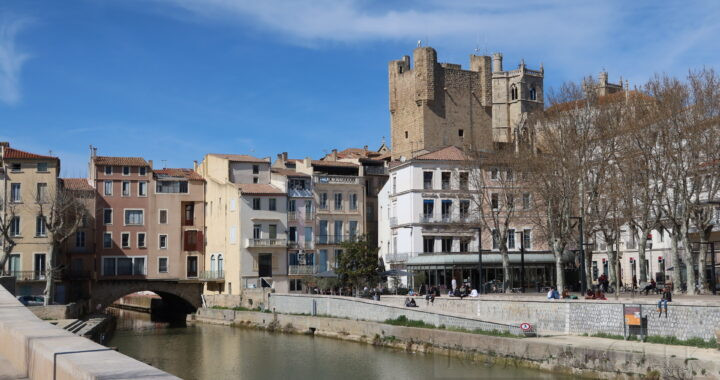
Canal de la Robine, Narbonne

Canal de la Robine

  • The Canal de la Robine is a seven mile canal that connects the River Aude to the Mediterranean in southern France.
  • It partly follows the route of the old Roman Canal through the centre of Narbonne to Port La Nouvelle.

History

  • The Romans established Narbonne in 118 BCE.
  • The River Aude (Atax) divides near Salelles, with one branch going through Narbonne and the other into the Etang close to Vendres. The Romans dammed the Aude at Salelles, and canalised the Aude through Narbonne to the Etang de Bages-Sigean. They named the canal the Robine.
  • The canal is crossed by a Roman Bridge, the ‘Pont des Marchants’, carrying the Via Domitia. The Roman bridge is under the shops built over it, and can best be seen from the towpath below.
  • In 1320 a major flood destroyed the dam and the canal through Narbonne became unnavigable.
  • In 1686, Vauban reconnected Narbonne with the Aude and the Canal du Midi which had been completed in 1681.


Photo and map: Canal de la Robine, Narbonne

National Museum of Scotland

  • The National Museum of Scotland was formed by the merger of four museums, now all housed in one location.
  • The Museum holds 12,000,000 artefacts.

Location

  • Chambers Street, Edinburgh, Scotland, EH1 1JF.
  • Admission is free.

Notable Roman Artefacts

  1. The Cramond Lioness
  2. Trimontium Helmet mask
  3. Trimontium Horse Headgear
  4. Bridgeness Distance Slab
    • (stating that the Legio II built 4,652 paces of the Antonine wall)
  5. The Traprain Treasure

Links


National Museum of Scotland, Edinburgh

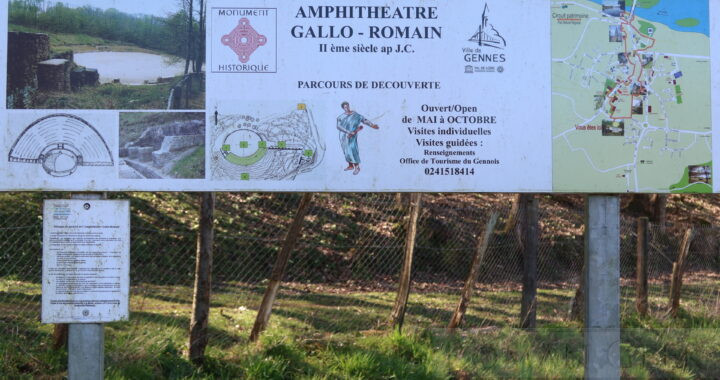
Gennes is a town on the river Loire near Angers. It holds the remains of a Roman Amphitheatre that once sat 5,000 spectators.

Gennes

  • Gennes is a town on the river Loire near Angers in the Departement of Maine-et-Loire in France.
  • It holds the vestigial Remains of a 2nd century CE Roman Amphitheatre with seating for 5,000 spectators.

The Roman Sites

  • Gennes Roman Amphitheatre.


Gennes Roman Amphitheatre