
Carnuntum

  • Carnuntum was a Roman Legionary Fortress founded in c.50 CE, whose ruins are located at Petronell-Carnuntum in Austria.
  • It became the Capital of the Province of Pannonia Superior in the 1st century CE.

History

Roman Site and Museum

  • Carnuntum Archeological Park
    • The Park holds the Remains of the Roman Fortress.
    • House of Lucius
    • Palace Remains
    • Amphitheatre Remains (which seated 25,000 spectators)
    • Heathen’s Gate or Heidentor (Roman Triumphal Arch: 361 CE)

Museums

  • Museum Carnuntinum
    • Located in the village of Bad Deutsch-Altenburg.
    • It holds the Finds from Carnuntum.


Carnuntum Archeological Park
Aquileia

  • Aquileia is a port town in Italy on the edge of the Lagoons on the River Natiso, a few miles from the Adriatic. It is in the Friuli-Venezia Giulia Region of Italy and is a UNESCO World Heritage Site.
  • It was founded as the port of Aquileia by the Romans in c.181 BCE and has retained the same name. It was located in Italia. It is one of the largest Roman cities to have been excavated, which had a population of 100,000 in the 2nd century CE.

History

  • It was the Terminus of the Amber Road from the Baltic.
  • In 181-180 BCE Aquileia was founded as a Roman Colony.
  • Its purpose was to be a Frontier Fortress for northeastern Italy, a Civic Centre for the Veneti Tribe and to control the Amber Trade into the Adriatic.
  • In circa 90 BCE it became a Municipium.
  • By the second century CE it had a population of 100,000.
  • In 168 CE the city was used as the Base for the Marcomannic Wars (168-180 CE) by Marcus Aurelius.

Roman Sites

  • The Archeological Remains of Aquileia
    • The city Remains can be seen in the three museums, the National Archeological Museum of Aquileia, the Paleochristian Museum and the Civic Museum of the Patriarchate.
    • It is the largest Roman City to have been excavated and is a Unesco World Heritage Site.
  • Aquileia cathedral
    • Built over a Roman Site, the cathedral floors hold Roman Mosaics.

Museums

  1. Aquileia National Archeological Museum
    • Via Roma, 1, 33051 Aquileia.
    • The Museum holds over 2,000 inscriptions, statues, mosaics, coins, glassware and other artefacts.
  2. Paleochristian Museum
    • A Museum built over the site of the early Christian Basilica of Fondo Tullio with mosaic floors.
  3. Civic Museum of the Patriarchate
  4. Archeological Area and Patriarchal Basilica of Aquileia (4th century CE)
    • This site holds the Remains of the Roman Forum. The floor of the Basilica holds a rare collection of well preserved and intact Roman mosaics.

Roman Roads


Aquileia National Archeological Museum

Red Sea

Origin of the Name

  • The name is derived from the Greek ‘Erythra Thalassa’, meaning ‘Red Sea’. which included the Arabian Sea.
  • Red is the colour which is produced by a type of bacteria in the Arabian Sea and associated Gulfs, which is visible to the eye, and can develop into ‘blooms’ stretching for hundreds of miles, lasting several months.

1. Ancient Red Sea Ports

Egypt

    • Ptolemy mentions six Red Sea Ports in Egypt. These were, running north to south:
      1. Clysma: (near Suez) In the fourth century CE, Clysma replaced Myos Hormos and Berenice.
      2. Philoteras:
      3. Myos Hormos: was the major Port with a very large Harbour protected by Moles, and plenty of ship building and repair facilities.
      4. Albus Portus:
      5. Nechesia:
      6. Berenice: this was first Egyptian Port for unloading cargos by the Red Sea Fleet on the return journey from India. Myos Hormos was another five days sail to the north.

Arabia

      1. Jeddah: in Arabia, was then a small Port half way down the Red Sea, once visited by Alexander the Great (356-323 BCE) which may have been a stopping point for fresh water for the Red Sea Ships.
      2. Ocelis: in Yemen, just before the Bab al Mandeb Strait. This was the first stopping point for ships from Egypt en route to India. The Periplus of the Erythraean Sea says it took 40 days from Ocelis to Muziris.
      3. Aden: in Yemen was ‘Eudaemon’, mentioned in the Periplus of the Erythraean Sea, originally a port of transhipment, but was already being bypassed by the long distance Red Sea Fleets in the first century CE. It was built in the crater of an extinct volcano.

Ethiopia

      1. Adulis: During the first century CE, King Zoskales ruled from Aksum. He controlled Adulis mentioned by Pliny the Elder as a port trading in Ivory, Hides and Slaves. The Aksumite Empire used Adulis for its base as a Sea Power. In 525 CE it invaded the Himyarite Kingdom from this base.
      2. Dahlak Archipelago: Adulis controlled the Pearl fisheries of the Dahlak Archipelago, whose pearls were famous in the Roman Empire along with its Tortoiseshell.
      3. Assab: Located closer to the Bab el Mandeb.

2. The Geography of the Red Sea

  • The Red Sea is a long narrow Sea running diagonally from North North West to South South East.
  • It is 1,200 miles (1930 km) long by 167 miles (270 km) wide.
  • At the northern end, is the shallow Gulf of Suez to the west, and the deeper Gulf of Aqaba to the east.
  • In the southern half, the coastal shelf extends far out and is only 164 ft (50m) deep, although the centre is deeper at over  9,840 ft (3,000 m). The southern half of the Red Sea also has many islands.

Coral Reefs

    • There are 1,240 miles of Coral Reef along the coasts, which are between 5,000-7,000 years old. Amongst the fish on the Reefs lives the Seahorse.

Mangrove swamps

    • There are forests of Mangrove trees along both coastlines of the Red Sea, in Egypt, Sudan, Eritrea, Djibouti, Saudi Arabia and Yemen. These lie between the tidal reaches of salt water often around a river outlet or an island. They support a rich marine life and protect coral reefs. They were mentioned by Pliny the Elder.

Dahlak Archipelago

Locusts

    • Both coastlines of the Red Sea can be breeding grounds for Desert Locusts.
    • Huge swarms of Locusts from Africa regularly cross the Red Sea carried by the winds to Arabia, flying by night at an altitude of up to 6,000 feet.

Tides

    • The North – Gulf of Suez: The Tidal Range is 2 feet (0.6 m)
    • The Centre – The Jeddah Area: Almost no Tidal Range: 6 inches (0.2 m) to 1 foot (0.3 m)
    • The South – Gulf of Aden: The Tidal Range is 3 feet (0.9 m)

The Currents and Winds

    • Due to evaporation there is a permanent inflow of water from the Gulf of Aden, producing a northerly surface current up both coasts of the Red Sea.
    • Evaporation causes the water to have a high salinity and become dense. This dense water becomes a deep outflow back into the Indian Ocean.
    • To replenish all this lost water, there is both a deep and a surface inflow from the Indian Ocean. But at various times of the year, local winds alter the surface currents.
    • In the northern half of the Red Sea, although the predominant winds are from the North West, the surface currents run north along both coasts, between 1.5 to 2 knots, in the opposite direction to the wind.
    • In the southern half of the Red Sea, the Northwesterly winds produce a southerly outflowing surface current, during the summer period from June to mid-September. This enabled the vessels departing to India in July, to descend the Red Sea and exit into the Gulf of Aden.
    • But in the Winter period, the winds reverse during December to March, and the surface current becomes a northerly inflow. This enabled the vessels returning from India in January, to enter the Red Sea from the Gulf of Aden, and sail back up towards Egypt.

3. Navigation of the Red Sea

  • In the northern Red Sea the all year round prevailing winds are from the Northwest, enabling vessels to sail south.
  • In the Southern Red Sea, during the winter period December to March, the prevailing winds reverse and blow from the Southeast as far as the border between Somalia and Ethiopia.
  • An ancient sailing ship could only sail up to 60 degrees into the prevailing wind, so it must either have
    the wind blow from behind it, or from on its beam, or get taken by the current.

Trajan's Canal

    • Trajan’s Canal provided another Route from the Nile near Cairo, via the Bitter Lakes to the Red Sea at Arsinoe. This could only operate for a few months of the year when the Nile was in Flood, and therefore the water level was higher than that of the Red Sea. The Romans knew that if they allowed the Red Sea in along the canal and into the Nile, salt water would ruin the Nile Delta.
    • During the fourth century CE, Myos Hormos and Berenice ceased to operate as trading ports, and Trajan's Canal appears to have become the main trade route for ships to India.
    • circa 300 CE, Diocletian rebuilt Fort Babylon on the Nile, which seems to have acted as a fortress and warehouse complex for water based trade between the Nile and the Red Sea.

Suez Canal

    • Today, the Suez Canal runs through the Bitter Lakes, connecting the Mediterranean Sea with the Red Sea. There are no locks, and sea water and fish flow freely along the canal between the two Seas.

The Northern Red Sea

    • In the northern Red Sea there is a northerly current running along the coast of Egypt and another northerly current flowing along the coast of Saudi Arabia. This runs anticlockwise around the top, from Saudi Arabia and returns south to meet the northerly Egyptian current, forming a Gyre or rotating water mass.
    • This made it difficult for sailing ships to reach the Gulf of Suez, so Berenice and Myos Hormos were positioned where the northerly current ends, even though this meant a difficult journey across the eastern deserts to the Nile by Camel Caravans.

The Southern Red Sea

    • In the southern Red Sea the surface Current is affected by the prevailing wind:
      • During the summer, from June to mid-September, the north westerly winds create a southerly surface current for four months flowing out into the Gulf of Aden, through the Bab el Mandeb. Although, deep below, there is an inflow from the Gulf of Aden.
      • The Red Sea Fleet usually left in June or July, taking advantage of the combined wind and current to help their journey south.
      • During the winter, between October and March, the Monsoon has the effect of reversing the wind to flow from the Southeast. This reverses the surface current, which becomes northerly as water from the Gulf of Aden flows in.
      • The Red Sea Fleet returned in December or January using the southeasterly wind and current to help them sail into and up the Red Sea.

Bab el Mandeb Strait

4. Ancient Sources on travelling the Red Sea

Eudoxus of Cyzicus

    • Poseidonius wrote that the sea captain Eudoxus of Cyzicus was sent to India by Ptolemy VIII.
    • He made two voyages using an Indian pilot in 118 BCE and sailing unguided in 116 BCE.
    • Eudoxus returned with a cargo of spices and precious stones.

The Periplus of the Erythraean Sea

    • The Periplus of the Erythraean Sea describes the Sea Route from Egypt to India in the first century CE, showing all the distances calculated from Berenice, the seaport nearest to India.
    • The Periplus describes the Ports and Peoples on the Route.
    • The Sea Distances were measured in Stadia: 625 feet or 1/8th of a Roman mile.

Pliny: Alexandria to the Red Sea

Pliny's Description of the Route to India

    • The Journey from Egypt to India took two and a half months to sail, according to Pliny the Elder:
    • 30 days from Myos Hormos to Ocelis. Watering and provisioning of vessels. Set off from around the 21st July. The Southwestern Monsoon, (Hippalus} blows from June to August in the Gulf of Aden.
    • 40 days from Ocelis to Muziris. Arrive around the 1st September. The Southwestern Monsoon ends around the end of September.

Strabo: The Red Sea Route to India

    • Strabo stated that 120 Ships sailed from Myos Hormos to India, every year. Ships usually left Egypt in June or July in order to reach the Indian Ocean and take advantage of the Monsoon which reached India around the first week of June and ended by the end of September. The Journey took about 3 to 6 weeks.
    • During July and August, around the Horn of Africa and Socotra, the winds can reach gale force making travel uncomfortable.
    • The Southwest Monsoon features thick haze and poor visibility,
    • The Fleet returned from India when the Monsoon reversed direction. This started in the last week of October, so the fleet would arrive back in Egypt sometime in January.
    • Navigation from the mouth of the Red Sea to the Indian Coast is basically east west, no compass was required, since vessels could follow an Easting and sail due east by the path of the Sun by day, the Pole star Polaris and the constellation of Orion by night.

Red Sea Fleet

    • There are fourth century CE references to a ‘Classis Maris Rubris’, a Red Sea Fleet, which seems to have been a commercial Fleet, possibly operating on the same lines as the Alexandrian Grain Fleet.
    • The Fleet may have been based at the large protected Harbour of Myos Hormos. Berenice seems not to have been a developed Harbour, although it was the first port of disembarcation, when the Fleet returned to Egypt, in the race to get the Goods back to Coptos and Alexandria. The rest of the Fleet then continued for another 5 days up to Myos Hormos.
    • During the Ptolemaic Period Merchant ships carried contingents of Archers on board, according to the Pithom Stele. Lucian also states that the Romans continued this practice of Archers on board merchant vessels.
    • There is no record of a Roman Naval Fleet in the Red Sea. Galleys carried very little water, and needed to take on water every one to two days for their oarsmen who consumed around 8 litres per day. The Red Sea has Rocky, waterless coasts with very few harbours to take on water, and so would have been unsuitable for a Galley Fleet.


The Red Sea

Temple of Amun

  • The Temple of Amun refers to the Temple complex at Karnak in Egypt, dating from 2055 BCE.
  • It is a Unesco World Heritage Site, which includes the necropolises. The Temple was dedicated to Amun-Re, his wife Mut and his son Montu (or Khonsu).

Description

  • The site contains three Temple Precinct areas, dedicated respectively to Amun-Re, his wife Mut and their son Montu. The fourth Temple, dedicated to Amenhotep IV, was dismantled soon after he had died.
  • Amun was the ‘King of the Gods’ in the Ancient Egyptian Religion, and appears in many of Ancient Egypt’s statues and temples.
  • Construction started in the Middle Kingdom (2,000-1,700 BCE) under Senusret I and continued up until the Romans arrived in 30 BCE.

Great Hypostyle Hall

  • The Hall is located in the Temple of Amun-Re. It has 134 stone columns some of which are 79 ft (24m) in height. Originally they supported a roof which is no longer in place.

Nearby Sites

Films

  • The Spy Who Loved Me‘ (1977)
    • This James Bond film features the Great Hypostyle Hall in the Temple of Amun with stars Roger Moore and Barbara Bach.


Karnak Temple, Luxor

Temple of the Oracle

  • The Temple of the Oracle of Amun, also known as the Ammonium, was located in the Siwa Oasis in Egypt.
  • It was famous in the Ancient World for its Oracle of Amun, which was a site of Pilgrimage.

Siwa Oasis
  • The Siwa Oasis was visited in February 332 BCE by Alexander the Great, who consulted the Oracle.
  • Visitors would arrive by sea at Mersa Matruh known as Ammonia, and then cross the Sahara to reach the Temple in the Siwa Oasis, which was known as the Ammonium.


Temple of Amun, Siwa Oasis, Egypt

Parallel of Rhodes

  • The Parallel of Rhodes was one of 33 Parallels of Latitude described by the Roman Geographer, Ptolemy who was influenced by Eratosthenes.
  • It is almost exactly the Parallel of 36 degrees North which runs from Gibraltar to Rhodes and could be used for east-west Navigation.

History

Eratosthenes

  • Around c.250 BCE Eratosthenes, the Greek Cartographer, created a Grid with various locations identified by Latitude and Longitude.
  • He drew his Line of Parallel through Rhodes and the Pillars of Hercules, Gibraltar. He chose this because it conveniently divided the then known world into two halves

Navigation

  • The 36th Parallel was an ancient east west sailing route.
  • The Mediterranean Current flows anticlockwise from East to West along this same line.
  • Without the compass, ancient Mariners either had to follow the coasts, or if out of sight of land, the East-West line of the Sun’s path.
  • Using the prevailing North wind on their starboard bow, would give them a beam reach until Malta.
  • By departing from Seleucia of Pieria in Syria, and following the Parallel of Rhodes, a vessel could sail due west, using the Current, pass north of Cyprus, skirt the southern coast of Turkey, and go direct to the island of Rhodes all in a straight line without hitting land.
  • Continuing round on the other side of Rhodes the vessel could again pick up the 36th Parallel, and sail in a straight line due west, which passed to the north of Crete and then to the south of the Peloponnese, between the islands of Kythira and Antikythera.
  • However, it should be noted that due to the Northerlies pushing vessels onto a lee shore at Crete, they preferred to navigate along the southern shore of the Island, which gave them shelter from the Northerly winds.
  • The 36th parallel passes between the Island of Malta and Comino.
  • Sailors would sight landfall at the Island of Malta, from here vessels could turn north into the Strait of Messina, or head northwest to Spain and Gaul.
  • After Malta, the 36th Parallel goes through the land mass of North Africa, reemerging to pass through the Straits of Gibraltar, then known as the Pillars of Hercules.

Rhodes

  • After Alexander the Great defeated the Persians and ejected them from the Eastern Mediterranean.
  • After the destruction of the Sea Power of Tyre in 332 BCE, Rhodes developed the powerful Rhodian Navy based on a type of Trireme called the Trihemiolia.
  • There then followed the Golden Age of Rhodes between 323-167 BCE, during which Rhodes dominated the Trade of the Eastern Mediterranean, and achieved great wealth.
  • The Rhodian Sea Law was a collection of their Sea Laws that was later utilised by the Roman Empire and the Byzantine Empire.

Piracy

  • All shipping in the Ancient World that sailed from Egypt and the Levant, had to pass Cilicia, Cyprus, Rhodes, Crete and the nearby island groups of the Dodecanese and Cyclades. As a result, these were traditionally Pirate bases. However, as one island or group of islands formed an efficient Pirate Fleet, they got to control the other Pirates and their islands, and so became the dominant Sea Power.
  • After the decline of the Rhodian Navy, which had replaced the Athenian Navy, there arose the Pirates of Cilicia, who came to dominate the Mediterranean, and were eventually suppressed by a Roman Navy under Pompey in 67 CE.


Rhodes:

Pontine Islands

  • The Pontine Islands are an archipelago located in the Tyrrhenian Sea off the coast of Italy.
  • They consist of Gavi, Palmarola, Pomza, Santo Stefano, Ventotene, Zannone.

Ventotene

  • Ventotene, one of the Pontine Islands, was used as a place of Exile for prominent Romans.
  • A small Roman harbour carved out of the rock is still in use today.


Ventotene

  • Ventotene, was Roman Pandateria, and is located in the Tyrrhenian Sea. It is a tiny Island, 0.61 mile (1 km) long and 0.43 mile (700m) wide.
  • It is one of the Pontine Islands along with Gavi, Palmarola, Pomza, Santo Stefano and Zannone.

The Roman Sites

  • A small Roman harbour carved out of the rock is still in use today.

Roman Place of Exile

  • Ventotene was used as a place of Exile for prominent Romans.
  • Julia the Elder (39 BCE- 14 CE)
    • Augustus accused his only daughter of Adultery and Treason. She escaped Execution and instead was banished in 2 BCE to Ventotene for 5 years, accompanied by her Mother Scribonia.
    • Augustus built an artificial harbour, chiselled out of the rock, to supply his exiled daughter, Julia the Elder. It is still in use.
  • Agrippina the Elder (14 BCE-33 CE)
    • Daughter of Julia the Elder: Tiberius Banished and imprisoned her for life in 29 CE, and she died and was buried there in 17 October 33 CE.
    • After becoming Emperor in 37 CE, her son Caligula, went to Ventotene, and returned both with her ashes and those of his brother Nero. The urn containing her ashes was placed on the bows of a Bireme that ceremoniously rowed up the Tiber into Rome. The ashes were then placed in the Mausoleum of Augustus.
  • Flavia Domitilla (d. 100 CE)
    • Also known as Saint Flavia Domitilla, who was banished here in 95 CE on the Charge of Atheism for practising Christianity. She died in 100 CE.


Ventotene

Hallstatt Salt Mine

  • Hallstatt Salt Mine is located near the village of Hallstatt in Austria, which has been active since the Bronze Age.

The Hallstatt Culture

  • This is the culture associated with the Celtic, Proto-Celtic and Illyrian peoples who lived and worked in the Salt Mine from the eighth century BCE to the fifth century BCE, the Early European Iron Age.
  • A cemetery containing 1,045 burials was excavated in the nineteenth century. Grave Goods from this Period include Iron swords as well as Bronze swords, bodies placed in graves (inhumation) as well as cremation.

Links

Nearby Salt Mines and Cities


Hallstatt Salt Mine, Austria

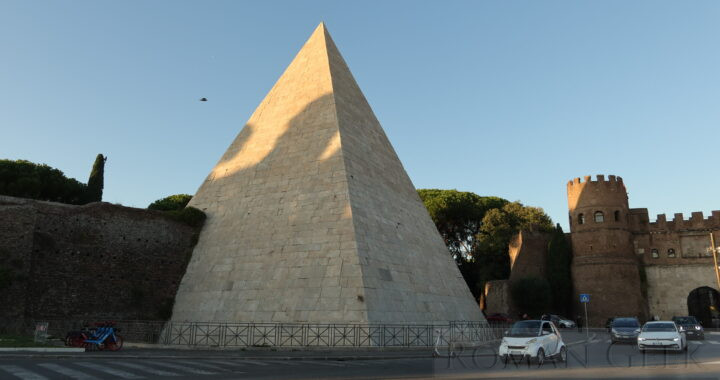
Pyramid of Cestius, Rome

Pyramid of Cestius

  • The Pyramid of Cestius is a Pyramid shaped Tomb in Rome, built between 18-12 BCE for a Roman magistrate called Gaius Cestius.

Getting There

  • Location: Via Raffaele Persichetti, Rome.
  • Nearest Metro Station: Piramide, Line B.
  • Nearest Tram Station: P.ta S. Paolo, Line 3.
  • Admission: Temporarily closed..

Description

  • Originally it was built outside the then city walls of Rome, which did not permit burials within its walls.
  • As Rome expanded it became part of the Aurelian Walls built in 270-275 CE.
  • Its steep slopes indicates a Nubian style, not Egyptian.
  • Another Pyramid, the ‘Pyramid of Romulus’ (now lost) existed close to Castel San Angelo.
  • There may be a link between the Cestius family and the Pons Cestius, but the origin of that name is not known.


Pyramid of Cestius, Rome