
Lost Army of Cambyses

  • Cambyses II, King of Persia, invaded Egypt in 525 BCE. According to Herodotus (3.26), the Priests at the Temple of Amun at the Siwa Oasis revolted against his Rule.
  • Cambyses II then sent an army of 50,000 men in 524 BCE, from Thebes to the Siwa Oasis, to quell the Revolt. Seven days into the Desert, the Army was caught up in a Sandstorm and every man lost, never to return.

Siwa Oasis

Temple of the Oracle of Amun

  • The Temple of Amun at the Siwa Oasis was famous in the Ancient World for its Oracle of Amun.
  • Visitors would arrive by sea at Mersa Matruh known as Ammonia, and then cross the Sahara to reach the Temple known as the Ammonium.
  • February 332 BCE, Alexander the Great visited the Oasis and consulted the Oracle.

Sandstorms

  • Sandstorms occur in the Sahara Desert in Africa, and other desert regions including the Arabian Peninsular.
  • The Sandstorm is characterised by its sudden onset, appearing as a wall of solid clouds, where the sun becomes obscured, visibility drops to a few feet, and high winds arise.
  • The leading edge of the sandstorm can be a wall of sand up to one mile high. Heavy objects can be picked up in the high winds and dropped.

How the Army of 50,000 could have been Lost

  • In a Sandstorm, people are easily separated, lost and disoriented, and must huddle together and shelter on the ground, covering their eyes nose and ears with a cloth.
  • Prolonged exposure to sand in the eyes can lead to blindness, and in the mouth to asphyxiation.
  • Survival consists of being covered with a blanket, and protecting the head with the arms or clothing.
  • The story may be a myth, but no Army without the knowledge of this technique of survival would have been able to survive.


Siwa Oasis, Egypt
Tomb of Ozymandias

  • The Tomb of Ozymandias was the name given to the Ramesseum by the Roman historian Diodorus Siculus writing between 60-30 BCE.
  • Ozymandias was the Greek name for the Egyptian Pharaoh Ramesses II, also known as ‘Ramesses The Great’, who reigned from c.1279-1213 BCE.

The Pharaoh Ramesses II

  • Ramesses II is considered by historians to have been the greatest Pharaoh of Ancient Egypt. He distinguished himself by opposing the Hittite Armies at the Battle of Kadesh in c.1274 BCE.
  • By 1250 BCE, he had completed the giant Funerary Temple dedicated to himself known as the Ramesseum or Tomb of Ozymandias.

The Tomb of Ozymandias or the Ramesseum

  • This was a Mortuary Temple built by Ozymandias or Ramesses II (1279-1212 BCE), which took 20 years to build and was completed in c. 1250 BCE.
  • The ruins of the Temple are located on the west bank of the Nile at Luxor (Thebes) in Egypt.
  • The Temple is built of sandstone from a quarry south of Luxor.
  • It covers an area of 6 hectares with two stone Temples at its centre surrounded by three enormous annexes consisting of storerooms, workshops and vaults, including one storeroom that seems to have served as a treasury.

Other Names for the Tomb of Ozymandias

  • ‘The Mansion of Millions of Years’
    • This was the name Ramesses II gave to the Temple. It was dedicated to Amun.
    • It served as a model for the ‘Mansion of millions of years’ built by his son, Ramesses III at Medinet Habu.
  • ‘The ‘Tomb of Ozymandias’
  • The ‘Memnonium’
    • This was the name given by two French engineers, Jollois and deVilliers, who recognised it as the Tomb of Ozymandias, after Napoleon’s Invasion of Egypt in 1799 CE.
  • The Ramesseum

The Colossus of Ramesses II (c. 1250 BCE)

  • The Colossus was an impressive giant statue of Ramesses II carved in limestone. It was 60 feet high (18m) and weighed 1,000 tons.
  • The shattered remains of the statue lay in pieces around the Temple, but only the Giant Head and Shoulders remain today and are now inside a small museum built to cover the statue.
  • It was one of several Giant Statues situated throughout Egypt that Ramesses II made of himself.
  • One of these statues is now on display in the British Museum.

The Poem ‘Ozymandias’ (1818)

  • An image of the ruined statue of Ramesses II may have inspired Percy Bysshe Shelley to write the famous sonnet ‘Ozymandias’ (The Greek name for Ramesses II).
  • It was published in 1818, prior to the arrival of a similar statue at the British Museum.


The Ramesseum, Luxor

Maddalena Pass between Italy and France

Maddalena Pass

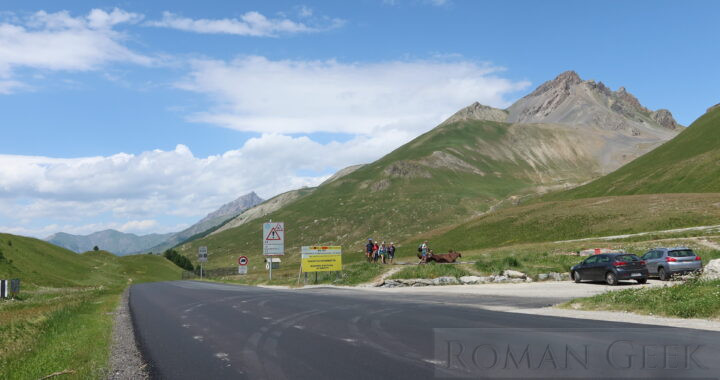
  • The Maddalena Pass forms the dividing point between the Cottian Alps and the Maritime Alps and is the frontier between Italy and France.
  • The Pass has an elevation of 6,545 ft (1996 m) and connects Cuneo in Italy with Barcelonnette in France.

History

  • The Romans acquired this Pass with the defeat of the Ligurian tribes in 14 BCE, and it became part of the Province of the Alpes Maritimae.

Alpes Maritimae

  • Control of the Maddalena Pass was under the Procurator for this Province, whose capital was at Cemenelum, now a suburb of Nice.

The other Alpine Passes

Maddalena Pass, France

Dragon

  • The Dragon is a mythological creature that appears or has appeared in the culture of many civilisations around the world, but with great variations.

In Medieval Western Culture

  • The Dragon has four legs, horns, bird wings and a tail and can breath fire.

In Eastern Culture

  • The Dragon has four legs, no wings and the body and tail of a snake, and is highly intelligent.

Mesopotamia: (2,334 – 539 BCE)

  • The Dragon is depicted as a lion dragon:
    • With the head (mouth open) and forelegs of a Lion, and the rear legs, wings and tail of a bird.
    • Or with the horns, neck and body of a snake, and the forelegs of a lion, and the rear legs of a bird.

Ancient Egypt

  • Apep:
    • A Giant Serpent who lives in the Egyptian Underworld, Duat, and is coiled around the body of Ra.
  • Nehebkau:
    • Another Giant Serpent who also guards Duat, the Underworld, but helped Ra defeat Apep. He was so massive the world balanced on his coils.
  • Denwen:
    • Yet another Huge Serpent who had a body of made of Fire, mentioned in the Pyramid Texts, and who started a Fire which very nearly destroyed all the Egyptian Gods.
  • ‘Ouroboros’:
    • This is a drawing of a Dragon or Serpent in a coil swallowing it’s own tail.
    • Found in the Tomb of Tutankhamun. It then became the symbol pf the early Gnostic Christian Church during the first few centuries CE.

Ancient Greece

  • There were many dragons in Greek Mythology:
    • Typhon, Ladon, Pytho, the Lernaean Hydra, the Colchian dragon, the Ismenian dragon, Helios’ chariot was drawn by dragons, the Scythian Dracaena, and the Gigantomachian dragon.

Ancient Rome

  • The Draco (meaning Dragon or serpent)
    • This was the military standard of the Roman Cavalry, and was carried by the Draconarius.
    • Arrian described it as being Scythian in origin, and that it inflated and whistled when the horse was running. It was adopted from the Dacians after the Dacian Wars (101-106 CE).

Ugarit (c. 6,000 – c. 1,200 BCE)

  • Lotanu:
    • A Sea Dragon, described as a powerful twisting Serpent with seven heads, is defeated and killed  by Baal.

Hebrew Bible:

  • Leviathan:
    • Psalms 74. lines 13-14. The Sea Dragon called Leviathan (the word is a derivative of Lotanu) is defeated and killed by Yahweh.

England

  • English mythology features the Legend of St. George and the Dragon, along with Griffins (half eagle, half lion) and Wyverns (two legged dragons).

France

  • In the Legend of Gargouille (Gargoyle), the Bishop of Rouen, St. Romanus (631-641 CE), saved the region around Rouen from a dragon called La Gargouille.

Other countries featuring Dragons in their culture:

  • Russia, Ukraine, Poland, Roumania, India, Tibet and Bhutan, China, Korea, Japan, and Vietnam.


Egypt

Pyramid of Djedefre

  • The Pyramid of Djedefre (c. 2,528-2,520 BCE) was the fourth Pyramid of Giza in Egypt.
  • The Pyramid of Djedefre (built c. 2,520 BCE) was completely dismantled by the Romans. Djedfre was the son of Khufu (2589-2566 BCE).

The Missing Pyramid

  • The Romans successfully dismantled the Pyramid of Djedefre, and used it as a stone quarry for buildings elsewhere.
  • Today, just a low outline remains in the ground.


Location of the Pyramid of Djedefre, Egypt:

Pyramid of Menkaure

  • The Pyramid of Menkaure (or Mycerinus) (c. 2,530 BCE) is the third largest Pyramid at Giza. Herodotus wrote that it was built by Mycerinus (c. 2,530 BCE).
  • The hole in one side is from the attempt by one of Saladin’s (1174-1193 CE) sons to dismantle the Pyramid, after which he gave up.


Pyramid of Menkaure, Egypt

Pyramid of Cephren

  • The Pyramid of Cephren, also known as the Pyramid of Khafre, (c. 2,558-2,532 BCE) is the second largest Pyramid at Giza.
  • Herodotus wrote that the second Pyramid was built by Cheops’ son Cephren (Khafre), who is also thought to have built the Great Sphinx.


Pyramid of Cephren, Egypt

Wadi Rum

  • Wadi Rum, meaning ‘Valley of Sand’, is a valley located in Jordan, 37 miles (60 km) east of Aqaba.
  • It is also known as the ‘Valley of the Moon’ and as the ‘Roman Valley’, because of the numerous Roman Ruins located in it. Wadi Rum was in the Province of Arabia Petraea.

History

  • It was made famous by T.E. Lawrence who used it as a base during WWI, whilst making attacks on the Ottoman Army during the Arab Revolt of 1917-1918.
  • It was possibly the location of a way station on the Incense Road, known as Aramava.
  • The highest peak in Jordan, Jabal Umm ad Dami, at 6,040 ft (1,840m) is located 19 miles (30 km) south of the village of Wadi Rum.
  • Nearby, is the second highest peak, Jebel Rum, at 5,687 ft (1,734 m).
  • Wadi Rum is home to the Zalabia Bedouin Tribe.

Film Location


Wadi Rum, Jordan

Battle of Phillipopolis

  • The Battle of Philippopolis, (Plovdiv), also known as the Siege of Phillipopolis, took place in 250 or 251 CE.
  • It was fought by Rome during the Gothic Invasions of 249-253 CE, but the city fell before Decius could arrive.

The Reason for the Siege

  • The Battle occurred against the background of the Crisis of the Third Century (235-284 CE).
  • A Gothic Army under King Cniva had crossed the Danube in 249 CE, after having already defeated a Roman Army under the Emperor Decius at Augusta Traiana.

The Siege

  • After a prolonged siege by King Cniva, Phillipopolis fell before the army of Decius could reach it.

The Outcome

  • King Cniva went on to ally himself against Decius, by supporting another Roman usurper, Priscus, Governor of Thrace. They then confronted Decius.

Battle of Abritus (251 CE)

  • In the Summer of 251 CE, King Cniva met Decius’ the three Roman legions at Abritus (Razgad) in Bulgaria.
  • Decius and his son and co-Emperor Herennius Etruscus, were defeated and became the first Roman Emperors to be killed in Battle by Barbarians.


Phillipopolis, (Plovdiv, Bulgaria)

Plovdiv

  • Plovdiv is a city located on both banks of the river Maritsa in the Plovdiv Region of south central Bulgaria.
  • It became the Roman city of Philippopolis after 72 BCE in the Province of Thracia. The Roman Theatre is still in use today.

History

  • Historically it was known as Philippopolis, meaning Philip’s City, after Philip II of Macedon conquered the town in the 4th century BCE.
  • It is known as ‘The city of the seven hills’ because it is surrounded by seven hills and is located in a fertile region.
  • It became the capital of the Province of Thracia during the early 3rd century CE, replacing Perinthus.
  • Battle of Phillipopolis (250 CE)
    • The Battle of Philippopolis (Plovdiv), also known as the Siege of Philippopolis, took place in 250 or 251 CE. It was fought by Rome during the Gothic Invasions of 249-253 CE, but the city fell before Decius could arrive.

Roman Sites

  • The Ancient Theatre of Philippopolis:
    • An Amphitheatre seating 5-7,000 people. Still in use today. Built under Domitian during the 90’s CE.
  • Roman Stadium:
    • Built during the reign of Hadrian (117-138 CE), it was based on the Stadium at Delphi, and seated 30,000 people.
  • Roman Odeon:
    • A smaller Theatre, seating 350 people, built during the second to fourth centuries CE, initially for the City Council, then used as a Theatre.
  • Roman Forum:
    • Built during the reign of Vespasian (69-79 CE).
  • Eirene Residence:
    • Private Residence with Mosaics from the fourth century CE.

Museums

  • Archeological Museum of Plovdiv
    • Located at 1 Saedinenie Square, Plovdiv.
    • The museum is divided into the following periods: Prehistory, Antiquity and the Middle Ages.

Roman Roads


Plovdiv (Phillipopolis)