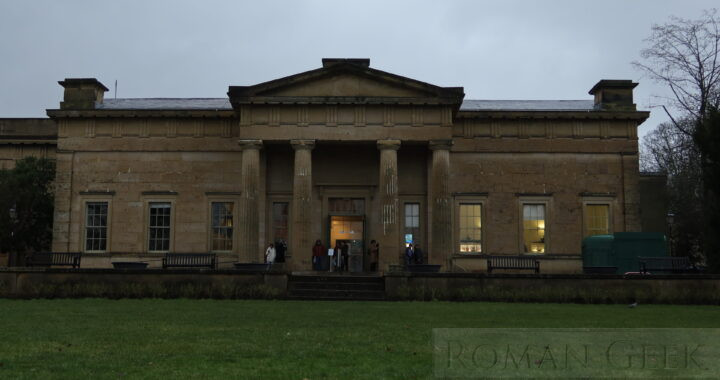
Yorkshire Museum, York

Yorkshire Museum

  • The Yorkshire Museum contains artefacts from the Roman, Viking and Medieval Periods.
  • It is located at Museum Gardens, Museum Street, York YO1 7FR

Description

  • The museum was opened in 1930 and has five permanent collections covering archaeology, numismatics, biology, geology and astronomy.
  • There are several notable Roman artefacts and coin hoards.

The Roman Collections

  • Wold Newton Hoard
    • 1,857 coins (early 4th century CE)
  • Heslington Hoard
    • 2,800 coins (early 4th century CE)
  • Overton Hoard
    • 37 silver denarii (early 3rd century CE)
  • Marble Head
  • Statue of Mars
    • Roman stone statue depicting the God Mars (4th century CE)
  • Ivory Bangle Lady
    • A Roman woman’s skeleton (4th century CE)

Photo: The Yorkshire Museum
Septimius Severus Parthian Campaign

Prelude

  • After a fifty year period of Peace, War in the East had reoccurred during the 160’s CE, when Armenia and Mesopotamia had fallen to the Persians, despite several attempts to eject them.
  • Septimius Severus decided on a Campaign to regain Mesopotamia and reestablish the Euphrates as the Frontier.

Preparation (195-196 CE)

Invasion (197 CE)

  • In 197 CE Septimius Severus broke the Parthian siege of Nisibis in Mesopotamia. He then continued to advance down the Euphrates sacking Seleucia and Babylon.
  • Septimius Severus finally captured and sacked Ctesiphon and its Gold and Silver were confiscated and part of its population removed and sold as Roman Slaves.

Outcome (198 CE)

  • However, Severus did not permanently occupy the Parthian Empire, but withdrew, instead annexing Mesopotamia into the Roman Empire in 198 CE.  Two of the new Legions remained in the east permanently to reinforce the frontier.
  • On his return to Rome the Senate awarded Severus a Triumphal Arch, the Arch of Septimius Severus in the Forum Romanum.
  • Severus gave himself the title ‘Parthicus Maximus’.

Sources

Ctesiphon, Iraq

Raphanae

  • Raphanae was the location of a Roman Legionary fortress in the Roman Province of Syria.
  • The Site has been excavated north of Umm Qais at Tell Abila in Jordan, but only the Ruins of a 6th century CE Church are visible.

Legio III Gallica (70-c. 323 CE)

  • This  Legion was based at Raphanae until c.323 CE, when it was moved to Syene in Egypt.


Raphanae, Syria

Alba Julia

  • Alba Julia is a city on the river Mures located in the Transylvania area of Roumania.
  • It was the Roman city of Apulum, the greatest Roman city on the Danube and the Military Governor’s HQ for all 3 provinces within Dacia.

Legionary Fortress

  • Apulum was a Roman legionary base and some traces have been found under the medieval fort of Alba Julia.


Alba Julia, Roumania

Viminacium

Viminacium

  • The Ruins of Viminacium, also called Municipium Aelium, lie 7 miles (12km) from Stari Kostolec in Serbia, wher the river Mlava joined the Danube.
  • It was a Legionary Fortress and the capital of the Roman Province of Moesia Superior. The Fort was occupied by the Legio VII Claudia between c.58-c.300 CE. It was also the Naval base for the Roman Navy on the Danube.

Viminacium Roman Archeological Park

  • Located at Put za Viminacium, Stari Kostolac, Serbia.
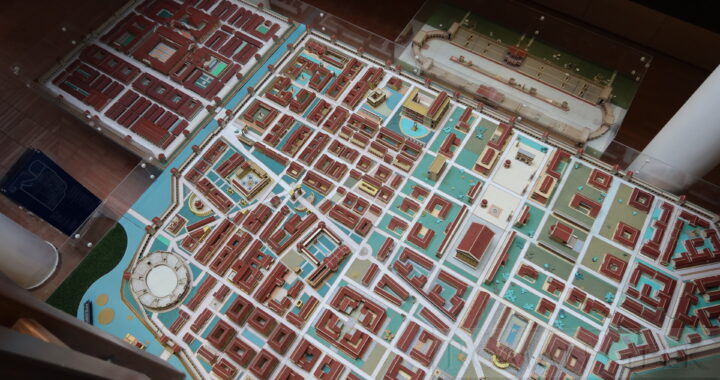
  • The Park is located on the site of the city of Viminaciuma and contains reconstructions and Remains of the Roman buildings, such as the Amphitheatre, Baths, Mausoleum and Tombs and parts of the Aqueduct.
  • It is one of the largest archeological sites covering over 1,100 acres (450 hectares ) and requires a ride in a small tourist bus or car to access each area.
  • The excavations unearthed a complete Doctors set of instruments from the Army Hospital. These were found to be identical to modern optical instruments, not previously thought to have existed during the Roman period.
  • The remains of several Roman vessels, some belonging to the Roman Navy, have been dug up and will be the basis of a future museum of ships.

Mausoleum

  • 16,000 graves have been excavated from the site, revealing that the people who lived here came from all over the Roman Empire including the Middle East.
  • The Mausoleum is thought to hold the Remains of Hostilian who reigned briefly in 251 CE before dying of the Plague of Cyprian at the age of 21. This would explain why his body was buried here and not taken to Rome. His father was the Roman Emperor Decius and his brother, the co-Emperor Herennius Etruscus.
  • A second Mausoleum was later discovered with a statue of a young Emperor, but who’s identity remains unknown.
  • It is possible to visit some of the tombs where there are well preserved wall paintings that can be seen. One painting displays ‘Divina’, a name given by archeologists to a Roman Mona Lisa, a young woman whose beauty is still clearly portrayed after 2,000 years. Another tomb displays a painting of a Panther, whilst another displays the Chi Rho Christogram.
  • The Paintings can be seen by walking through a selection of the crypts.

Roman Bathhouse

  • The Roman Baths have been excavated and reveal six pools which had their water heated externally, while the main connecting floors were supplied by underfloor heating, the Hypocaust.
  • Each room had a mosaic, but these unfortunately have not survived.
  • Water was brought by aqueduct from a distant source and heated for the baths.

Amphitheatre

  • It is thought that the Amphitheatre could accommodate between either 5,000 or 12,000 spectators. Gladiators fought in the arena and there were wild animal fights, the bones of which have been found buried nearby, including those of a camel and a bear.
  • Annual cultural events are held in the wooden reconstructed seating of the Amphitheatre.

Domus scientiarum Viminacium

  • Recently opened is the Domus scientiarum Viminacium, a new scientific research and visitor centre, built in the style of a reconstructed Roman Villa rustica.
  • An adjacent dormitory for archeologists and work related visitors has also been built in the style of a small Roman military barracks.
  • Next to this is a children’s adventure park.

Mammoth Park

  • The Mammoth Park is inside the Viminacium Archeological Park.
  • A separate Building holds the skeleton of a female Mammoth called ‘Vike’.
  • The Mammoth was aged 60 years old when she fell in to a swamp and died, approximately 1 million years ago.

National Museum of Pozarevac

  • Over 40,000 items have been excavated from Viminacium, 700 of these were made of gold and silver.
  • They now reside in the National Museum of Pozarevac, and others in the Archeological Institute at Belgrade.

History

  • Viminacium was originally located on the junction of the river Mlava (River Margus) with the Danube, which has now retreated. One side was along the river Mlava and another on the Danube.
  • Viminacium was the Headquarters for conducting the Dacian Wars (85-106 CE) under Domitian and Trajan.
  • Trajan built a bridge across the Iron Gates Gorge, at its narrowest point 70 miles (115km) downstream.
  • Viminacium is depicted in one of the scenes on Trajan's Column in Rome.
  • The city was first destroyed by Attila the Hun in 441 CE, and later by the Avars in 582 CE, after which it remained uninhabited.

Capital City

  • The City was the Capital of Moesia Inferior, with an estimated population of up to 40,000.
  • The city was permitted to have its own Mint and produce Roman Coins.

Legion:

  • The Fort was the HQ for the Legio VII Claudia between c.58-c.300 CE, with around 5,000 soldiers.

Navy

  • Viminacium was a base for the Roman Navy on the Danube, the Classis Pannonica, confirmed by the excavation of several warships, one with a ram, whose length varied between 15-22m (49-66 feet). The vessels were made of oak, held together with iron cramps.

Roman Road

  • It was on the Via Militaris connecting the Adriatic with the Black Sea and the Aegean.

Instruments of an Eye Doctor

  • Excavations produced a rare set of eight instruments in a bronze box belonging to an eye doctor, for treating cataracts and trachoma, that are almost identical to modern instruments, showing that Roman Medicine was very advanced.
  • The instruments consisted of tweezers, scalpels, needles, cataract needles, stone palette and a glass balsamarium. Also found were round flat pastilles bearing an inscription describing their contents as containing Saffron. They were kept in cartridges.

Roman Naval Base

  • Viminacium had a naval harbour, and was a fleet base for the Roman Navy on the Danube, as evidenced by the excavations of several navy galleys. Classis means Fleet in Latin.
  • The Classis Pannonica operated on the Danube, to the west of the Iron Gates up to to Regensburg.
  • Its sister fleet, the Classis Moesica, operated to the east of the Iron Gates, down to the Black Sea.

The Danube Military Frontier

  • Viminacium was an important part of the Danube Limes, a Frontier Defense System consisting of a chain of Legionary Fortresses, Camps and Watchtowers along the south Bank of the Danube, which stretched from Raetia (Switzerland) to the Black Sea.
  • Trajan (98-117 CE) added stone walls around the Forts and Hadrian (117-138 CE) added an earth rampart along the Danube.
  • The western section is a Unesco World Heritage Site.

Roman Roads


Viminacium Archeological Park

Silistra

  • Silistra is a town in Bulgaria which was the Roman legionary base of Durostorum in the Province of Moesia Inferior.

Roman Legionary Fortress

Roman Sites

  • Fortress Walls
  • Roman Tomb of Silistra (c. 350 CE)
    • Located at the intersection of Sedmi Septemvri and Boyka Voyvoda Street. Tours must be reserved at at the Reginal Historical Museum of Silistra.
    • Well preserved Roman Tomb with 11 panels of portraits and frescos depicting people and hunting scenes.

Museums

  • Regional Historical Museum of Silistra
    • Located at Boulevard Tsar Simeon Veliki, 74, Silistra.
    • The museum holds a large collection of Roman artefacts excavated from the fortress.


Durostorum

Nicopolis

  • Nicopolis is the Archeological Site of the Roman City of Nicopolis located in Old Preveza, 3 miles (5km) north of Preveza, in the Region of Epirus in northwestern Greece.
  • The city was founded by Augustus in 29 BCE to commemorate his victory at the nearby Battle of Actium (31 BCE). It became the capital of the Province of Epirus in 110 CE.

Roman Sites

  • Actium Trophy Monument
  • Aqueduct Bridge
  • Baths
  • Nympheum Fountain
  • Odeon
  • Stadium, used for the Actian Games
    • Gymnasium
    • Hippodrome
    • Theatre
  • Vila of Antoninus
  • Walls and Gates

Museums

  • Archeological Museum of Nicopolis
    • Located in the Archeological Area of Nicopolis.
    • The museum holds many Artefacts including Marble Tombs, Statues and Sarcophagae from the excavations of Nicopolis.


Nicopolis

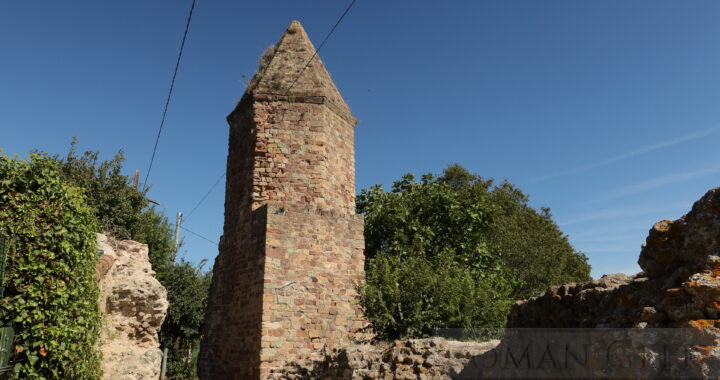
Lanterne d'Auguste, Frejus

Frejus Roman Lighthouse

  • Frejus Roman Lighthouse, also known as the Lanterne d’Auguste, is a hexagonal building that resembles a lighthouse, but is not in fact a lighthouse.
  • However, there were three Roman lighthouses at Frejus. One lighthouse was located on the Isle du lion de mer, an island in the bay, which guided vessels towards the harbour of Forum Julii. The other two lighthouses were located on either side of the harbour entrance to guided the vessels in.

Frejus

  • Frejus was known as Forum Julii to the Romans. The Town and harbour were founded sometime before 43 BCE.
  • It became the only Roman Naval Port in Southern Gaul under Augustus. After the Battle of Actium (31 BCE), he relocated to Frejus the galleys which he had taken from the the defeated fleet of Cleopatra and Mark Anthony.
  • Between 29-27 BCE, Augustus settled the veterans of the Legio VIII Augusta at Forum Julii.
  • Tiberius (14-37 CE) constructed an Aqueduct, Amphitheatre, Roman Baths, a Theatre and a Lighthouse. The walls are over 2 miles (3.7km) long.


Photo and Map: Lanterne d’Auguste, Frejus

Typhoon

Description

  • They develop over warm water, can have a diameter of between 60-1,240 miles (100-1100km) and are characterised by heavy rain and squalls with wind speeds between 64 – to over 140 knots.
  • There are almost no Cyclones south of Latitude 5° North, and they usually lose strength when they pass over land.

Northern Indian Ocean

  • Cyclones occur in the Northern Indian Ocean, east of the Horn of Africa and west of the Malay Peninsula.
  • This area divides into two main Seas, the Arabian Sea up to Sri Lanka, and the Bay of Bengal from Sri Lanka to the Malay Peninsular.

Cyclone Season

  • The Season varies, but usually operates between May to December, with the worst month for cyclones being November.
  • The direction of a cyclone varies, but tends to develop in the Bay of Bengal, and then track North, Northwest or West, occasionally turning unexpectedly. The cyclone usually makes landfall in Eastern India and Bangladesh, but they occasionally track across the Arabian Sea to Somalia and Socotra.

During the Age of Sail

Going East

  • Sailing ships used the South West Monsoon (May to September).
    • Aden to Sri Lanka, the Arabian Sea.
      • Sailing ships departed in July as there are no cyclones in the Arabian Sea during August.
      • They returned with the Northwest Monsoon in starting in October.
    • Sri Lanka to Singapore, the Bay of Bengal.
      • Sailing vessels had to leave Sri Lanka no later than early October to avoid the worst cyclone month of November. May or June being the best months to cross as cyclones are rare.
      • Calms can be encountered at any time of year.
      • In the event of encountering a cyclone, the vessel turned due south, as below Five Degrees Latitude North, there are no cyclones.
    • Singapore to Hong Kong, the South China Sea.
      • There is no safe month during the cyclone season of May to December. However, below the Five Degree Latitude North there are no cyclones. The best months to sail are May and June as destructive cyclones are rare. Sailing during January, February and March wa safe, but the vessel had to tack against the North Westerly Monsoon.

Going West

  • In the reverse direction, going West, sailing vessels used the Northeast Monsoon (October to March).


The Indian Ocean and the South China Sea

Flying Dutchman

  • The Flying Dutchman is a Ghost Ship in a popular myth about a ship that is condemned to sail the Seven Seas in perpetuity. The myth originated in Holland after it became a Sea Power in the sixteenth century CE.
  • The Flying Dutchman has been reported in sightings by sailors many times and has gone into folklore when sighted, as being a bad omen. Richard Wagner wrote an opera called the Flying Dutchman in 1843.

Origin of the Myth

  • The ‘Flying Dutchman’ was part of a Fleet of ships belonging to the Dutch East India Company, that sailed between the East Indies and the Netherlands with cargoes of spices and silk.
  • The Captain is alleged to have been Hendrik Van der Decken, who encountered a storm off the Cape of Good Hope, and instead of putting in to port, insisted on continuing the voyage, resulting in the ship being lost.
  • According to the legend, as punishment, the ship and its captain were condemned by the Devil to sail the Seven Seas for eternity.
  • However, the Devil gave him a chance of redemption by allowing him to come ashore once every seven years and redeem himself by searching for his one true love and achieve salvation through her.

Cape of Good Hope

  • Frequent sightings have been reported off the Cape of Good Hope in South Africa since the Myth began in the 1600’s.

Explanation by Optical Phenomena

  • Mirage
    • One explanation of the frequency of sightings is as an optical illusion known as a mirage. A ship appears either in the air with its reflection, or upside down in the air, long before it physically makes its appearance on the ocean.
    • A ‘thermal inversion’ will produce an optical phenomena. Air is usually warmer on the surface and cooler higher up. In calm weather, a layer of warm air lying over a layer of cold dense air, will bend light and act as a refracting lense. This produces both inverted and upright images.
  • Fata Morgana
    • In Italy, a mirage often sighted in the Strait of Messina is called a Fata Morgana, named after the Sorceress, Morgana le Fay, in the Legend of King Arthur. It can be seen over land as well as over the sea. The mirage consists of a distorted object or multiple objects one above the other, either stretched or compressed, seen just above the horizon. The image changes continuously.
  • Looming
    • This is not a mirage, as it does not produce multiple or inverted images, but makes the image appear larger and closer than it is.


Cape of Good Hope