Kasserine Dam

  • The Kasserine Dam (2nd century CE) was a Roman Gravity Arch Dam which provided water for Cillium (modern Kasserine in Tunisia.
  • It was located in the Roman Province of Africa Proconsularis.

Kasserine

  • Kasserine in Tunisia was the Roman city of Cillium or Cillilana.
  • The Ruins of Cillium include a Basilica, Baths, Theatre, Triumphal Arches and Mausoleums.

Kasserine Pass

  • The Kasserine Pass is a 2 mile (3.2km) long Pass through the Atlas Mountains, which controls the road to Constantine (Cirta) in Algeria.
  • A major Battle was fought here in WWII between the Allied Army and the German Army.


Kasserine Dam, Tunisia

Glanum Dam

  • Built in c. 27 BCE, the Glanum Dam was the earliest known Roman Dam built in Gaul. It was an arched Dam.
  • It was located in Glanum Roman town next to Saint-Remy-de-Provence in the Provence-Alpes-Cotes d’Azur Region of southeastern France.

Description

  • It consisted of two stone 3 ft 4″ (1.02m) wide walls, built in a curve, with a 4ft 9″ (1.2m) gap between, thought to have been filled with rubble.
  • The Dam was 20 ft high (6m) and 11 ft (3.5m) thick.
  • The Dam blocked a gorge with steep sides. The water was carried via an aqueduct to Glanum, for its Fountains and Public Baths.
  • Today, a modern Dam has been built on the identical site, destroying the old Roman Dam.


Glanum Dam, St. Remy-de-Provence

Petra Pertusa

  • Petra Pertusa, also known as Passo del Furlo, means ‘Tunneled Rock’ and is a Roman Tunnel in Italy, which is still in use today.
  • It was built by Vespasian (69-79 CE) in the narrowest point of a mountain gorge on the Via Flaminia, 25 miles (40km) from the Adriatic.

Description

  • The 124 ft (38m) Tunnel was mentioned by Procopius and is marked by an inscription.
  • The gorge is in a Mountain Pass known as the Passo del Furlo. Vespasian built the Tunnel to allow the road to pass through a high wall of rock with a fast running river beside it, which was too dangerous to cross.
  • In 538 CE, it was the location of a Battle between Belisarius and the Goth Witigis.

Other Roman Tunnels


Petra Pertusa, Passo del Furlo

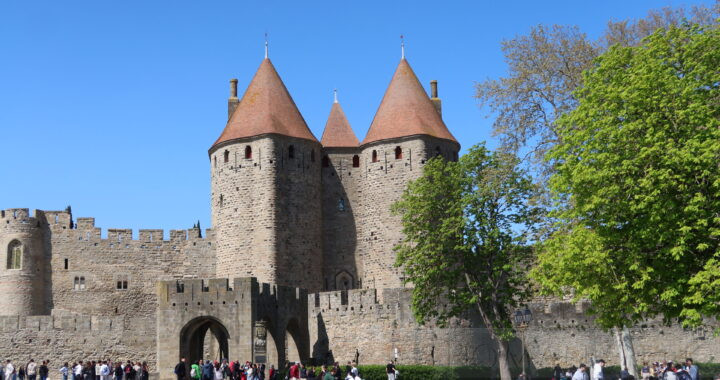
Carcassonne Old City

Carcassonne

  • Carcassonne Old City is a rare double-walled medieval city located on the River Aude in the Occitanie Region of southern France.
  • It has been a UNESCO World Heritage Site since 1997.

Museums

  • Carcassonne Castle (inside the Old City), holds two Museums:
    • The Archeological Museum: Holds artefacts from the Roman and Prehistoric periods.
    • The Museum of the Middle Ages: Holds artefacts and weapons from medieval Carcassonne.

History

  • The Medieval walled town was built on the ruins of the Roman city and fort, which now form the lower section of the northern ramparts.
  • Originally, it was the Oppidum of the Volcae Tectosages Gallic Tribe.
  • Under the Romans, it became the Roman town and fort of Carcasum, located on the Via Aquitania, in the Province of Gallia Narbonensis.

Roman Roads

Nearby Sites and Museums


Carcassonne Old City

Sarcophagus of Balbinus

  • Balbinus (238 CE) reigned as the Roman Emperor for three months during 238 CE. Despite this short time, he had a marble Sarcophagus made for himself and his wife.
  • It is the only Roman Imperial Sarcophagus to survive and is decorated with reliefs showing himself in military uniform beside his wife.

Getting There

  • Location: Via Appia Pignatelli, 11, Museo di Pretastato, Praetextatus Catacombs, Parc de la Caffarella, Rome.
  • Nearest Metro Station: Colli Albani, Line A.

Museum

  • The Sarcophagus is located in the Museo di Pretastato, Praetextatus Catacombs, Park of the Caffarella, Rome.

Balbinus


Museo di Pretastato, Park of Caffarella, Appian Way

Castra Praetoria

Getting There

  • Location: Viale del Polyclinico, Rome.
  • Nearest Metro Station: Castro Pretorio, Line B.

The Roman Site Today

  • The original Walls run along the Viale del Polyclinico.
    • The Metro station and city district are both named Castra Praetorio.
    • Sections of three of the four walls of the Castra Praetorio are still standing today, as they were incorporated into the Aurelian Walls.
    • However, the interior was demolished by Constantine I in 312 CE and is now occupied by modern buildings.
  • The Porta Praetoriana (Praetorian Gate)
    • This is a walled up gate that is visible opposite 129 Viale del Polyclinico.
  • The northeastern corner Tower
    • This is visible from the Piazza Girolamo Fabrizio.

History

  • The Castra Praetoria was the first building to use Opus Recticulatum, using concrete walls faced with Tuff.
  • The walls of the Castra were incorporated into the later Aurelian Walls between 270-275 CE.
  • It was eventually demolished by Constantine I in 312 CE.

Architecture

  • It was built in the shape of a rectangle with 16 towers which did not extend beyond the wall.
  • It probably had a gate on each side, although only the North and East Gate remain.
  • There was no ditch surrounding it.
  • The walls were built using Opus Recticulatum, which was Roman concrete, Opus Caementicium, filled with stones and then faced with brick or a volcanic stone called Tuff, producing a pattern.
  • It was one of the first structures to be built this way.
  • The interior of the walls supported a series of arches that supported a walkway along the top, and living quarters below.

Non-Standard Legionary Fortress Plan

  • Excavations have revealed that the interior was not based on the layout of the standard legionary fort.
  • The Fort was divided into five zones by four horizontal avenues across the north south axis.
  • Two rows of barracks extended from wall to wall.
  • Another two rows of very unusual two storey barracks are located in front of the east gate.
  • One estimate for the number of soldiers housed in the Castra is between 5,000 and 15,000.
  • No evidence of a Principium, Commanding Officer’s quarters, have been identified. This would suggest that the Praefectus Praetorio lived in the Imperial Palace, and conducted business from there.


Porta Praetoriana, Castra Praetoria

Pharos of Portus

History

  • An artificial island was built between the Moles of the Harbour in c.46 CE, under Claudius (41-54 CE).
  • It was was created by sinking one of the huge vessels that brought an Obelisk from Egypt to sit on the Spina of the Circus of Nero.
  • The Pharos of Portus was constructed on the artificial island between the moles.

Sources

  • Suetonius ‘The Twelve Caesars’
    • Book V, Claudius Chapter XX’
    • He recounts that the Pharos of Portus was built in imitation of the Pharos of Alexandria.


Portus

Temple of Isis at Philae

  • The Temple of Isis was erected on Philae Island in the Nile by the Pharoah Nectanebo I (c.370 BCE). Other Gods were worshipped here, such as Hathor. The Romans also continued adding Monuments, including Trajan's Kiosk.
  • The Temple visible today, was built by the Greek Ptolemies in third century BCE. It has now been moved to Agilkia Island after the Aswan Dam was completed.

Description

  • The Temple of Isis was built in the Ancient Egyptian style and decorated inside with Hieroglyphs depicting scenes with Osiris and Isis. Both priests and priestesses lived in the temple to conduct daily worship, and take care of Pilgrims.
  • Despite the Edict of Thessalonica issued by Theodosius in 380 CE, ending the worship of the Ancient Egyptian Religion and the use of Hieroglyphics, the Temple continued with its own priesthood acting as a place of worship and preserving the Hieroglyphic tradition until the time of Justinian (527-565 CE). It was the last Temple of Isis to survive from the Classical World.

Philae Island

  • Philae is the larger of two islands on the river Nile in Egypt, located just before the First Cataract.
  • Philae has steep sides and was surrounded by a defensive wall at the top.
  • Bigeh is the smaller island, and was considered to be the burial place of Osiris. Pilgrims visited the island to see his tomb.

Pilgrims

  • Pilgrims made the journey up the Nile to worship at Philae, throughout the Classical antiquity. After the Ancient Egyptians, came the Greeks, followed by the Romans. The Nubians also came upriver to worship at the Temple.
  • Philae Island was a tourist destination for Roman Pilgrims to see the Temples on the Roman Grand Tour.
  • One Roman left Graffiti on the wall of the Temple of Isis at Philae Island that states: ‘I.L. Trebonius Oricula was here’.

Garrison

  • There was also a protective garrison on the island, as it was the last defensive frontier with Nubia.
  • The Island was a warehouse for trade between Egypt and Nubia. The Goods from Nubia were stored here and also at Syene, for onward transfer to Memphis, or in the opposite direction to Meroe in Nubia.


Temple of Isis at Philae (now on Agilkia Island)

Trajan’s Parthian War

  • The Emperor Trajan made careful preparations to invade Parthia between 111-114 CE.
  • In 115 CE, he invaded and captured the Parthian capital, Ctesiphon and added Mesopotamia as a Roman Province. This expanded the Roman Empire to its greatest extent in its history.

The Reason for the War

Preparations for the War with Parthia (111-114 CE)

  • Letters between Pliny the Younger and Trajan show that Trajan had already been preparing and provisioning ten Legions in the East as early as 111 CE, although no new Legions were created for this War.
  • In 112 CE he promoted the future Emperor, Hadrian, Commander in the East, based at Antioch in Syria.
  • For 50 years the Roman and Parthian Empires had shared appointing the Kings of Armenia.
  • In 113 CE, when Parthia didn’t consult Trajan, and appointed their own choice of King, Trajan declared War.
  • This was to make Trajan, the first Roman Emperor to invade Parthia.

The Invasion of Armenia (114 CE)

  • In 114 CE, Trajan collected the Eastern Legions as he moved out of Antioch, he was joined by an additional 2 Legions from the Danube, and various Vexillatios from other Legions, giving him around 80,000 men.
  • Trajan then invaded Armenia, the eastern part of modern Turkey, where he replaced the Parthian appointed King.
  • Trajan continued the campaign and the surrounding Kingdoms fell or surrendered to the Roman Armies.
  • Trajan’s strategy was to be a pincer movement launched from Armenia:
    1. One Roman Army was to go north under Lucius Quietus, across the River Araxes from Armenia, and invade the area between the Caspian Sea and the Caucasus. This would divide the Persian Army.
    2. Trajan then split the remaining Legions into two groups.

The Invasion of Mesopotamia (115 CE)

  • In 115 CE Trajan invaded Mesopotamia:
  • One army headed east and then down towards Babylon.
  • Whilst Trajan, starting from Dura Europos on the Euphrates, had a fleet of 50 ships built. These he sailed down the Euphrates.
  • Trajan then portaged (hauled) his ships over a 20 mile strip of land between the Euphrates and the Tigris.
  • Once on the Tigris, he captured Seleucia and the Parthian capital Ctesiphon.
  • Continuing down the river, he took Charax on the Persian Gulf, his fleet surviving a Tidal Bore.
  • Here he stopped, having left small garrisons of soldiers to control the occupied territory.
  • Interestingly, he sent a letter to the Roman Senate apologising for not carrying on and invading India, as Alexander the Great had done.
  • Trajan did not attempt to pursue the Parthian Army who had withdrawn beyond the Kushan Mountains into the Iranian Plateau.

The Roman Empire reaches its greatest extent (116 CE)

Rebellions force Trajan to withdraw the Legions from Mesopotamia (115 CE)

  • In 115 CE, a major Rebellion called the Kitos War, erupted, which forced Trajan to withdraw the Legions from Mesopotamia, and back to Syria.
  • Uprisings started to occur, not only in the conquered territories, but also in Egypt, Judaea and Cyrenaica.
  • The Legions were withdrawn from occupied Parthia, and dispersed to quell the various Rebellions.

The Death of Trajan (117 CE)

  • Already unwell, Trajan fell seriously ill on the return journey to Rome whilst sailing past Turkey.
  • He died in the port of Selinus, Turkey, and his body was brought back to Rome.

The Outcome

  • Trajan’s successor Hadrian, adopted a Policy of Deterrence instead of War and the Roman dream of repeating Alexander the Great‘s domination of the East was over.
  • In 121 CE, Hadrian negotiated a Peace Treaty with Parthia that prevented further conflict.
  • Hadrian decided to avoid the huge expense of warfare, and not to conduct any wars during the next 21 years of his reign.
  • Instead, Hadrian, adopted a policy of Deterrence, reinforcing every Frontier with well defended Walls or Limes. He insisted each Legion was constantly training for warfare.


Ctesiphon, Iraq

Trajan’s Forum

  • Trajan’s Forum was a monumental combination of open and enclosed spaces to celebrate the victory in the Dacian Wars which ended in 106 CE.
  • The architect Apollodorus of Damascus supervised its construction between 105-107 CE, and the inauguration took place in 112 CE, with Trajan's Column being inaugurated a year later in 113 CE. It held Trajan's Market.

Trajan’s Monuments in Rome

  • Trajan's Market
    • This was a monumental complex of shops and offices.
  • Trajan’s Column
    • This was inaugurated a year later in 113 CE.
  • Basilica Ulpia.
  • Arch of Trajan.
  • Temple of Trajan (not confirmed).
  • Two Libraries.
  • An Equestrian statue of Hadrian, set in the Atrium.


Trajan’s Forum