
Osrhoene

1. History

  • Pre-Roman history:
    • Known as Osrhoene or Edessa (modern Urfa, Turkey) after its capital, Edessa.
    • It was part of the Greek Seleucid Empire (312-63 BCE) until 136 BCE.
    • Between 132 BCE – 244 CE, the Kingdom of Osrhoene existed as an independent Kingdom ruled by the Abgarid Dynasty of Arab Nabatean descent, some had Nabatean names whilst others had Persian names .
  • Acquisition by Rome:
  • Timeline of this Province:
  • After Diocletian’s Reforms (297 CE):
    • Osrhoene came under the Diocese of Oriens.
  • After Death of Theodosius (395 CE):
  • Famous Persons from this Province:
  • Chief archeological Finds:
    • Edessa (modern Urfa, Turkey).
  • Historic Battle Sites:
  • Main Historical Sources for this Province:

2. Geography

  • Capital City:
  • Chief Cities:
  • Location Today:
    • Southeastern Turkey and eastern Syria, the Euphrates formed it’s western border.
    • A tributary, the Khabur, formed the eastern border, and Frontier with Persia.
  • Neighbouring Roman Provinces:
  • Climate and Temperature Today:
  • Main Rivers:
  • Mountain Ranges:
  • Islands:

3. Political Organisation

  • Imperial/ Senatorial Province
    • Imperial
  • Praefect/ Procurator/ Legate List:
  • Tribes and Population:
  • Language:
    • Syriac

4. Military Organisation

  • Legions:
  • Navy:
  • Defensive Works:
  • Main Threats:

5. Economy

  • Chief Exports:
  • Agriculture and Fishing:
  • Manufacturing:
  • Mines:
  • Mints:

6. Transport

  • Roads:
  • Waterways:
  • Ports:
  • Ancient Trade Routes:
  • Number of Days taken to travel from this Province to Rome:

7. Relationship with Rome

  • Osrhoene was a Buffer State between the Roman Empire and the Persian Empire, having frontiers with both.

8. History of Christianity in this Province

  • Osrhoene had a long history of Christianity, starting with King Abgar IX (179-186 CE), who was the first Christian King of Edessa.


Osrohene (Edessa) (Sanliurfa), Turkey)
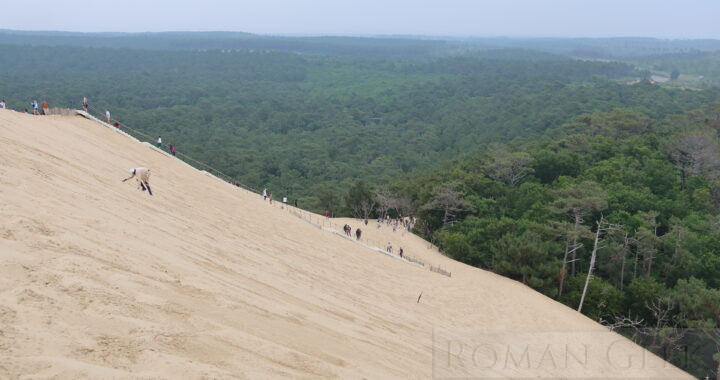
Dune du Pilat, Bassin D'Arcachon

Dune du Pilat

  • The Dune du Pilat is Europe’s biggest Sand dune at over 328 feet (100m) high.
  • It is located on the Atlantic coast, near the bassin D’Arcachon, west of Bordeaux in France. The Dune was formed around 2,000 BCE, by sand being blown off the beach by westerly winds and on to the forest.

Click to see a list of Sand Dunes


Dune du Pilat, Parking

Sanctuary of Apollo at Delos

  • The Sanctuary of Delos is considered to be the birthplace of the twin Gods Apollo and Artemis. The Sanctuary consisted of three Temples to Apollo built between 575-390 BCE.
  • It is located on the island of Delos which has been a Unesco World Heritage Site since 1990. The whole Island is an Archeological site which holds many Remains, as well as the Ruins of the Three Temples of Apollo.

The Three Temples of Apollo

  • The First Temple of Apollo (c. 575 BCE)
    • This was constructed by the Athenians and was known as the Porinos Naos.
  • The Second Temple of Apollo (417 BCE)
    • This Temple was also built and dedicated by the Athenians and was known as the Oikos (House) of the Seven. It held seven statues including one of Apollo.
  • The Third Temple of Apollo (c.390 BCE)
    • This was known as the ‘Temple of the Delians’, and was the greatest of the three Temples dedicated to Apollo.
    • It was founded in 478 BCE, but only completed c. 390 BCE.

Archeological Museum of Delos

  • Located on the island, the museum holds a Collection of Statues, Pottery, Jewelry, Frescos and Mosaics, which were excavated from Delos.

National Archeological Museum of Athens

  • Many of the Artefacts excavated from Delos are also held in the National Archeology Museum of Athens.


Delos

Erg of Bilma

  • The Erg of Bilma is a Sand Sea in the Fezzan area of the Sahara, which is located in modern Niger.
  • It had to be crossed by Camel Caravans until recent times.

Description

  • The Erg of Bilma covers an area of 176,000 square miles (455,000 square km). It lies below Libya, between the southern Sahara and the Sahel.
  • The Kaouar Cliffs protect a chain of ten oases from the Sand dunes. They run north-south for 150 miles (241km), ending in the Bilma Oasis.
  • The Bilma oasis is the last oasis before reaching the Sahel.

Garamantes


The Erg of Bilma, Niger

Crossing of the Red Sea

  • The Crossing of the Red Sea is an Event in The Bible which occurred when Moses led the Israelites out of Egypt. The location is unknown.
  • The story is told in Chapter 14 of Exodus in the The Bible.

The Story

  • After the Ten Plagues of Egypt, the Pharaoh finally commanded Moses to take the Israelites out of Egypt, which became known as the Exodus.
  • Moses led the Exodus guided by a Pillar of smoke by day and a pillar of fire by night, until they reached the Red Sea. At this point the Pharaoh changed his mind and pursued Moses with a chariot army.
  • Moses was instructed by God to hold out his rod over the Red Sea which made an easterly wind blow all night creating a dry crossing passage between two walls of water. During the night, the Israelites passed through the walls of water and safely reached the other side.
  • At dawn, the Pharaoh and his chariot army appeared and attempted to pass through the same passage. At this point the wind abated, the walls of water collapsed and the Pharaoh and his chariot army were engulfed by water and destroyed.
  • Freed from their captivity, Moses and the Israelites continued on their way to the Promised Land.

The Location

  • The location remains unknown but is generally considered to be the Gulf of Suez.
  • Gulf of Suez
    • The Gulf averages 130 feet (40m) depth, maximum 230 feet (70m) depth.
    • Northwesterly winds regularly depress the water level along the beaches.
    • It has been suggested that an exceptional wind could leave a reef exposed and create a crossing.


Gulf of Suez, The Red Sea

Baobab Tree

  • The Baobab Tree, or Adansonia, is a deciduous tree which grows in arid areas and stores water in its trunk. It sheds its leaves in the dry season.
  • The tree is also known as the ‘Upside down tree’, because without its leaves, the branches resemble the roots.

Description

  • The Tree grows in Madagascar, Africa, the Arabian Peninsular and Australia.
  • The Baobab can grow to a height of almost 100 ft (30m) with a diameter of 52 ft (16m).
  • The age of some Baobab trees has been estimated at over 2,000 years old.
  • Baobab trees are mysteriously dying off, possibly due to persistent droughts as a result of climate change.


Madagascar

Shatt al-Arab

  • The Shatt al-Arab is a Tidal River part of which forms the Border between Iraq and Iran, and extends for 120 miles (200 km) inland from the Persian Gulf,
  • Three rivers and the Mesopotamian Marshes all drain out through the Shatt al-Arab.

Mesopotamian Marshes

  • This is a vast floodplain formed by the confluence of the Tigris, the Euphrates and the Karen River from Iran.
  • It consists of enormous lakes, huge marshes and forests in a sub-tropical climate.
  • The Marshes are divided into three Regions, the Quma Marshes (mostly drained today), the Howizeh Marshes and the Hammar Marshes (also mostly drained since 1990).
  • The Karen River joins the Waterway from Iran, bringing an enormous quantity of silt which requires constant dredging for ocean going vessels to reach Basra, Iraq’s main Port.

The Marsh Arabs

  • The Shatt al-Arab flows through the Mesopotamian Marshlands where the Marsh Arabs have lived since at least the ninth century CE.
  • The Marsh Arabs live in Reed houses which can only be reached by boat.
  • They may be the descendants of the Sumerian Empire, in which case their origins date back to 3,000 BCE.

Date Palm Forests

  • The Region holds one of the largest Date Palm Forests in the world and attracts migrating water birds who spend the winters there.


Shatt al-Arab River

Centumcellae

  • Centumcellae was a major commercial and naval port built by Trajan in 106 CE to serve Rome.
  • It is now the deep water harbour of Civitaveccia located 37 miles (60km) northwest of Rome.

Museums

  • National Archeological Museum of Civitavecchia
    • The Museum holds Artefacts from the Port, as well as a detailed Plan of Trajan’s Harbour.

The Harbour of Trajan

  • Rome was at the height of its commercial power under Trajan, who decided Rome required another giant harbour to complement Portus.
  • The harbour was first described by Pliny the Younger (61-112 CE), who stayed in Trajan’s villa which overlooked the construction of the Port.
  • The harbour was built in the shape of an Amphitheatre with a curved breakwater to the south and a fortress on the end.
  • There was a straight breakwater to the north, perforated by tunnels designed to reduce the oscillation of the waves, also with a fortress on the end.
  • An artificial island, built from the material excavated in the harbour, acted as an offshore wall. On it were two forts and a Lighthouse.
  • It had a permanent depth of 20 feet (6m) making it an all year round harbour.
  • The Port had an impressive complex of Temples, Colonnades, Statues and Columns.

Vecchia Darsena

  • Trajan ordered the construction of an inner harbour, the Vecchia Darsena, which still exists today as part of the old harbour of Civitaveccia.

Naval Base

  • During the 2nd and 3rd century CE, the Roman Navy had a base at Centumcellae which accommodated war galleys.
  • Gravestones found nearby attest to sailors in Biremes, Triremes and Quadiremes being based here from both the Imperial Fleets at Ravenna and Misenum.

Pharos of Centumcellae

  • The Lighthouse was situated on an artificial island between two giant moles that protected the entrance to the harbour of Centumcellae. It is no longer in existence.

Termae Taurine

  • These were the Baths of Trajan located 2 miles (3km) northeast of Civitaveccia, which were served by nearby Hot Springs.

Roman Roads

  • Via Aurelia
    • Rome-Alsium-Centumcellae-Vada Volaterrana-Pisa


Darsena Romana, Centumcellae, Civitavecchia

Hannibal’s Crossing of the Alps

The March to the Alps

  • As Rome controlled the seas between Carthage and Italy, Hannibal was unable to land his army in Italy by sea.
  • He therefore decided to march his army through Iberia and invade Italy from the north.
  • He began with the siege of Saguntum near Valencia in 219 BCE.
  • Saguntum was loyal to Rome, and when Hannibal sacked Sagunto and enslaved the population, Rome declared war on Carthage, which began the Second Punic War (218-202 BCE).
  • Hannibal then divided his army into three divisions and rapidly crossed the Ebro, into territory of Roman influence, in order to reach Gaul.
  • Although a fleet of 60 ships was despatched to Spain, the Roman army was too slow to intercept Hannibal.
  • This enabled him to pass over the Pyrenees without meeting Roman opposition, and head towards the Rhone.
  • By successfully defeating the Cavates tribe who were blocking the river crossing, Hannibal was able to move his army across the Rhone, and climb the Alps in October.

Crossing the Alps

  • The crossing took place in October, the month where major snowfalls can block the higher Passes but leave some lower Passes still open.
  • Hannibal allied himself with the Centrones Tribe who lived in the area of the Little Saint Bernard Pass, but as they reached the chosen Pass, the Centrones attacked and Hannibal’s army had to fight to get through. After successfully defeating the Centrones, they rested for three days.
  • Historians remain divided about which Mountain Pass Hannibal used. The contested options are:
    1. Mont Cenis Pass Elevation 11,850 ft (3,612m) (The highest, closing earlier than the other Passes)
    2. Col de la Traversette Elevation 9,669 ft (2,947m)
    3. Col de Clapier Elevation 8,125 ft (2,477m)
    4. Roman Great St. Bernard Pass Elevation 8,100 feet (2,469m) (Napoleon used this Pass in 1800 CE)
    5. Little St. Bernard Pass. Elevation 7,178 ft (2,188m)
    6. Mont Genevre Pass Elevation 6,083 ft (1,854m) (The lowest, remaining open longer than the higher Passes)
  • Finally, despite the steep descent, Hannibal made a path for his army to march down out of the Pass. After three days of marching, his army, reduced in size but still intact, camped near Ivrea in Italy.

Surus

  • The last surviving War Elephant was named ‘Surus’, meaning ‘the Syrian’, as narrated by Plautus (254-184 BCE).
  • Surus may have carried Hannibal on a seat on his back.

Sources


Mont Genevre Pass (Possible Route)

Castra Peregrinorum

  • The Castra Peregrinorum meant ‘Fort of the Provincials’. Peregrini meant a Provincial.
  • The barracks were located on the Caelian Hill, and the Ruins were found just next to the church of San Stefano al Monte Celio.

Description

  • It was a military barracks shared between the ‘Peregrini’ and the Frumentarii.
  • The barracks were possibly constructed as early as Augustus (30 BCE – 14 CE), but definitely by the reign of Trajan (98-117 CE).
  • After c.180 CE, a Mithraeum was constructed out of existing chambers.

Origin and Role of the Soldiers

  • The Peregrini were ex soldiers who had served in the Provinces, now based in Rome but operating in all the Provinces that had no Legions.
  • The Frumentarii were also ex soldiers from the Provinces, now based in Rome, initially to organise the supplies, in particular, grain, for the Legions in the Provinces.

Headquarters of the Frumentarii

  • Under Hadrian, the Frumentarii were reorganised to run messages, make reports and undertake special duties. They were a separate organisation to the Praetorian Guard. The Frumentarii remained in uniform.
  • Information flowed in to the Castra Peregrinorum from all over Italy and the Empire.
  • Despite the name ‘Peregrini’ meaning ‘Provincial’, the soldiers were Roman Citizens.

Command Hierarchy

  1. Princeps Peregrinorum
    • This was the Camp Commandant mentioned by Ammianus Marcellinus in the fourth century CE.
    • An earlier Inscription mentioning his title was also discovered dating to the reign of Trajan (98-117 CE).
  2. Sub Princeps Peregrinorum
    • his second in command.
  3. Optio Peregrinorum
    • a junior officer.
  4. Centurio Frumentarius
    • an ordinary officer.


Santo Stefano al Monte Celio, Rome