Bucephalus

  • Bucephalus (355-326 BCE) was the most famous horse in the Ancient World and belonged to Alexander the Great.

History

  • Bucephalus was described as a massive horse with a massive head. He was Black with a white star on his forehead.
  • His name means, ‘Ox’ ‘Head’ derived from a brand mark on his rear.
    Plutarch related that the horse was untameable but was made a gift to Alexander at the age of 13 when he met him for the first time, and he tamed him.
  • A mythical bond of Immortality formed between Bucephalus and Alexander. Bucephalus was born with a mutation which gave him more toes than an ordinary horse, giving him mythical status. Alexander believed he himself was descended from Achilles through his mother.

Battle of Hydaspes (326 BCE)

  • Bucephalus died after the Battle of Hydaspes in 326 BCE.
  • Alexander buried him in a great tomb and founded the town of Alexandria Bucephala on the right hand side of the Jhelum River.
  • Its location today is unknown, although it may have been near the modern city of Jhelum, Pakistan.

Other Great Horses

  • Asturcus or Genitor
    • Julius Caesar had a favourite horse called Asturcus or Genitor.
  • Incitatus


Jhelum, Pakistan

Moselle

  • The Moselle River flows through France, Luxembourg and Germany where it joins the Rhine at Koblenz.

Gallia Belgica

  • The Moselle was situated in the Roman Province of Gallia Belgica and was known as the ‘Mosella’.
  • Part of Belgium is also drained by the Sauer and the Our, which are tributary rivers to the Moselle.
  • The major Roman cities on the Moselle were Trier and Koblenz.

In Roman Sources

  • Tacitus
    • In 117 CE, Tacitus mentions the Moselle in his Annals, Book XIII.
  • Ausonius
    • In 371 CE, Ausonius wrote about it in a poem entitled ‘Mosella’.
    • Ausonius describes the journey from Bingen to Trier

Other Major European Rivers:


Moselle

Battle of Cape Bon

  • At the Battle of Cape Bon (468 CE), Anthemius, Emperor of the Western Roman Empire, and Leo I, Emperor of the Eastern Roman Empire, combined forces to attack the Vandal King, Geiseric, and invade the Capital of the Vandal Kingdom at Carthage.

The Reason for the Battle

  • It was a last attempt by the combined forces of the Eastern and Western Empire to dislodge the Vandals from North Africa and save the Western Roman Empire.

The Battle

  • It was one of the  Classical World’s greatest military amphibious operations, with 1,113 vessels (Cedrenus) and 50,000 men. Various writers recorded the Battle including Procopius, who estimated 100,000 men.
  • The Commander Basilicus anchored off Cape Bon, 40 miles (64km) from Carthage, whereupon Gaiseric, requested 5 days grace to present a Peace Treaty.
  • However, Gaiseric created a fleet of fireships which were launched at the anchored Roman Fleet, and as ships tried to escape they were attacked by the Vandal Fleet. Half the Roman Fleet was lost along with 10,000 Roman soldiers, Basilicus fled with the other half.

The Outcome

  • It was the last attempt to save the Western Roman Empire which fell in 476 CE.
  • The Reconquest of North Africa was finally achieved by the Roman Empire in the East under General Belisarius in 533 CE.


Cape Bon, Tunisia

Wakhan Corridor

  • The Wakhan Corridor lies in northeastern Afghanistan and connects Afghanistan with China through the Hindu Kush Mountains.
  • At the eastern end of the corridor lies the Wakhjir Pass.

Description

  • The Corridor is 220 miles (354km) long and between 8-40 miles (12-64km) wide, along which the Panj and Pamir rivers merge to form the Amu Darya or River Oxus.
  • The Wakhan Corridor formed part of the Silk Road which connected China with India through Afghanistan and the Khyber Pass.


Wakhan Corridor, Afghanistan

Capitoline Museums

  • The Capitoline Museums are a Group of Art and Archeological Museums located on top of the Capitoline Hill in Rome, Italy.
  • There are three main buildings linked by an underground gallery.

Notable Exhibits

  • The Dying Gaul
    • also known as the Capitoline Gaul (2nd century BCE)
  • The Bronze Equestrian Statue of Marcus Aurelius (161-180 CE)
  • The Inscription to Duilius
    • Made by Augustus between 30-1 BCE, it records Duilius’ naval victory of 31 captured galleys at the Battle of Mylae in 260 BCE.
  • The Marble Statue of the Capitoline Venus (2nd century CE)
  • The Lupa Capitolina
    • Bronze statue of the she-wolf suckling Romulus and Remus (c. 500 BCE or 11th century CE)
  • Boy with a Thorn (Bronze statue c. 1 CE)
  • The Capitoline Brutus
    • A Bronze bust thought to be of the Roman consul Lucius Junius Brutus (d,509 BCE) (dated to 4th-2nd century BCE)

Other Museums of Rome

  • Vatican Museums
    • The Vatican Museums are located in the Vatican City, Rome.
    • The collection includes Roman Art and Renaissance Art and contains 70,000 works of which 20,000 are on display.
  • National Roman Museum
    • The National Roman Museum has four locations in the city of Rome and is dedicated to the history of Ancient Rome: the Palazzo Massimo alle terme, the Palazzo Altemps, the Crypta Balbi and the Baths of Diocletian.


  • Capitoline Museums, Rome

Aqua Anio Vetus

Getting There

  • Location: Via de Porta S. Lorenzo, Rome.
  • Nearest Metro Station: Termini, Line A, Line B.

The 11 Aqueducts of Ancient Rome

Cloaca Maxima

  • The Cloaca Maxima was the Sewer of Ancient Rome, through which all the used water from the aqueducts flowed into the River Tiber.

Sources

  • Frontinus:
    • ‘De Aquaeductu’, ‘The Aqueducts of Ancient Rome’, (c.95-99 CE).
  • Vitruvius:
    • De Architectura (c.15 BCE)  It includes a general section on Aqueducts.


Tower of Babel

  • The Tower of Babel is a story from The Bible explaining the origin of all the world’s languages.
  • The Tower was built by the Babylonians and designed to reach into heaven.

The Story

  • In the first Book of the Bible, Genesis, Chapter 11, verses 1-9, tells the story of the Tower of Babel.
  • After The Flood, the descendants of the survivors migrated to ‘Shinar’ meaning Mesopotamia.
  • Here they decided to build a city with a tower that would reach into heaven.
  • However, God did not approve of their project. He sent them into confusion, so that they were unable to understand each other, and were scattered over the Earth.

Possible Location based on Etymology

  • The Great Ziggurat of Babylon has been suggested as the Tower of Babel. It was dedicated to Marduk, the Lord of all the Gods in Babylon.
  • The Bible does not refer to a ‘Tower of Babel’. The narrative states that the people set out to build ‘a city and a tower…and that it was called Babel’. In Hebrew, the city of Babylon was called ‘Babel’ because it meant ‘to confuse’.
  • Books 1-11 of Genesis are considered to have been written during the Babylonian Exile (587-538 BCE).
  • The Great Ziggurat of Babylon had already been built around 610 BCE, and therefore, the Ziggurat may have influenced the authors of Genesis.


Babylon

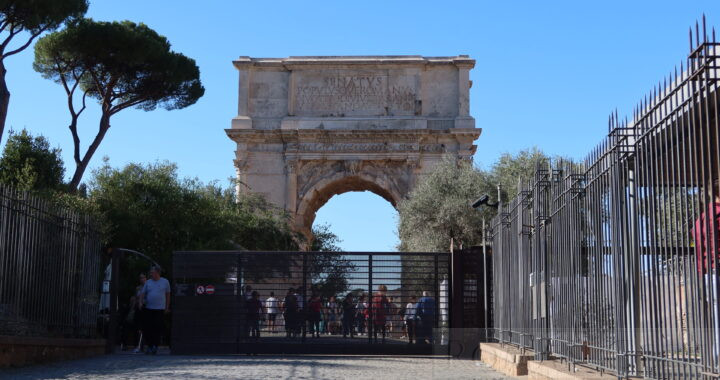
Arch of Titus, Rome

Arch of Titus

Description


Photo and Map: Arch of Titus

Crypta Neapolitana

Virgil's Tomb

  • Virgil was a Roman Poet (70-19 BCE) who lived during the reign of Augustus.
  • A Monument erected in his memory is located in Piedigrotta, Naples at the entrance of the Crypta Neapolitana.
  • Virgil died in Brindisi but asked for his ashes to be buried in his villa near Naples. Although the ashes have been lost, the monument to his memory remains, known as ‘Virgil’s Tomb’.

Via Domitiana

  • Naples-Crypta Neapolitana Tunnel-Pozzuoli-Cumae Tunnel-Formiae (where it joined the Via Appia)

Aqua Augusta

  • This Aqueduct ran in tunnels for a great part of its journey from  its source through seven cities to Misenum.
  • It ran in a tunnel in parallel to the Crypta Neapolitana road tunnel.

The Tunnel at Cumae (closed)

  • Another road tunnel was built for the Via Domitiana at nearby Cumae, which is 958 ft (292 m) long and oriented east to west.
  • It is not open to the Public.

Other Roman Tunnels


Virgil’s Tomb

Battle of the Allia

  • The Battle of the Allia (18th July 390 BCE) took place during the Gallic invasion of Italy by Brennus or Brennius, Chieftain of the Senones, and the Roman Republic.

Date and Location

  • On 18th July 390 BCE, the battle took place at the confluence of the River Allia and river Tiber, 11 miles (18km) north of Rome.

The Adversaries

  • The Gauls
    • versus:
  • The Roman Republic

The Commanders

  • Brennus, Chieftain of the Senones
    • versus:
  • Six unknown Tribunes

The Strength of the Forces under the Roman Republic

  • Between 15-24,000

The Strength of the Forces under Brennus

  • Between 12-40,000

How the Armies were Deployed

  • The Gallic Army marched towards Rome then when they saw the Roman Army, they spread out in a line with their right wing on the bank of the Tiber, whilst their camp was established on a hill.
  • The Roman Army had been unprepared and was caught by surprise whilst still in Rome. They had rushed to meet the Gauls, intercepting them 11 miles (18km) from Rome beside the Tiber.

How the Battle was fought

  • The Roman Army lined up in front of the Gallic Army, but when they extended their wings, the centre became dangerously thin and vulnerable.
  • The Romans sent their weaker reserves to wait on a hill on their right flank.
  • Brennus immediately sent an experienced detachment to dislodge the reserves from their hill, thinking that they were positioning to attack his force from the rear. The Roman reserves were easily routed.
  • At this point panic seized the rest of the Roman Army. The Left wing gave up and ran to the Tiber, whilst the Gauls pursued them and massacred those on the bank. The surviving Roman soldiers jumped into the river and fled to the Etruscan city of Veii.
  • The Right Wing of the Army ran back to Rome.
  • The battle led to a total rout of the Roman Republican Army, the majority of whom fled into the territory of the Veii,
  • The Gauls were stunned by how easy their victory had been and marched on to Rome, first spending the night by the river Anio.

The Sack of Rome

  • Rome had no defensive wall, so the following day the Gauls occupied the empty city of Rome.
  • The population had been forced to flee to the nearby town of Caere, whilst the surviving soldiers had retreated to the fortress on the Capitoline Hill, intending to hold out there.
  • The Gauls then plundered the city.

Marcus Furious Camillus (446-365 BCE)

  • The Senate then made the exiled Roman General, Marcus Furious Camillus (446-365 BCE), Dictator. He was able to raise an army of 12,000 men and marched on Rome.
  • Camillus fought the war in the streets of Rome until the Gauls all fled.

The Outcome

  • To cope with continued wars and the threat of rebellion by the Plebeians, Camillus was made Dictator five times until 367 BCE, which was one of the Republic’s longest Dictatorships.
  • Rome’s first defensive wall, the Servian Wall was built soon after the attack.

Sources


River Tiber, approximately 11 miles north of Rome