Augsburg

  • Augsburg is a cathedral city that lies on three rivers, the Lech, the Wertach and the Singold, and is located in the State of Bavaria in southeastern Germany.
  • It was founded in 15 BCE as a Legionary Fortress and named ‘Augusta Vindelicorum’, meaning ‘Augusta of the Vindelici’, becoming the capital of the Province of Raetia in 120 CE.

History

  • Augsburg was founded by Drusus and Tiberius as a Legionary Camp in 15 BCE.
  • It remained part of the Roman Empire until after 400 CE.
  • Because of its direct link to Italy, and its position between the Rhine and the Danube, Augsburg held a position of great strategic, military and economic importance.

Legions

Roman Sites

  • Romische Grabungsstatte
    • Located in Peutingerstrasse, Augsburg, this Roman excavation site displays various Roman ruins.
  • Archeological Garden
    • Located at Auszere Pfaffengasschen 9, Augsburg, near the cathedral and displays information boards explaining the excavated Roman Ruins.

Museums

  • Augsburg Roman Museum
    • Located at Zeugplatz 4, Augsburg.
    • The museum holds 10,000 Artefacts excavated from the Roman Fort and City.
    • Amongst the items on display are a bronze horse head, coin hoards, tombstones, altars, glass vessels, ceramic vessels, jewellery and many military items.

Roman Roads


Augsburg, Germany


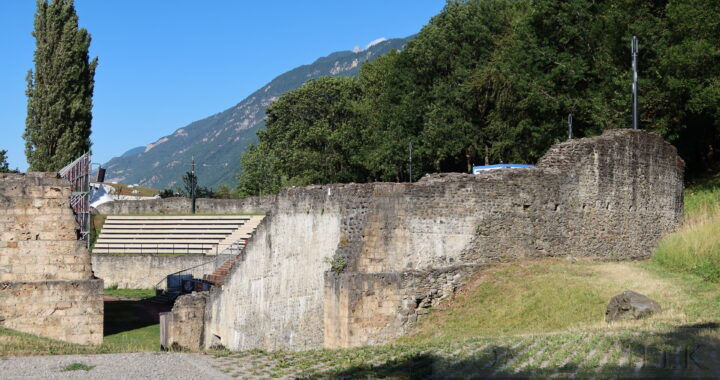
Martigny Roman Amphitheatre

Martigny

  • Martigny is a city and capital of the district of Martigny in the Canton of Valais in Switzerland.
  • It has an elevation of 1,545 ft (471m) and is on the road to the Great St. Bernard Pass.

History

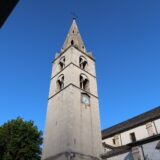
Church of our Lady of the Visitation, Martigny

Church of our Lady of the Visitation, Martigny

Roman Sites

  • Amphitheatre
  • Temples
  • Thermal Baths
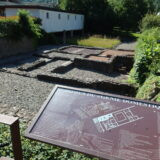
Domus of the Household Genius, Martigny

Domus of the Household Genius, Martigny

Museums

  • Musee Gallo Romaine
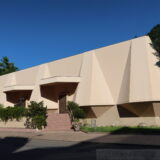
Fondation Pierre Gianadda Museum, Martigny

Fondation Pierre Gianadda Museum, Martigny

Roman Roads


Roman Amphitheatre, Martigny

Izmit

  • Izmit is a port city located on the southern coast of the Sea of Marmara, and is the capital of the Kocaeli Pronce in northwestern Turkey. It was known in Classical Antiquity as Nicomedia.
  • It became part of the Roman empire in 74 BCE and was the capital of the Province of Bithynia.

History

  • It was an important City located opposite nearby Byzantium, on a crossroads of Trade Routes between East and West.
  • Nicomedia briefly became the capital of the Eastern Roman Empire between 283-330 CE under the Reforms by Diocletian.
  • Constantine I continued to use Nicomedia as the Capital of the Eastern Roman Empire between 324-330 CE, until Byzantium was ready to become the new capital.

Roman Sites

Museums

  • Kocaeli Museum
    • The Museum is also known as the Kocaeli Archeology and Ethnography Museum or the Izmit Museum.
    • It is located at Demiryolu Caddedi, Kemalpasa, Kocaeli.
    • The museum holds Finds from the Hellenistic, Roman and Byzantine Periods.

Roman Roads


Nicomedia (Izmit), Turkey

Knossos

  • Knossos (1900-1400 BCE) was the major city of the Minoan Civilisation (2700-1420 BCE) and its Royal Palace was the largest. It was abandoned between 1380-1100 BCE.
  • The Ruins are located 3 miles (5 km) east of Heraklion in Crete. Historians are undecided whether Knossos was the capital city of Crete or whether the major cities were all independent. Knossos had no defensive walls, nor was there a weapons arsenal.

Other Minoan Sites

  • There are other Minoan City and Palace Sites in Malia, Phaistos and Zakros.


Knossos Palace

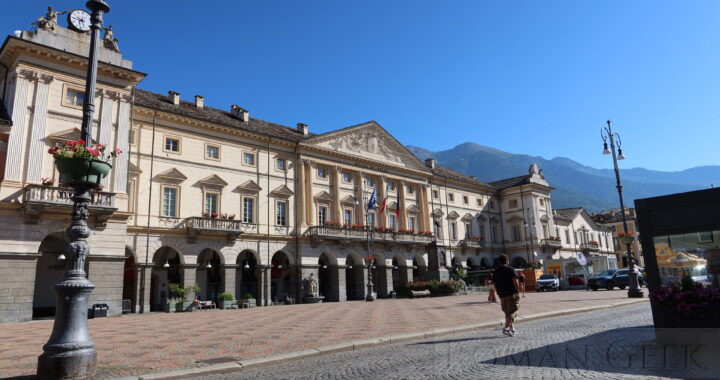
Hotel de Ville, Aosta, Italy

Aosta

  • Aosta is a cathedral city in Italy located near to the entrance to the Mont Blanc Tunnel leading into France.
  • It is in the Aosta Valley Region of Italy.
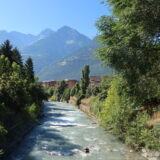
Dora Baltea River, Aosta, Italy

Dora Baltea River, Aosta, Italy

History

  • The Romans conquered the Salassi in 25 BCE and renamed their city Augusta Praetoria Salassorum and in 11 BCE they made it the capital of the Province of Alpes Poenninae on the alpine frontier of Italia.
  • The Fortress guarded the Roman Road to the Great St. Bernard Pass, which lies 11 miles (18km) to the northwest.
  • 3,000 veteran legionaries were settled in Aosta.
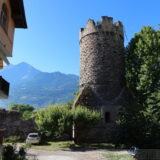
Medieval Tower, Aosta, Italy

Medieval Tower, Aosta, Italy

Roman Sites

  • The Roman Walls
    • The walls are completely preserved. They are 21 ft (6.4m) high and 9 ft (2.7m) thick at the base.
    • It had 20 Towers, 6 of which are still intact.
    • It had 4 Gates, 2 of which are intact.
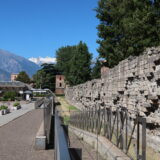
Roman Walls of Aosta, Italy

Roman Walls of Aosta, Italy

  • The Porta Praetoria
    • The Eastern Gate is intact, as is also the South Gate.
Porta Praetoria, Ostia, Italy

Porta Praetoria, Ostia, Italy

  • Amphitheatre
    • In the Monastery of San Catarina,
  • Theatre
    • Seating up to 4,000 spectators (c. 10 CE)
  • Triumphal Arch of Augustus
  • Cemetery
  • Baths
  • Insulae
  • Roman Towers
Tour du Pailleron, Aosta, Italy

Tour du Pailleron, Aosta, Italy

  • Roman Bridges
    • Pont de Pierre, over the Buthier river at Aosta.
    • Pont d’Ael, 5 miles (8km) west of Aosta.
Ponte Romano, Aosta, Italy

Ponte Romano, Aosta, Italy

Museums

Archeological Museum, Aosta, italy

Archeological Museum, Aosta, italy

Roman Roads


Aosta

Bowness-on-Solway

  • Bowness on Solway is a coastal village in the County Cumbria, located on the south bank of the Solway Firth Estuary between England and Scotland.
  • It was the location of a Roman Fort called Mais which marked the western end of Hadrian's Wall. No visible Remains of the Fort exist today.

Roman Roads


Bowness-on-Solway

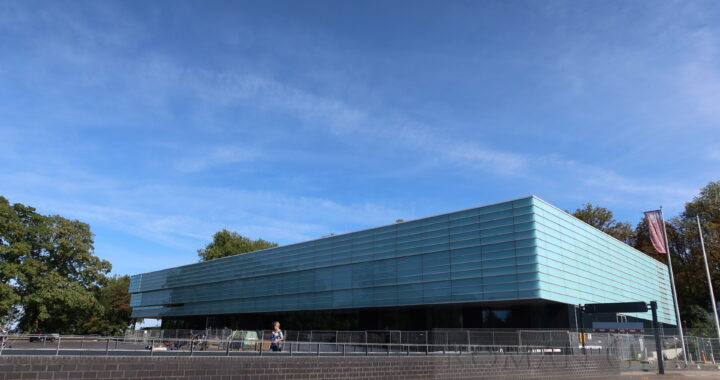
Valkhof Museum, Nijmegen

Nijmegen

  • Nijmegen is a city on the river Waal in the Province of Gelderland in the Netherlands.
  • It was the Oppidum Batavorum and became the Roman town of Noviomagus which was located in the Roman Province of Germania Inferior.

History

  • In the 1st century CE, the Romans built a Fort to guard the Waal and Rhine valleys during the 1st century BCE. The Oppidum Batavorum grew up beside the fort.
  • In 69 CE the Oppidum Batavorum was destroyed during the Batavian Revolt.
  • In 71 CE the Legio X Gemina was stationed there.
  • In 98 CE the town became a Municipium.
  • 103 CE the Legio X Gemina was moved to Vienna.
  • 104 CE Trajan renamed the town Ulpia Noviomagus Batavorum.
River Waal, Nijmegen

River Waal, Nijmegen

The Smetius Collection

  • This was a Collection of 10,000 Roman Coins and 4,500 Artefacts collected by Johannes Smetius and his son Johannes Smetius Junior. They published their Collection in two Catalogues, one in 1644 and another 1678.
  • The whole Collection is now dispersed and lost.

Museums

  • Valkhof Museum
    • Located at Kelfkensbos 59, Nijmegen, the museum holds Artefacts from the Roman period.
  • Victory Monument to Tiberius in the museum.
    • This is the remnant of a column which holds reliefs depicting Roman Gods and a Roman in a Toga performing a sacrifice to Tiberius.


Valkhof Museum, Nijmegen

The first Salisbury Cathedral was built in Old Sarum in 1092 BCE, but moved stone by stone in 1220 CE to modern Salisbury, just 2 miles away..

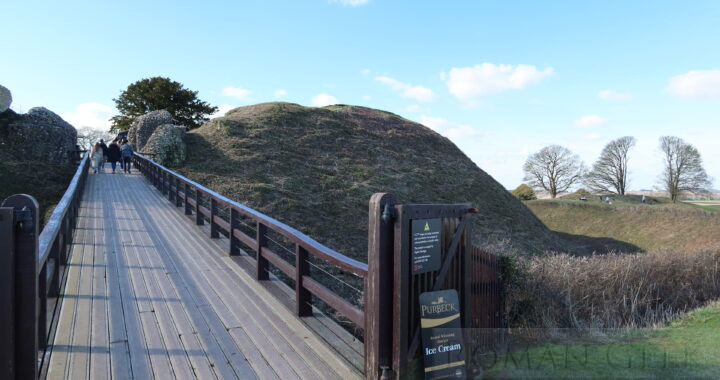
Old Sarum

  • Old Sarum is a double walled Iron Age Fortress built around 500 BCE although the site has been occupied since 3,000 BCE.
  • It is located next to the River Avon, 2 miles (3km) north of Salisbury in Wiltshire.

History

  • The Romans built a Hill Fort here called Sorviodunum on a crossroads of two Roman roads.
  • In 1086 CE William the Conqueror invited all the Chieftains and Nobles to come to Old Sarum and recognise him as the new King of England.
  • The first Salisbury Cathedral was completed on this site in 1092 BCE, followed by a Royal Palace and a small town.
  • In 1220 CE the Cathedral and town were moved down to the Banks of the River Avon.
  • Salisbury Cathedral holds a model of medieval Old Sarum showing the town and cathedral inside the walls.
  • ‘Rotten Borough’: Until the 1832 Reform Act, Old Sarum was a ‘Rotten Borough’ that continued to have Parliamentary Representation even though nobody lived there.

Roman Roads

  • Portway
    • London-Silchester-Old Sarum- Dorchester
  • Roman Road
    • Old Sarum-Poole
  • Iter XV
  • Iter XII
    • For some reason part of Iter XV is repeated in this Iter XII.

Nearby Monuments


Old Sarum, Wiltshire

Trajan’s Bridge (c.100 CE) The Bridge carried the Roman Road from Leon to Braga. Commemorative Column of the Peoples The column was erected on the bridge in 104 CE and holds a dedication to Vespasian and Titus.

Chaves

  • Chaves is a town on the river Tamega in northern Portugal 6 miles (10km) from the Spanish Frontier.
  • It was known to the Romans as the spa town of Aquae Flaviae whose Baths were fed by hot springs. The town was located in a mining area in the Province of Hispania Tarraconensis.

Roman Sites

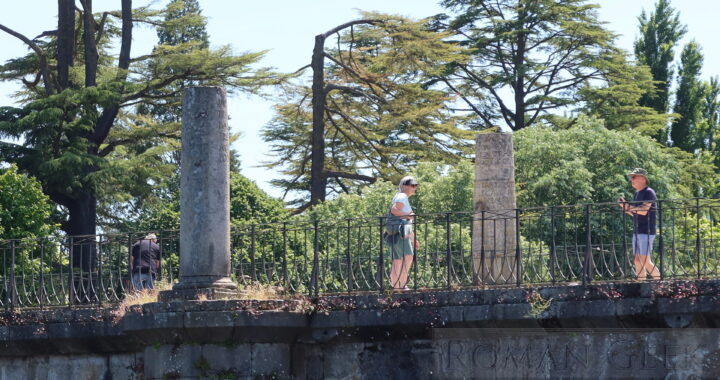
  • Trajan’s Bridge (c.100 CE)
    • The Bridge carried the Roman Road from Leon to Braga.
  • Commemorative Column of the Peoples
    • The column was erected on the bridge in 104 CE and holds a dedication to Vespasian and Titus.
  • Roman Baths of Chaves
    • Currently housed in a Museum that is under construction.

Museums

  • Museo da Regiao Flaviense
    • The Archeological Museum holds artefacts from the Roman period.
  • Museo das Termas Romanas de Chaves
    • The Museum houses the Roman Baths of Aquae Flaviae.

Roman Roads


Trajan’s Bridge, Chaves