British Museum, London

British Museum

  • The British Museum is a Museum of Human Culture which contains over 8,000,000 items. It is one of the largest Museums in this category.

Getting there

  • Location: Great Russell Street, Bloomsbury, London.
  • Nearest Underground Station: Tottenham Court Road, Northern Line, Central Line.
  • Admission: Free. Opening Hours: Tuesday to Sunday 1000-1700, closed Mondays, open on Bank Holidays.

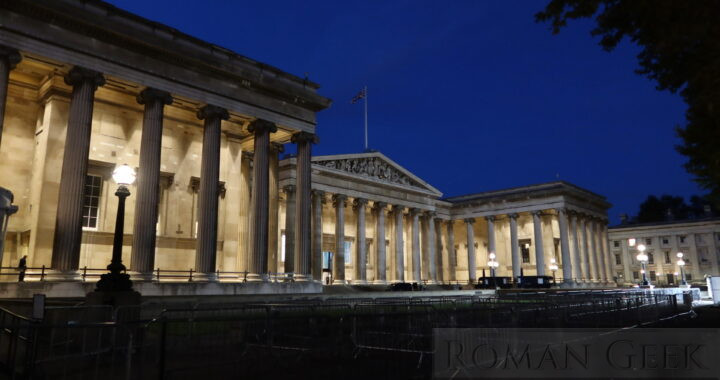
Built in the style of a Greek Temple

  • The Museum first opened to the Public in 1759, based on the collections of the scientist Sir Hans Sloane.
  • In 1823 the architect Sir Robert Smirke designed the present building in the Neoclassical Greek Revival Style, as a quadrangle with four wings. It was completed in 1852.
  • The Museum is based on the Temple of Athene Polias at Priene, with 44 Ionic columns 45 ft (14m) high.
  • The building rests on a concrete plinth, and is constructed using a cast iron frame filled with brick and faced with Portland stone.
  • The Pediment holds 15 allegorical sculptures representing ‘The Progress of Civilisation’.


Ground Floor


  Starting from the Main Entrance.

  Turn immediately left into the Cloakroom.

  It leads into Room 6, turn right into Room 4.

  Room 4   Ancient Egypt

  • Rosetta Stone (196 BCE)
    • The Rosetta Stone is a Stele written in three languages and holds the key to deciphering Egyptian Hieroglyphs.
  • Egyptian Sculptures (5,000 BCE-300 CE)

  Go through Rooms 8, 23, 17, into 18a, 18b.

  Rooms 18a  ,   18b   Ancient Greece ‘Parthenon’

    • Parthenon (447-438 BCE)
      • Elgin Marbles
        • The Elgin Marbles, also known as the Parthenon Marbles, are statues designed by the artist Phideas between 447-438 BCE, that originally decorated the Parthenon in Athens.

  Go back into 17, turn left into 19 and into 20, 21, 22 and 23.

  Room 20   Ancient Greece

    • Xanthos, Turkey.
      • Xanthos Tomb of Payava (c. 375-360 BCE)
      • A vaulted stone Sarcophagus built for the presumed Persian Ruler of Xanthos, Payava, in Lycia. It has carved reliefs in both Greek and Persian style.

  Room 21   Ancient Greece

  Room 22   Ancient Greece World of Alexander: Greek and Roman Sculpture’

  Room 23    Ancient Greece ‘Greek and Roman Statues’

    • Various sculptures which are mostly Roman marble copies of Greek Bronzes which have not survived.

  Return to the Main Entrance and climb the South Stairs to the Upper Floor.

Upper Floor

 starting anti-clockwise from the South Stairs

 Go through Room 40.

  Room 41   Sutton Hoo and Europe  (from 300-1100 CE)

  Room 49   Ancient Rome Roman Britain Gallery’

  Go through Rooms 50, 51, 52, turn left through 53, go through 54.

  Room 55   Mesopotamia

    • Venus Tablet (c. 650 BCE)
      • The Venus Tablet is a Cuneiform Tablet made in the 7th century BCE, recording astronomical observations of the planet Venus that were made around the 17th century BCE.
      • It forms part of the Library of Ashurbanipal at Nineveh (c. 650 BCE).

  Go through Room 56 into 57

  Room 57   Ancient Levant: ‘Israelites and Phoenicians’

    • Jewels from Tharros, Sardinia.
      •   Go through Room 58, turn right into 59. it leads into 61, and 63 leads left into 66.

  Rooms 61-66   Ancient Egypt

    • Amarna Letters (c.1,360-c.1,332 BCE)
      • The Amarna Letters, also known as the Amarna Tablets, are a series of 382 Clay Tablets found in Tell el-Amarna, Egypt, the former Egyptian Capital of Pharaoh Akhenaton (c. 1350-1330 BCE).
    • Papyrus of Ani
      • This is a well preserved example of the Book of the Dead which was discovered in Luxor and is now held in Rooms 62-63.
    • Egyptian Mummies (2,686 BCE-395 CE)

  Go back to Room 61, Room 59 then leads into 73, 72, 71 and 70.

  Room 70   Ancient Rome ‘Roman Empire’

    • The Portland Vase (c.1-25 CE)
      • A rare Amphora made in Rome and consisting of a dark blue and opaque white cameo glass, dated to between 1-25 CE. Etched in the white glass are seated men and women.
    • The Warren Cup (c.10 CE)
      • A Greco-Roman silver drinking goblet with decorated reliefs, dated to 5-15 CE. Acquired in 1999 for £1.8M.
    • Collections of Roman Amphorae, Pottery, Sculptures, Coins and Musical Instruments.

  Room 70 leads into Room 69.

  Room 69   Ancient Greece ‘Greek and Roman Life’

    • Satala, Turkey
      • The Satala Aphrodite (c. 1st century BCE).
        • This is the Bronze Head of a statue of Aphrodite from Satala, which was acquired in 1873 by the British Museum.
    • Xanthos, Turkey
      • Xanthos Nereid Monument (c. 380 BCE)
        • A Tomb built in c. 380 BCE for a King of Lycia in the style of a Greek Temple on a podium.

  Go through Room 68 and The Coffee Lounge is opposite the South Stairs, overlooking the Great Court. There are another two Cafes in the Great Court below.


Photo and map: British Museum, Great Russell Street
Archeology Museum of Antibes

Antibes

  • Antibes is a coastal resort city between Cannes and Nice in the Provence-Alpes-Cote d’Azur Region of southeastern France.
  • The old quarter is full of bars and restaurants and holds a famous open air food market.

History

  • It was named Antipolis by the Phocaean settlers during the fifth century BCE who were Greeks from Marseille (Massilia).
  • It was also known to the Romans as Antipolis and was the original Roman entry point for Trade into Gaul. It was in the Province of Alpes Maritimae.
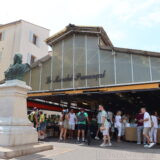
Le Marche Provencal, Antibes

Le Marche Provencal, Antibes

Roman Sites

  • Roman Walls
  • Roman Aqueduct

Museums

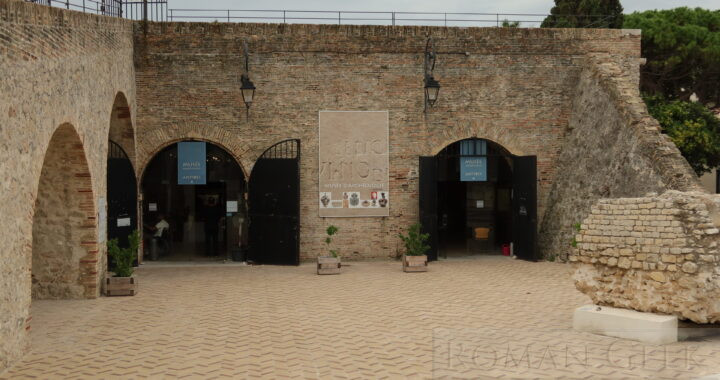
  • Archaeology Museum of Antibes.
    • Located at Bastion Saint-Andre, 06600, Antibes.
    • The museum has on display a Collection of Statues, Amphorae and Finds from Shipwrecks found in the harbour.

Roman Roads


Museum of Archaeology, Antibes

Saint-Paul-Trois-Chateaux, France

Saint-Paul-Trois-Chateaux

  • Saint-Paul-Trois-Chateaux is a town on the Rhone located 37 miles (60km) north of Avignon.
  • The Tricastine Archeological Museum holds many artefacts from the Roman Period.

History

  • It was founded by the Romans in the 1st century CE as Augusta tricastinorum.
  • It was the capital of the Gallic Tricastini Tribe. Tricastini from the Latin probably meaning three castles.

Museums

  • Archeology Museum (Musée d’Archéologie Tricastine)
    • Holds many artefacts excavated from the Roman ruins.
Archeological Museum, Saint-Paul-Trois-Chateaux, France

Archeological Museum, Saint-Paul-Trois-Chateaux, France

Roman Sites

  • Medieval and Roman Walls
  • Triumphal arch
  • Amphitheatre
  • Villas
  • Sanctuaries
  • Mosaics
  • Early Christian necropolis


Saint-Paul-Trois-Chateaux

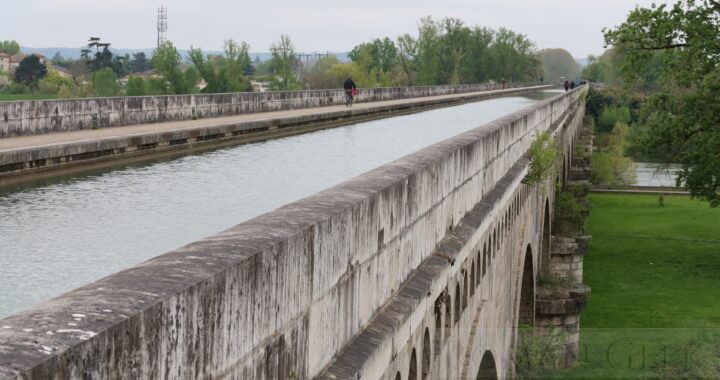
Aqueduct du Canal de Garonne, Agen

Agen

  • Agen is a cathedral city located on the River Garonne in the Nouvelle Aquitaine Region of Southwestern France.
  • It is famed for being the centre of the prune growing region of France.

History

  • During the Gallo-Roman Period it was known as Aginnum.
  • It was the capital of the Nitiobroges Gallic Tribe in the Province of Gallia Aquitania.

Museums


Villascopia, Roman Villa, Agen

Villascopia, Roman Villa, Agen

Nearby Roman Sites

  • Villascopia
    • Located in Rue Lamarque, 47240 Castelculier, 4.5 miles (7.5km) from Agen town centre..
    • The Ruins of a 4th century CE Gallo-Roman villa are enhanced by 3D projections. There is also a collection of artefacts found on the site.
    • The Site is now permanently closed to the Public.


Other Sites

  • Aqueduct du Canal de Garonne
    • The modern Canal de Garonne (connecting to the Canal du Midi) is carried across the River Garonne by an impressive aqueduct built in 1849.

Roman Roads

Museum of Fine Arts, Agen

Nicomedia

  • Nicomedia, was a port city located on the southern coast of the Sea of Marmara, which is today Izmit in Turkey.
  • It became part of the Roman empire in 74 BCE and was the capital of the Province of Bithynia.

History

  • It was an important City located opposite nearby Byzantium, on a crossroads of Trade Routes between East and West.
  • Nicomedia briefly became the capital of the Eastern Roman Empire between 283-330 CE, under the Reforms by Diocletian.
  • Constantine I used Nicomedia as the Capital of the Roman Empire between 324-330 CE, until Byzantium was ready to move in to, after which it was renamed Constantinople.

Roman Sites

Museums

  • Kocaeli Museum
    • The Museum is also known as the Kocaeli Archeology and Ethnography Museum or the Izmit Museum.
    • It is located at Demiryolu Caddedi, Kemalpasa, Kocaeli.
    • The museum holds Finds from the Hellenistic, Roman and Byzantine Periods.

Roman Roads


Nicomedia (Izmit), Turkey


Amida

  • Amida was a Bronze Age city built on the right bank of the Tigris, which is now the modern city of Diyarbakir in Turkey.
  • It was a Roman Border Fortress located in Mesopotamia.

History

  • The Roman Walls of Amida still stand and were built by Constantius II to withstand the siege of Amida in 359 CE by the Persians.
  • Amida was one of the Eastern Roman Border Fortresses defending against the Parthian Empire. The other Fortresses were Dura Europos and Nisibis.
  • The city was constantly besieged and retaken by both sides until the 7th century CE.

Roman Ruins

  • Roman Walls of Amida.

Museums

  • Diyarbakir Archeological Museum
    • Located at Cevat Pasa, 21300 Sur, Diyarbakir.
    • The museum holds Finds from the Upper Tigris dating back to 10,000 BCE.


Amida (Diyarbakir, Turkey)

Aksum

Description

Aksumite Empire

  • The Aksumite Empire (c. 100-940 CE)  covered the area of northern Ethiopia and Eritrea.
  • It was considered by the Persian Prophet Mani (216-274 CE), to be the fourth great World Empire, along with Rome, Persia and China.

Ancient Sites

  • Aksum is the Site of seven large Stelae, weighing up to 500 tons. They are built in the same style as an Egyptian Obelisk.
  • There are also Royal Tombs and Palace Ruins.
  • Aksum is also famous for, allegedly, being the home of the Ark of the Covenant mentioned in The Bible.


Aksum

Saint Chamas Roman Bridge

Saint Chamas

  • Saint Chamas is a town in France that is 26 miles (43km) southeast of Arles and 31 miles (50km) northwest of Marseille.
  • It is famed for the Pont Flavien Roman bridge which carried the Via Julia Augusta from Arles to La Turbie and on to Italy.

Roman Sites

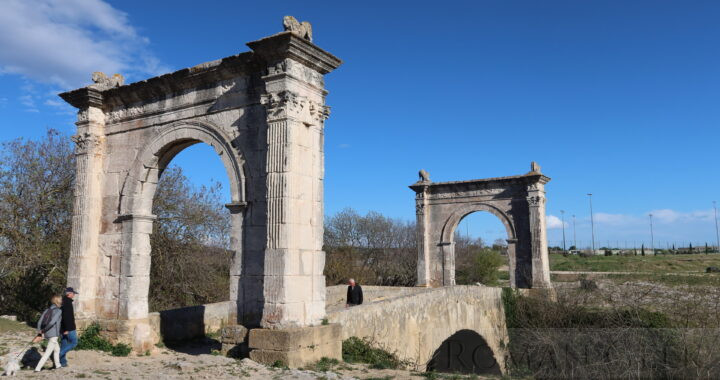
  • ‘Pont Flavien’ Roman Bridge (1st century BCE)
    • It has two Triumphal arches one at each end of the bridge which spans the river Touloubre.

Roman Roads


Photo and map: Pont Flavien, Saint Chamas

Athens

  • Athens is the capital city of Greece and one of the world’s oldest continuously inhabited cities, dating back to the 11th century BCE.
  • Athens and Greek culture had a huge cultural influence over the Romans, but it was not permitted to have a political influence, and instead of being made the capital of the Roman Province of Achaea, Corinth was made the capital.

History

  • Cradle of Civilisation
    • The city is famous for being one of the ‘Six Cradles of Civilisation’ and the ‘Birthplace of Democracy’.
  • Hellenistic Philosophy
    • Plato had his Academy in Athens, and Plato was his student who wrote many works based on Plato’s teachings.
    • Aristotle was the student of Plato and set up the Lyceum.
  • Eleusinian Mysteries
    • This was an Annual Pilgrimage from all over Greece, which started in Athens and ended in Eleusis.

Acropolis

Pireus

  • The Pireus was the Port for Athens, and held the Naval Harbour and Shipsheds for the Athenian Navy.
  • The Pireus was then fortified continuously and became one of the greatest naval bases in the Ancient World, until it was destroyed by the Romans in 86 BCE.

Roman Monuments

  • Although Corinth was the capital of the Roman Province of Achaea, successive Emperors built important Roman structures in Athens.
    • The Roman Agora or Roman Forum of Athens
    • Tower of Winds
    • Arch of Hadrian
    • Hadrian’s Library (125-132 CE)
    • Philopappos Monument
    • Temple of Olympian Zeus
    • Hadrian’s Aqueduct (mostly underground)

Museums

  • National Archeological Museum of Athens
    • Patission Street, Athens
    • The museum collections include Prehistoric items, Statues from the Roman period, Pottery from Ancient Greece, Frescos from Bronze Age Santorini, the Antikythera Mechanism and items from the Antikythera Shipwreck and an Epigraphical collection.
  • Acropolis Museum
    • Dionysiou Arepagitou Street, Athens
    • This Archeological museum houses the artefacts, in particular the Statues, found when excavating the Acropolis.
  • Byzantine and Christian Museum
    • Leof. Vasilissis Sofias Avenue 22, Athens
    • The museum holds collections of Art, Pottery and Manuscripts from between 285-1453 CE.


Temple of Athena Nike, Athens

Stanwix

  • Stanwix is a suburb of Carlisle, north of the River Eden in the County of Cumbria.
  • It was a Roman fort known either as Petrianum or Uxelodunum, and was on Hadrian's Wall.

Auxiliary Regiment

  • Ala Petriana Milliaria
    • This was an Auxiliary Cavalry Regiment of 1,000 horse from Gaul.

History

  • The Ala Petriana Milliaria was the only Ala with 1,000 horse on Hadrian's Wall, making its Prefect the most senior Officer on the entire Wall.
  • Stanwix was the Command Headquarters for the whole of Hadrian’s Wall. Signals were sent from all the other castles on the Wall to Stanwix via a relay system. It is not known whether this system used light signals or messengers on horseback.
  • A Signalling system using either lights or semaphore also lay alongside the Roman Road from Carlisle to York. The Prefect at Stanwix would have been able to send and receive messages from the Legionary Legate at York in minutes.

Roman Sites

  • Very little of the fort is visible today.
    • A small section of the north-western rampart masonry footings of the Fort are displayed in the Car Park of the Cumbria Park Hotel.
    • The remains of the Fort are under St. Michael’s Church, with the Fort wall showing as an Embankment in the Graveyard.

Roman Roads

Nearby Sites


St. Michael’s Church, Stanwix