Rochester: A Medieval City in Kent
Overview
Rochester is a port town in Kent, located on the river Medway, 30 miles (48km) southeast of London. it was a city until 1998 when it became part of the Medway Towns Area. It is noted for its Norman Cathedral and Castle. Rochester’s most famous resident was Charles Dickens who lived nearby.
History
The Battle of the Medway took place near Rochester in 43 CE, when Emperor Claudius invaded Britannia and overcame the armies of Caratacus and Togodumnus. It became the Roman town of Durobrivae Cantiacorum and had a Roman Bridge which carried Watling Street across the Medway. Today, there are no visible Roman monuments.
Rochester holds a strategic position at the crossing of the tidal Medway, and for centuries Rochester had the only bridge to cross it. During the medieval period, Rochester Castle was frequently besieged, notably in 1215 and 1264. In 1667, during the Second Anglo-Dutch War, part of the English fleet based at Rochester was captured and burnt after Admiral de Ruijter broke through the defenses. During the Napoleonic Wars, Rochester and the Medway Towns were surrounded by a ring of protective fortresses. Between 1567-1984 the Royal Navy operated an important Navy Dockyard at nearby Chatham, constructing over 500 ships there. During WWI Short Brothers manufactured seaplanes from an aircraft factory close to Rochester Castle.
Things to Do and Places to see in Rochester
1. Rochester Cathedral
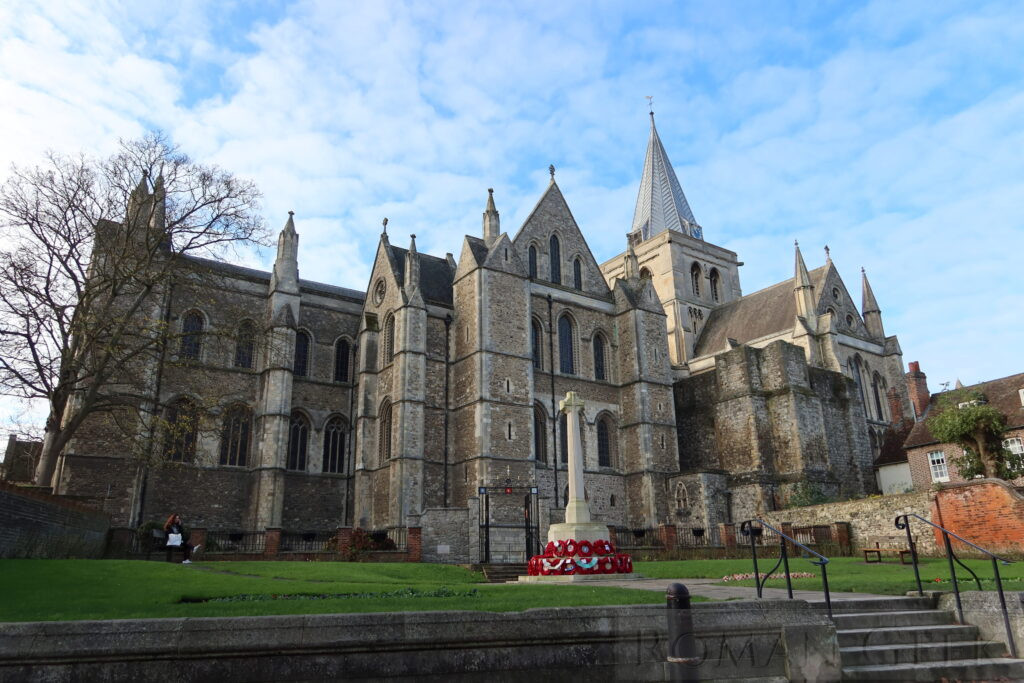
Rochester Cathedral
Description: Rochester cathedral is the centre for the Diocese of Rochester and seat of the Bishop of Rochester. The Cathedral was founded in 604 CE by St. Justus, first Bishop of Rochester and one of the companions of Augustine of Canterbury. The Normans rebuilt the cathedral between 1079-1238. In 1535, St. John Fisher, Bishop of Rochester was beheaded by Henry VIII for refusing to accept him as supreme Head of the Church of England. During the 1870’s extensive restoration work was carried out by Sir Gilbert Scott. Visitors may descend into the impressive crypt under the quire, which dates from 1080 and displays a Romanesque groin vaulting. The Pipe organ dates from 1905, and the cathedral has a ring of ten bells with some dating from the 11th century.
2. Rochester Castle
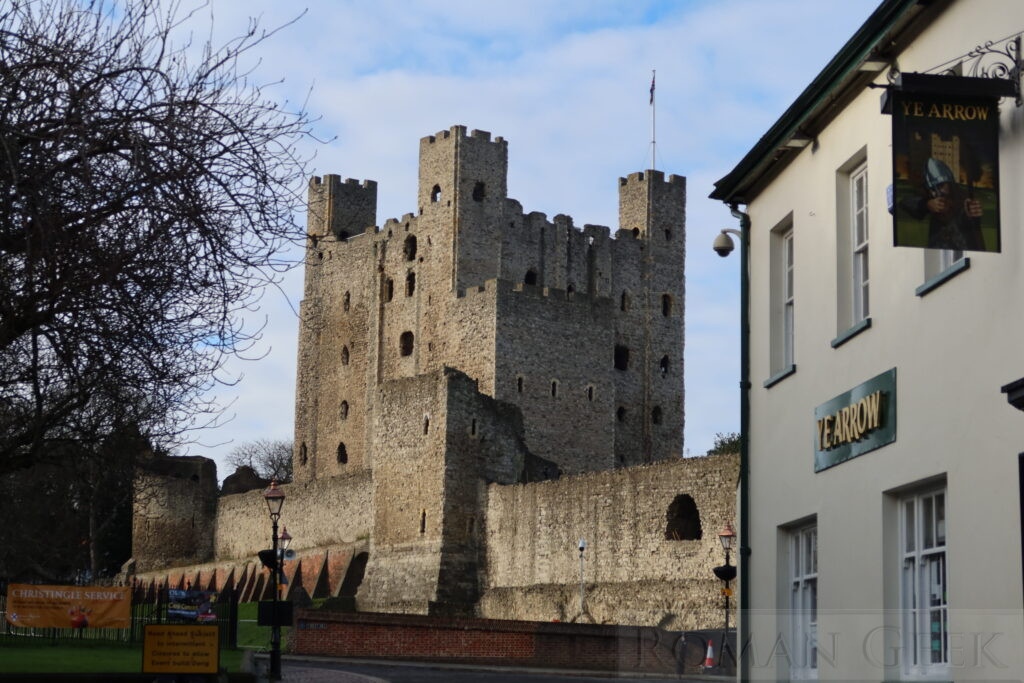
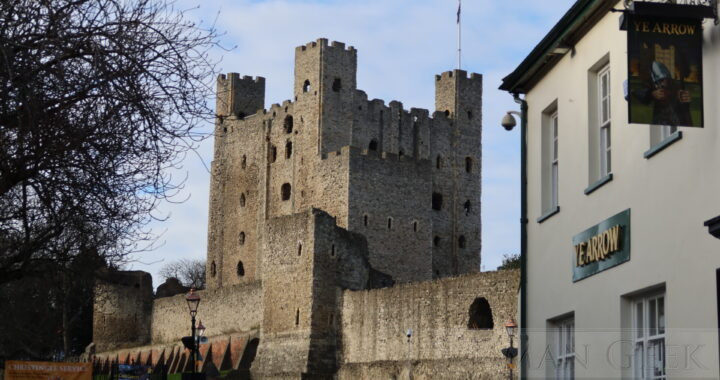
Rochester Castle, Kent
Description: Built between 1087-1127, the castle Keep is one of the best preserved in England, but is a shell with no floors today. It was designed by Gundulf Bishop of Rochester, who is thought to have also designed the White Tower at the Tower of London, and Colchester Castle, which all share strong similarities.
Historical Insight: The castle was besieged many times during the Medieval period, notably in 1215 and 1264, but fell into disuse after 1600. Some of the stone was re-used to build Upnor Castle nearby. Charles Dickens described the castle ruins in ‘The Pickwick Papers’ and ‘The Mystery of Edwin Drood’. The castle is said to be haunted by its own ghost, known as the white lady.
3. Esplanade Gardens
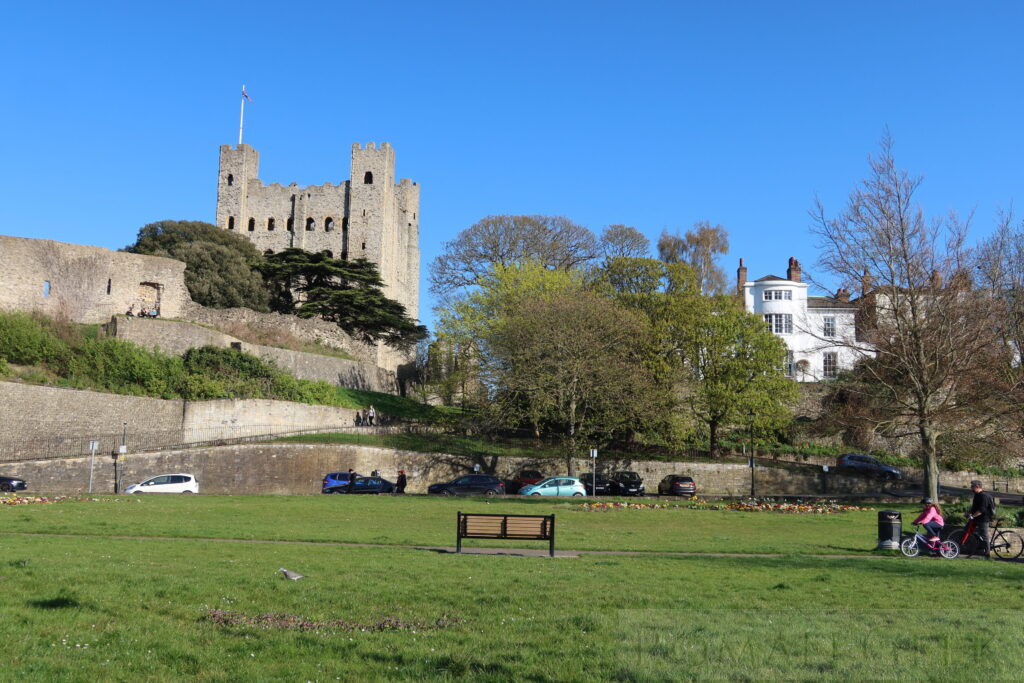
Esplanade Gardens, Rochester
Description: This is a relaxing public garden running alongside the Medway. There are benches and a play area, with views of the Medway Bridge and Rochester Castle. The gardens are planted with well-maintained flowerbeds of colourful flowers.
4. Rochester Pier
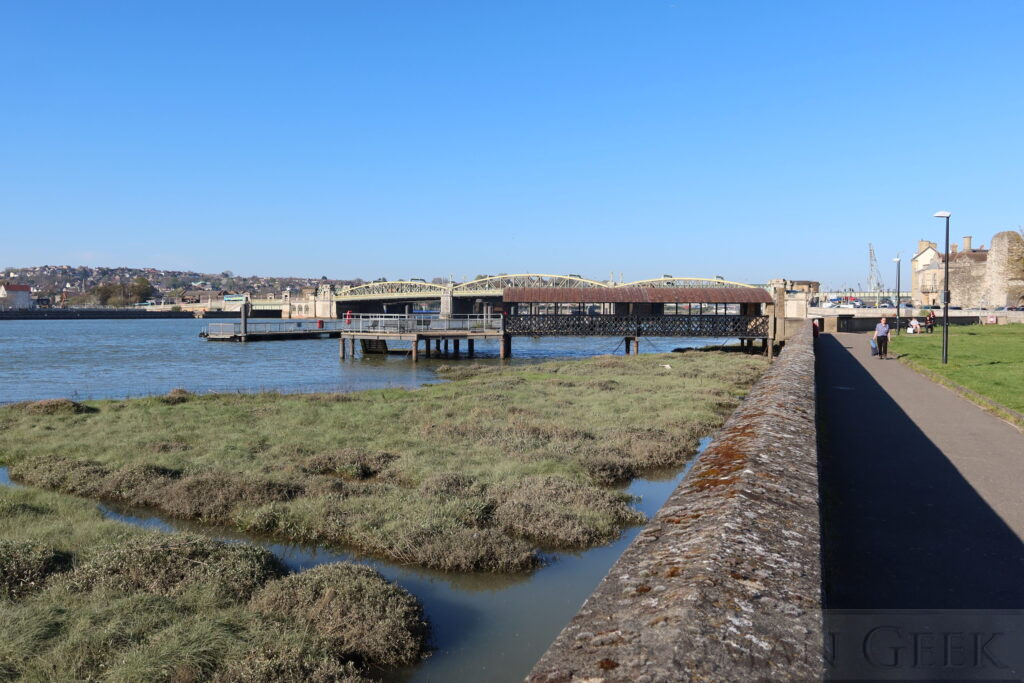
Rochester Pier
Description: The Pier has been closed since 2019 and is awaiting restoration. Built in 1881, the Pier served the Kingswear Castle paddle steamer, which operated between Rochester and London and offered local pleasure trips.
5. Rochester Bridges
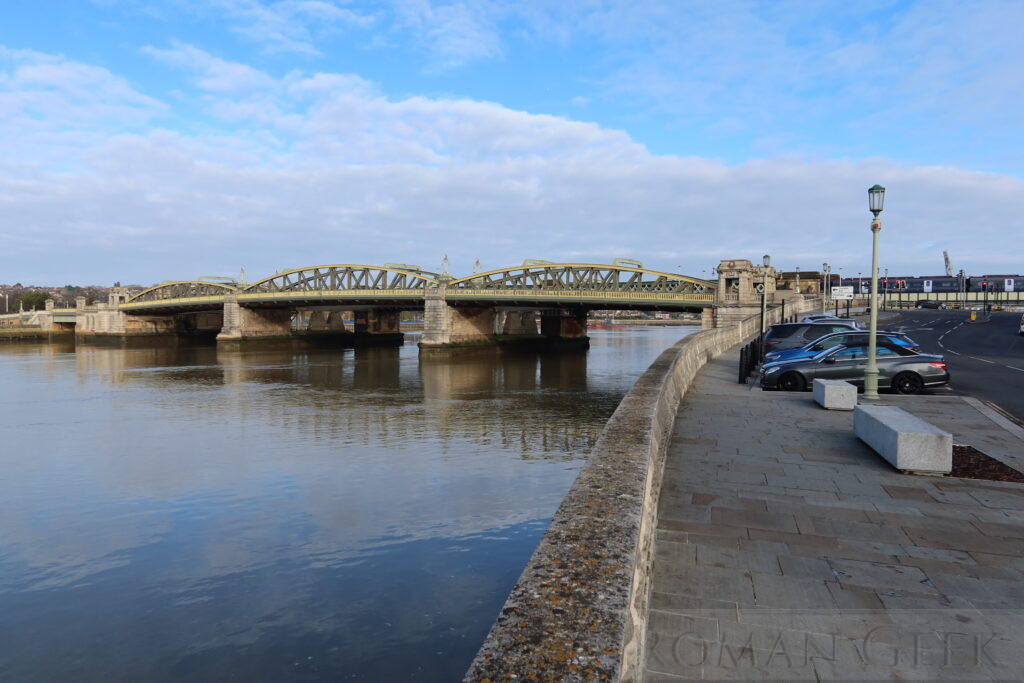
The Road and Rail Bridges across the Medway in front of Rochester Castle.
Description: There are in fact four separate bridges: The Old Bridge (constructed in 1857 and which replaced the medieval bridge) and the New Bridge (1970) carrying the A2, the Railway Bridge (1858) and a Service bridge (1970) carrying pipes and cables. During construction, Victorian engineers uncovered the old Roman Bridge foundations (43 CE), consisting of nine stone piers set on iron tipped oak timbers driven deep into the riverbed. This was probably the first bridge in England, with stone foundations supporting a wooden deck.
Historical Insight: For over 600 years, in order that the Medway river crossing be free of charge with no tolls, the bridge has been funded by historic property investments and not by public taxes. This began in 1399, when King Richard II established the Wardens and Commonalty of Rochester Bridge, and gifted land to the Wardens to ensure the Bridge be properly maintained. This was followed in 1575, by The Rochester Bridge Act, an Act of Parliament which was passed for the ‘perpetual maintenance of Rochester Bridge’. This function is continued today by the Rochester Bridge Trust, which operates as a charitable organization and owns and maintains both the A2 road bridges and the service bridge.
6. Guildhall Museum
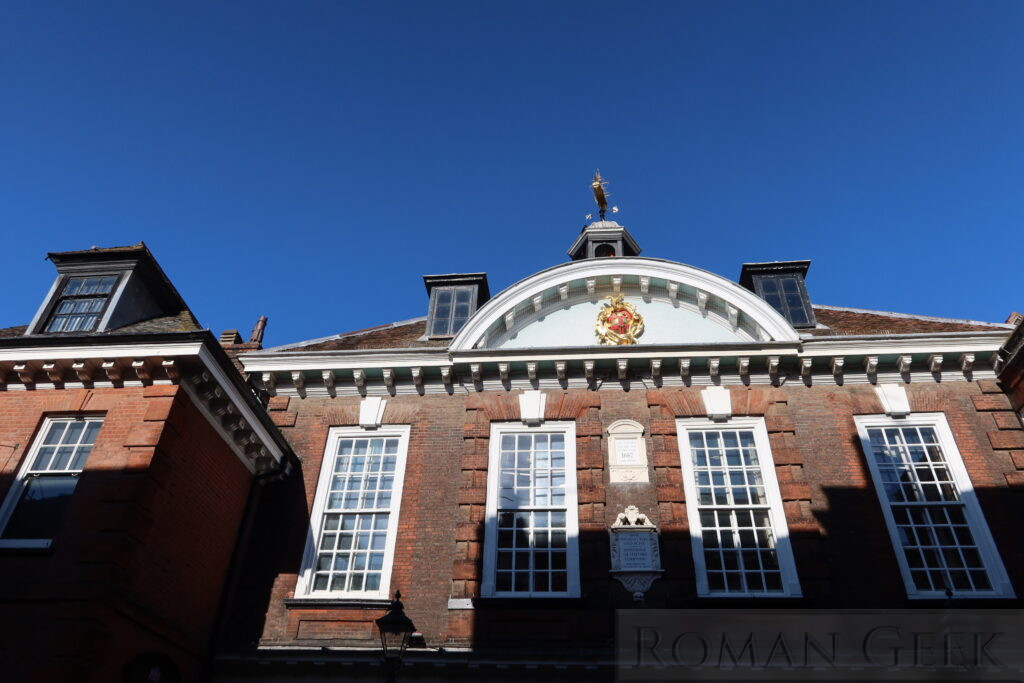
Rochester Guildhall
Description: Located at 17 High Street, the Guildhall was completed in 1697 and is a Grade I listed building. The ornate plaster ceilings were donated in 1695 by the Rochester MP, Admiral Sir Cloudseley Shovell. The weathervane is of a warship and was added in 1780. The building functioned as a council chamber and as a courtroom. The council chamber featured in Charles Dickens’ Great Expectations (1861), in the scene where Pip is formally indentured into an apprenticeship with Joe Gargery. The museum features artefacts and works of art depicting the history of Rochester. There is a reconstruction of a prison hulk and an exhibition about Charles Dickens.
Historical Insight: The Rochester MP, Sir Admiral Sir Cloudseley Shovell, started in the Navy as a cabin boy at the age of 14, and rose to become Rear-Admiral of the Blue Fleet (Rear Squadron), Admiral of the White Fleet (Van or Front Squadron) and finally Commander-in-Chief of the Fleet (Middle and Senior Squadron). During his career he was involved in many wars and engagements. For 300 years, a large part of the fleet was based at nearby Chatham or in dock there for maintenance, so he was invited to stand as the Member of Parliament for Rochester. Sir Admiral Cloudesley Shovell died aged 56 when he was shipwrecked on the Scilly Isles at 8pm on 22 October 1707. He is buried in Westminster Abbey. In the worst disaster in British naval history, 2,000 men and four ships were lost in one night. Up to then Longitude at sea had been found by Dead Reckoning. What was needed was an accurate method of determining Longitude, which led Parliament to pass the Discovery of Longitude at Sea Act in 1714. The problem was solved by John Harrison in 1730 with his invention of the Marine Chronometer.
7. Rochester High Street
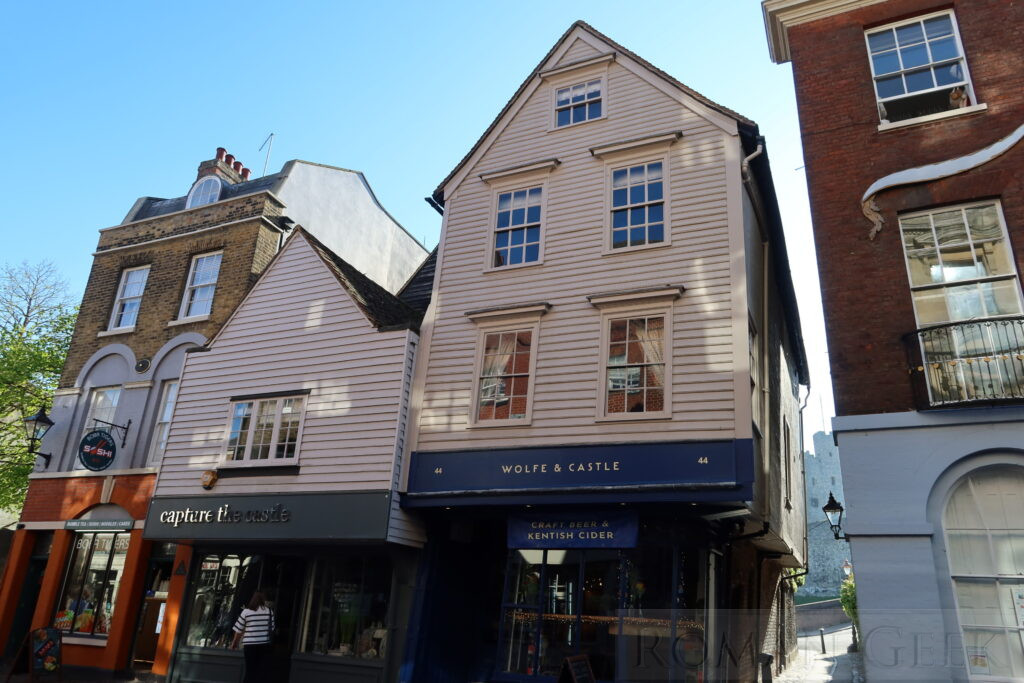
Rochester High Street
Description: The High street follows the alignment of the Roman east-west road, the Decumanus Maximus, which was the continuation of Watling Street. It is full of quirky buildings, independent shops, cafes, bars and restaurants, such as The George Vaults at No 35.
Tip: Major festivals are held in the High Street such as The Rochester Sweeps Festival (Early May Bank Holiday), Rochester Dickensian Christmas Festival (December) and the Rochester Artisan Market (second saturday of each month at the bridge end of the High Street).
8. Huguenot Museum
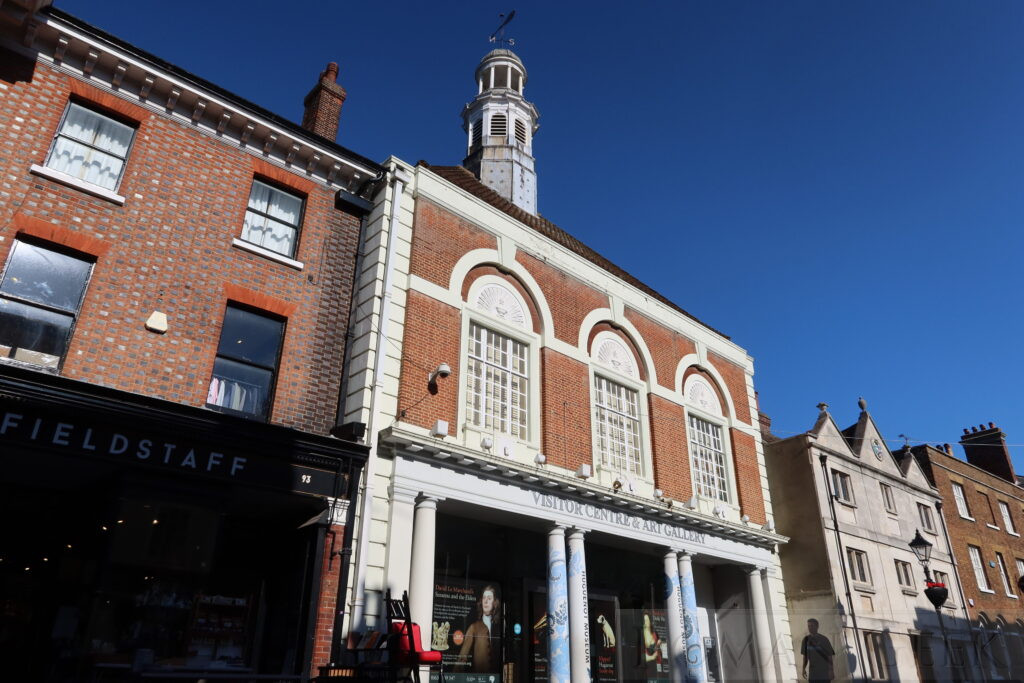
Huguenot Museum, Rochester
Description: This is the first Huguenot Museum in the country and tells the story of the Huguenot persecution in France, their dramatic escape to England after Louis XIV’s Revocation of the Edict of Nantes in 1685, and the trades, crafts and skills they brought with them such as silkweaving, silversmithing, watch and clock making and papermaking. The museum holds the French Hospital Collection which consists of oil paintings, silver, documents and silk samples.
9. Six Poor Travellers House
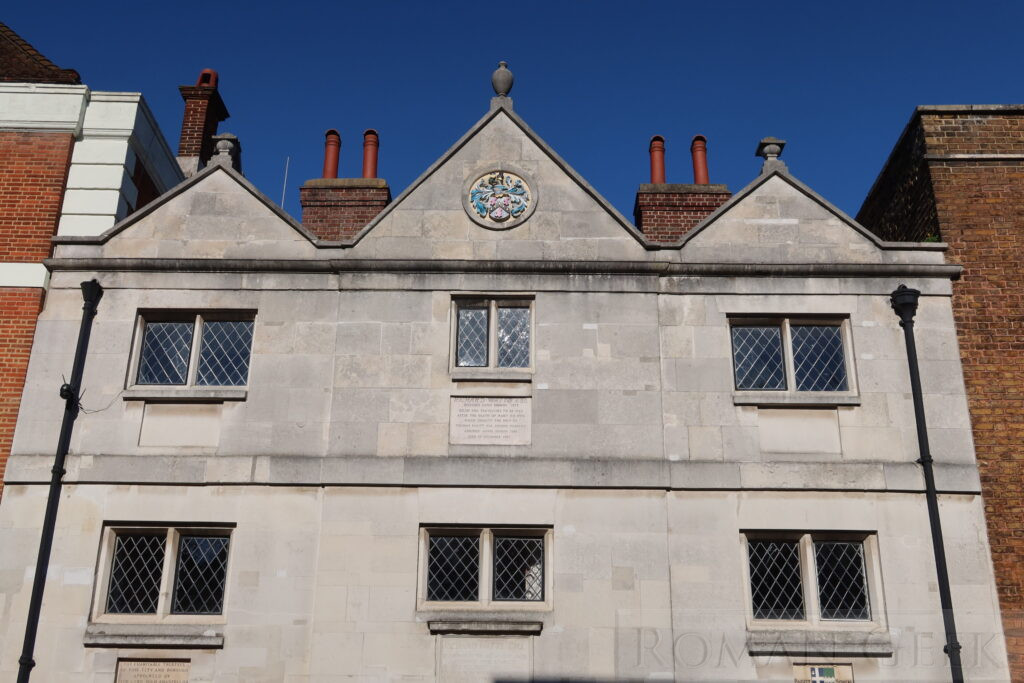
Six Poor Travellers House, Rochester
Description: This is a Tudor Charity House founded in 1579 by the Elizabethan MP Richard Watts to provide Board and Lodging for six poor travellers ‘for one night only’. It continued to operate until July 1940. It was immortalised in a short story by Charles Dickens called The Seven Poor Travellers (1854). It is now a Museum where Visitors can view the Travellers’ Rooms, The Tudor Physic Garden (Herb garden). It was also used as a House of Correction for disorderly behaviour.
10. Rochester City Wall
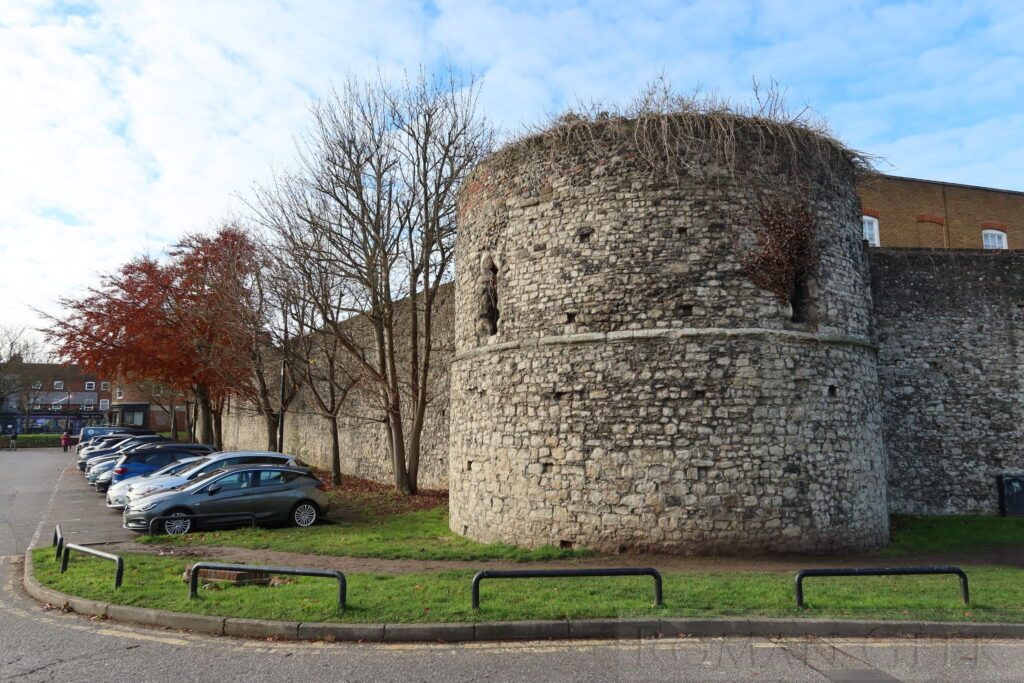
Rochester Roman City Wall. The Medieval Wall is built over the Roman Wall.
Description: The Romans constructed the first city walls around Durobrivae between the 2nd-3rd centuries, and they remained in use during the Saxon and Medieval period. During the 13th-14th centuries CE, the Normans rebuilt over the Roman Stone Walls which date to c. 225 CE. Parts of the Roman Walls are still visible. The Northeast Tower still stands with a section of wall opposite the Blue Boar car park.
11. Eastgate House
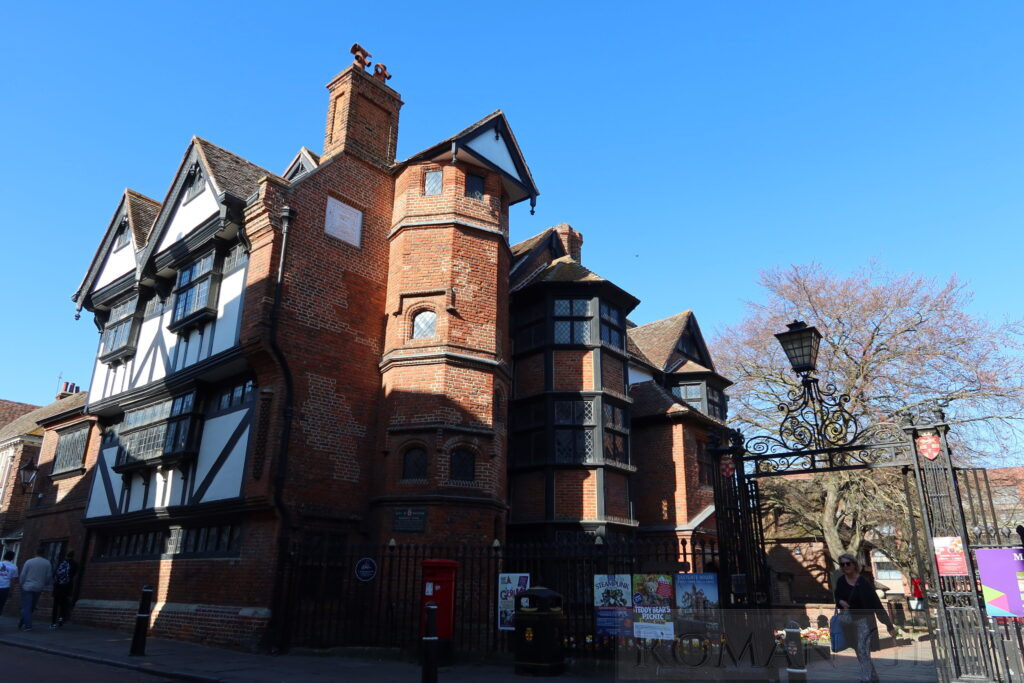
Eastgate House (Dickens Museum), Rochester
Description: Eastgate house, now a Dickens Museum, is a Grade I listed Elizabethan townhouse dated to 1591. The house was made famous by Charles Dickens, featuring as ‘Westgate’ in the Pickwick Papers and as the ‘Nun’s House’ in The Mystery of Edwin Drood. The grounds hold the ‘Swiss Chalet’, relocated from Gad’s Hill, where Dickens wrote several of his novels.
12. Restoration House
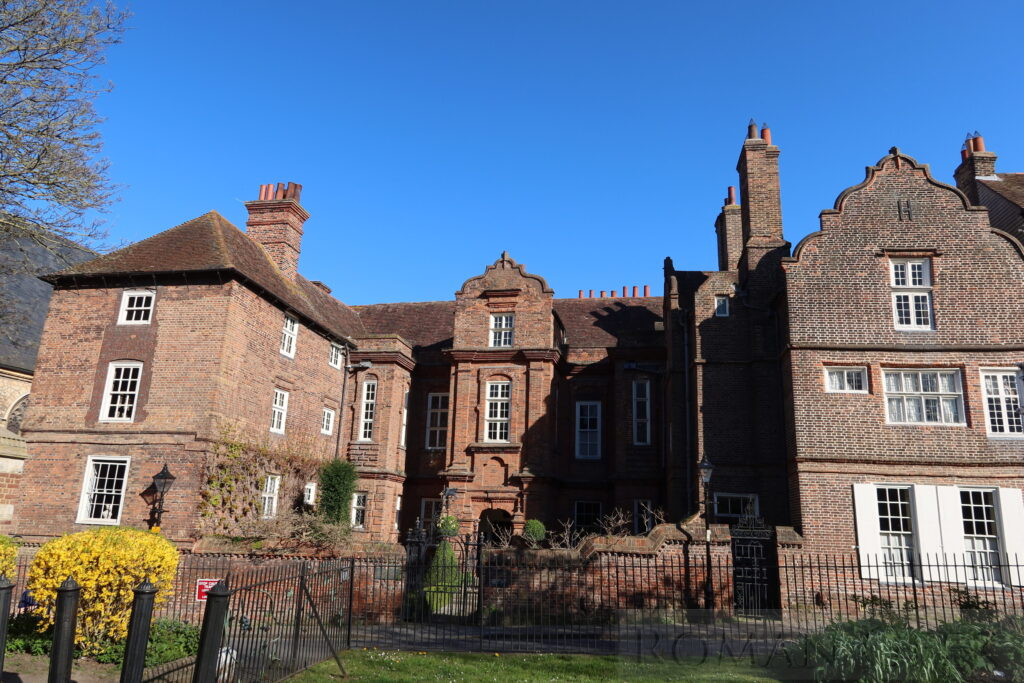
Restoration House, Rochester
Description: Originally two separate buildings dating from 1454 and 1502, a third building was added in between to create one house. The name comes from an overnight stay by Charles II on 28th May 1660, after landing at Dover, on the eve of his Restoration as King.
Further Afield
13. Chatham Historic Dockyard
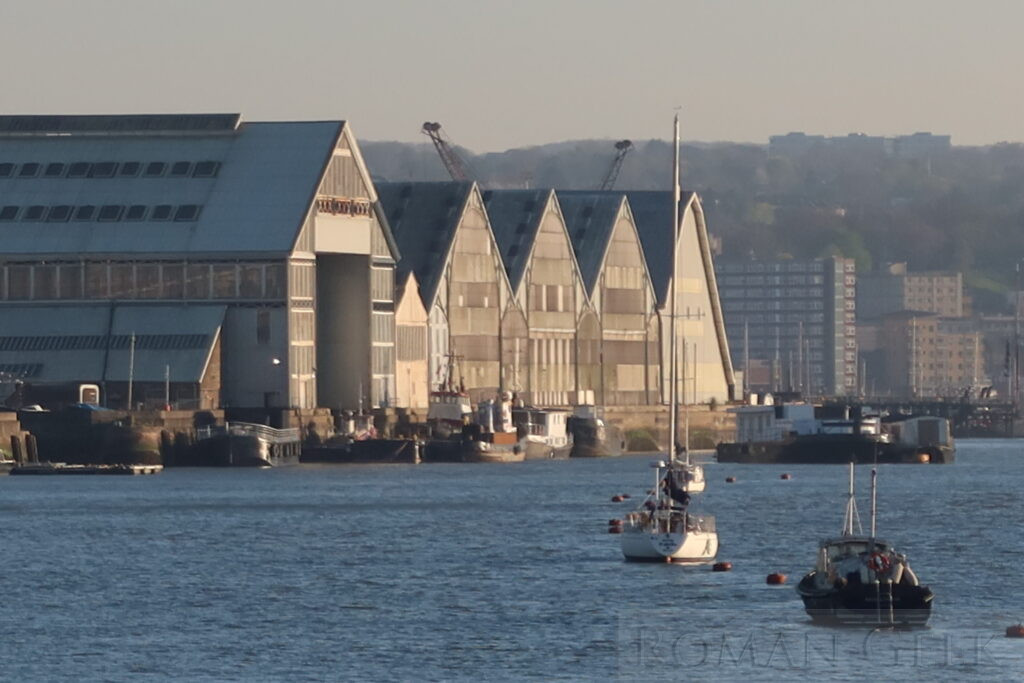
Chatham Dockyard Visitor Centre
Description: The Chatham Royal Dockyard operated for over 400 years between 1567 and 1984. It supplied over 500 ships for the Royal Navy using the latest shipbuilding and industrial technology. Visitors can walk through the Ropery, where miles of ships’ ropes were made, the Smithery, where the anchors and chains were made, and the Dockyard Railway. HM Submarine Ocelot (1962) is open for visits as is the Destroyer HMS Cavalier (1944) and HMS Gannet (1878).
13. Upnor Castle
Description: Completed in 1567, this Elizabethan Castle was built by Elizabeth I with a chain across the Medway to protect the Chatham Dockyard and ships of the Royal Navy. The Medway was an ideal river to store Tudor Naval ships that were either out of commission or that required refitting. However, in 1667, during the Second Anglo-Dutch War, part of the English fleet based at Rochester was captured and burnt after Admiral de Ruijter broke through the chain and sailed into Rochester.
Rochester Walking Tour
- Your geolocation will appear as a blue icon that moves on the map as you walk.
- You may start anywhere on the map and just follow the blue line to the next point of interest.
Travel Tips
- Best time to visit: Spring and autumn for mild weather and fewer tourists. Rochester Festivals.
- Photography Hotspots: Medieval cathedral and castle, historic townhouses, Medway river
- Nearby Attractions: Kit's Coty House, Lullingstone Roman Villa, Chatham Historic Dockyard
Visitor FAQ
- What is Rochester famous for?
- Rochester cathedral and castle, Charles Dickens featured Rochester in many of his novels, for centuries Rochester had the only bridge over the tidal Medway.
- Can I see Roman Ruins in Rochester?
- No, there are no Roman Monuments left above ground. However, the medieval city wall is built on top of the Roman Wall, parts of which are still visible.
- How far is Chatham Historic Dockyard from Rochester city centre?
- Approximately 25 minutes by car.
- Are there Guided Tours of Rochester historical sites?
- Yes, local guides offer walking tours highlighting the Cathedral, the Old Town and other venues. Contact the City of Rochester Society.
- Is Durobrivae Cantiacorum the same as Rochester?
- Yes, Durobrivae was founded by the Romans in 43 CE.
- Which Roman Province was Rochester located in?
- What was the role of Durobrivae Cantiacorum (Rochester) in the Roman Empire?
- Rochester served as a key military and economic port guarding the Medway crossing to London. It lay on Watling Street the road leading from the continent to London.
- Which Roman Road connected Rochester?
- Why are the two Diocesan cathedrals, at Rochester and Canterbury, located only 25 miles (40km) apart?
- Their proximity is unique in England and dates back to the arrival of St Augustine between 597-604 CE, who was sent by Pope Gregory I to convert the Saxons to Christianity. St. Augustine first established the Diocese of Canterbury, capital of the Saxon King Aethelberht of East Kent. Then in 604 CE, he established the Diocese of Rochester, to cement the Church’s administrative authority over the capital of the Saxon kingdom of West Kent. Also in 604, he established the third Diocese over the Saxon kingdom of Essex under King Saeberht, whose capital was at London, and the building of St. Paul’s cathedral. Canterbury was pre-eminent over the other two Dioceses.
Quick Facts
- Modern Location: Rochester, England
- Category: Historic city centre, medieval cathedral and castle, tourist destination
- Activities: Walking tours, sightseeing, photography
- Nearby Roman Site: Lullingstone Roman Villa
- Nearest Roman road: Watling Street
- Roman Province: Britannia
Nearby Attractions
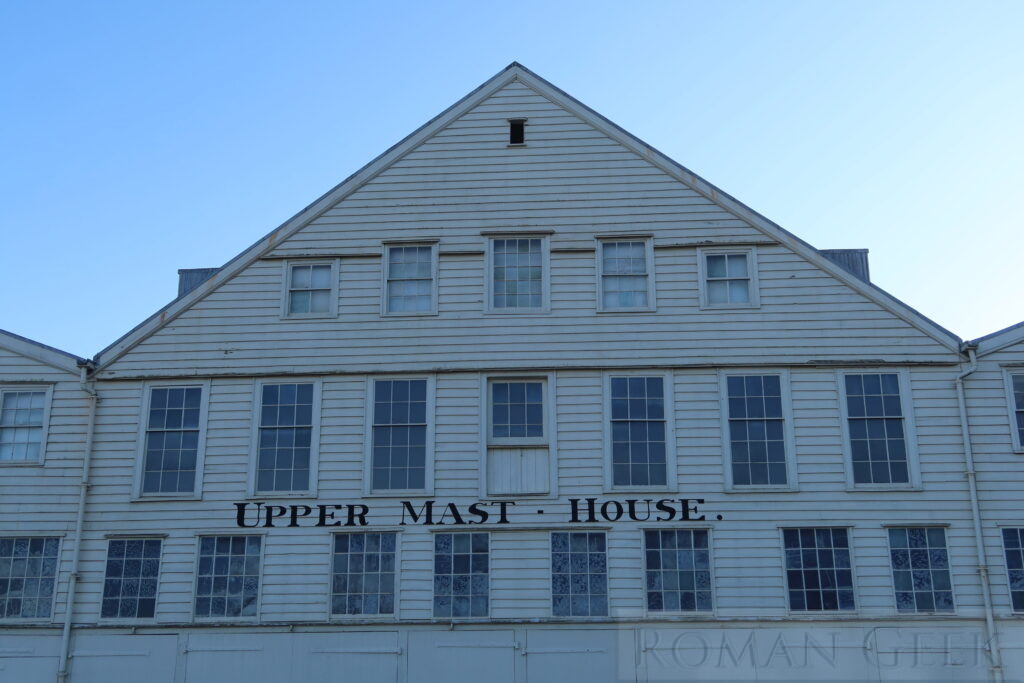
Chatham Dockyard Visitor Centre
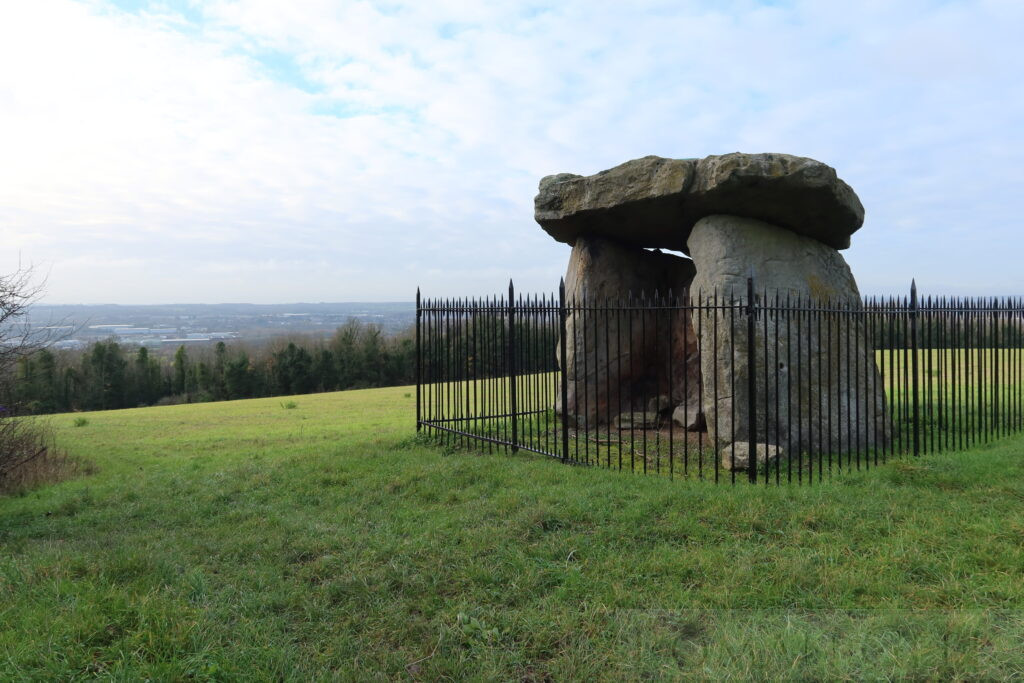
Kit’s Coty House, near Aylesford, Kent, is a Megalith dating from 4,000 BCE.

 Museums