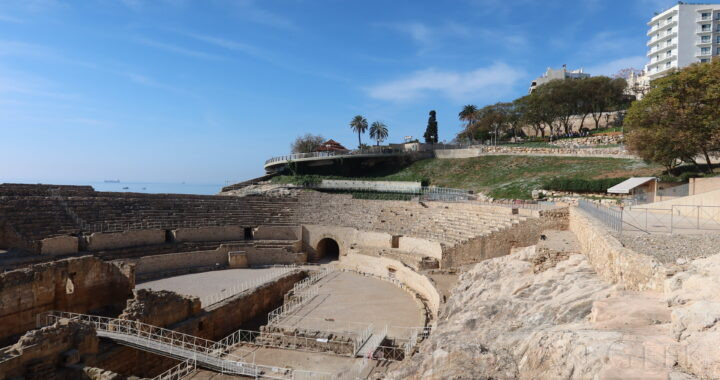
Tarragona Roman Amphitheatre

Tarragona

  • Tarragona is a Port city located on the mouth of the river Francoli on the Mediterranean coast in the Autonomous Community of Catalonia in northeastern Spain.
  • It was Roman Tarraco, capital of the province of Hispania Tarraconensis and holds the Archeological Ensemble of Tarraco, a Unesco World Heritage Site.

History

  • Publius Scipio arrived in 217 BCE and fortified the city in the Second Punic War (218-202 BCE) against Carthage. The Romans then took over 200 years to completely conquer Iberia.

The Roman Sites

Archeological Ensemble of Tarraco

  • Pont de les Ferreres
    • A Roman Aqueduct 4 miles (7km) to the north of Tarragona.
  • Roman Walls and 2 Gates
    • Portal del Roser
    • Portal de Sant Antoni
  • The Capitol or Citadel
  • The Forum
  • The Palace of Augustus
  • The Circus or Amphitheatre (its remains are underneath the Circus)
  • Tower or Sepulchre of the Scipios
    • (supposedly buried there) 4 miles (6km) out of town
  • Arch of Sura or Bara
  • The Aurelian Way

Museums

Roman Roads

Tarraco Arena, Tarragona
Tharros

  • Tharros is the Ruins of an ancient city located near Oristano in Sardinia.

History

  • It was founded by the Phoenicians in the 8th century BCE and later became a Roman and Byzantine city until abandoned in the 1oth century CE.
  • Artefacts can be seen in the Archeological Museum at Cagliari and in the British Museum.

Roman Sites

  • Archeological Area of Tharros
    • The Roman Ruins of Tharros is an open air museum, with the foundations of baths, temples and houses.

Museums

  • Archeological Museum at Cagliari
    • Located at Piazza Arsenale 1, Cagliari.
  • British Museum
    • Located at Great Russell Street, London, it holds artefacts from Tharros in Room 57.

Archeological site of Tharros, near Oristano, Sardinia

Leon

  • Leon is a cathedral city located on the river Bernesga and capital of the Province of Leon in the Autonomous Community of Castilla y Leon.
  • It was the Fortress city of ‘Legio’ located in the Province of Hispania Tarraconensis. The Legionary Fortress then became the city of Leon.

History

  • A Roman Legion was always based here for the duration of the Roman Empire.
  • Although there was no Frontier to defend, the Legion’s main task was to oversee the production of Gold from the nearby Las Medulas Gold Mine and its transport to the Mediterranean.

Legions based here

Roman Sites

  • Leon Roman Walls
    • Located near the Cathedral between Los Ponces Tower-Castillo Gate-San Isidoro Tower.

Museums

  • Museum of Leon
    • Located at Pl. de Santo Domingo, Leon.
    • This is an Archeological Museum containing Artefacts from all periods of history, including Roman artefacts.

Roman Roads

Nearby Sites

Walls of Leon, near Leon Cathedral

Aleria

  • Aleria is a city on the east coast of the island of Corsica which is located 43 miles (70km) south of Bastia, in the Haute-Corse Department of France.
  • It was a major naval base for the Roman Navy during the Roman Empire.

History

  • In c.586 BCE, the Greeks from Phocaea founded Alalia and established it as a maritime city.
  • In 540 BCE, the Greeks were defeated by a Carthaginian–Etruscan Alliance, and they lost Alalia to the Etruscans.
  • In 259 BCE, Corsica was occupied by the Romans during the First Punic War (264-241 BCE), although the interior was not pacified until 162 BCE.
  • In c. 100 BCE the Romans rebuilt Alalia and renamed it Aleria, in the Province of Corsica.
  • Because of its location as a perfect natural harbour on an inland Lagoon, the Etang de Diane, Aleria was rebuilt in 80 BCE as a major Roman naval base and city. Under Augustus it became the capital of Corsica.
  • The harbour was built on the southern end of the lagoon where it meets the river Tavignano, controlling where the mouth of the river meets the sea.
  • The Base was an outpost of the Classis Misenensis based at Misenum, near Naples in Italia.
  • Corsica and Sardinia each produced Three Auxiliary Cohorts, a total of six Cohorts for the Roman Army.
  • In 436 CE, Aleria and Corsica fell to the Vandal Empire.

Roman Sites

  • Ruins of the city of Aleria
  • Naval harbour of Aleria (subsequently silted up)

Museums

  • Archeological Museum of Aleria
    • Located in the Fort of Matra.
    • The museum holds the Finds from the excavation of Aleria.

Roman Roads


Aleria

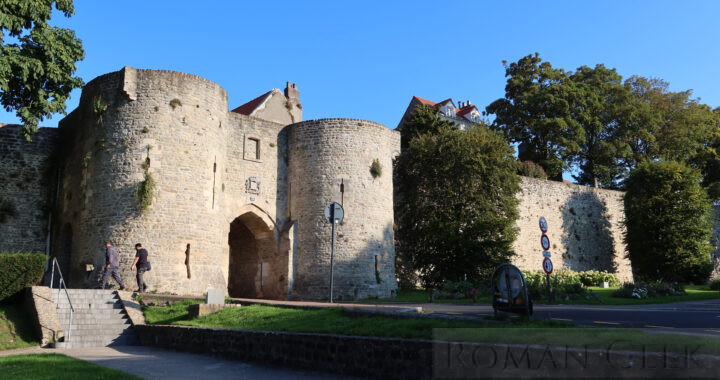
Porte Gayolle, Boulogne Old Town

Boulogne

  • Boulogne is a Port on the English Channel located on the estuary of the river Liane in the Pas-de-Calais Department of Northern France. It is 31 miles (50km) from Dover as the crow flies.
  • The Romans called it ‘Gesoriacum’ and it may also have been ‘Portus Itius’, later its name was changed to ‘Bononia’.

History

  • The Roman Port and Fortress were located in the Province of Gallia Belgica.
  • Boulogne was the main entry point into Gaul from Britannia.
  • Between 39-40 CE, Caligula planned an invasion of Britannia and assembled the Legions of Germany on the Channel Coast at Boulogne. Suetonius states that Caligula then changed his mind about the Invasion, and ordered the troops to collect sea shells instead and to bring them back to Rome.
  • Then in 43 CE, Suetonius states that Boulogne (Gesoriacum) was one of the ports used by Claudius in the Roman Conquest of Britannia of 43 CE.
  • Boulogne was the terminus of the Via Belgica, a military Road from Cologne to Boulogne and was the port of crossing for Richborough, the entry point into Britannia. Travellers then used Watling Street to reach London and beyond.

Antonine Itinerary

  • Boulogne and was the port of crossing to Richborough, the entry point into Britannia, as stated in the Antonine Itinerary.
  • ITER BRITANNIARUM

    a Gessoriaco de Gallis

    From Boulogne, of the Gauls

    Ritupis in portu Britanniarum

    to Richborough of the Britains

    stadia numero ccccl

    450 Stades (56.25 Roman miles)

Museums

Boulogne Castle

Boulogne Old Town

Boulogne Old Walls

  • The Walls:
    • The Walls of the Roman Fortress of the Classis Britannica were incorporated into the Medieval walls of Boulogne Old Town. The Walls are intact and can be walked around in a complete rectangle. For the most part, they are wide enough for two vehicles to pass.
  • The Medieval Castle:
    • Built on the Roman foundations, this is located in the northeastern corner and is now a Museum, .
  • The Basilica of Notre-Dame:
    • Completed in 1875, it was constructed on the site of a medieval cathedral and over a 12th century CE Medieval Crypt, which is intact and can be visited. The Dome of the Basilica is of a similar design to St. Paul’s Cathedral.
  • The Belfry:
    • Also in the Old Town located on the Place Godefroy de Bouillon is the 12th century CE Belfry, a UNESCO World Heritage Site. Originally built as a castle keep, it now houses a museum of religious art.

Basilica of Notre-Dame: The Crypt

  • Located in the Old Town, the 19th century CE Basilica of Notre-Dame de Boulogne supports a dome built in the style of the dome of St. Paul’s Cathedral in London, and stands over a 12th century crypt.
  • This ancient crypt has many rooms displaying over 400 artefacts dating from the Roman period to the Medieval period.
  • The crypt is one of the longest crypts in France with a length of 420 feet (128m). It is supported by Romanesque columns dating from the 11th century CE and one room holds the foundations of a Roman Temple of Mars.

Column of the Grande Armee

  • The Column of the Grande Armee is a Triumphal Column flanked by pavilions in Wimille near Boulogne in northern France. It is located at Rue Napoleon, Wimille.
  • It was completed by Napoleon in 1810 and is modelled on Trajan’s Column in Rome.
  • The Column has a height of 173 feet (53m) and was constructed in the style of a Triumphal Column of the Corinthian order.
  • The column was built to celebrate the impending invasion of England by Napoleon.
  • He then cancelled the invasion and instead the column celebrates the first award of the National Order of the Legion of Honour (Legion d’honneur), the highest military and civil order of merit in France.
  • The column has a spiral staircase to the top which is open to the public.

Boulogne Roman Lighthouse

  • Boulogne had a Roman Lighthouse which was built by Caligula (37-41 CE) in c. 39 CE, for his planned invasion of Britannia. It was not switched off until 474 CE.
  • It collapsed in 1644 and on the site of the Roman Lighthouse, Napoleon built the Column of the Grande Armee which is modelled on Trajan's Column in Rome.

Roman Roads

Via Belgica

The Batavian Revolt (69-70 CE)


Map and Image: Porte Gayolle, Boulogne Old Town

Toledo

  • Toledo is a cathedral city located on the river Tagus, 46 miles (74km) south of Madrid in the Autonomous Community of Castilla-La Mancha in central Spain.
  • It was the capital of the Carpetani Iberian Tribe and became the Roman city of Toletum, in the Province of Hispania Tarraconensis. After the Fall of the Roman Empire, Toledo became the capital of the Visigothic kingdom between 546-719 CE.

Toledo Steel

  • Toledo has been a centre of Steel and Sword manufacturing since c.500 BCE. Hannibal chose Toledo swords during the Second Punic War (218-202 BCE). From then on the Romans Legions used swords made in Toledo.
  • Toledo Steel is made by forging together a hard steel and a soft steel to obtain the benefits of both types in one sword. It was a long process by which individual blacksmiths only produced two to three weapons each year.

The Roman Sites

  • Toledo Roman Walls
    • Parts of the Roman walls can be seen in the expanded Visigothic walls, which were then expanded again by the Moors and again by the Reconquista.
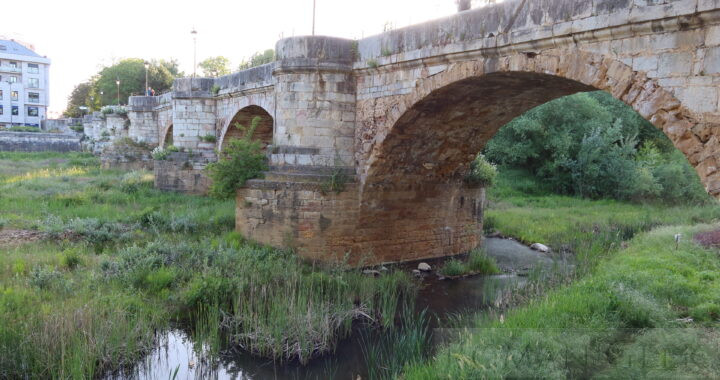
  • Puente de Alcantara Roman Bridge
    • The bridge crosses the Tagus river.
  • Roman Circus
    • With seating for 15,000 spectators.
  • Cave of Hercules
    • Located in the Callejon San Gines, this underground vault was a water reservoir supplied by an aqueduct.

Museums

  • Museum of Santa Cruz
    • The museum holds an archeological collection of artefacts covering all periods of history, including the Roman period.

Roman Roads

Puente de Alcantara, Toledo

Sea Mills

  • Sea Mills is a suburb of the city of Bristol located on the Avon Gorge.
  • It was a Roman Port called Portus Abona. No visible Remains exist above ground.

Roman Port

  • Sea Mills was the Roman port and settlement of Portus Abonae or Abona, on the junction of the river Avon and the river Trym.
  • According to the Antonine Itinerary, Sea Mills was manned by a unit of the Legio II Augusta which ran the Ferry Crossing over the Avon.
  • The Ferry connected the Legionary Fortress of Caerleon with Silchester and London.

Roman Roads


Sea Mills, Bristol


Binchester Roman Fort

Binchester Roman Fort

  • Binchester Roman Fort is located 1.5 mile (2km) north of Bishop Auckland in County Durham.
  • It was known as Vinovia and guarded the crossing of Dere Street over the river Wear. A branch of Dere Street ran due north to Newcastle from Binchester.

Auxiliary Units

  • The fort was continuously manned by a Cavalry Unit of the Auxilia up until the Romans left in c. 410 CE.
    • Ala Vettorium
      • from Spain (1st century CE)
    • Cuneus Frisiorum Vinobiensium
      • from Holland (The Frisii Tribe 3rd century CE to c.408  CE)

Roman Sites

  • The Commandants House (Praetorium)
  • The Bath-house
  • The Via Pricipalis (part of Dere Street
  • An Altar stone

Museums

Roman Roads


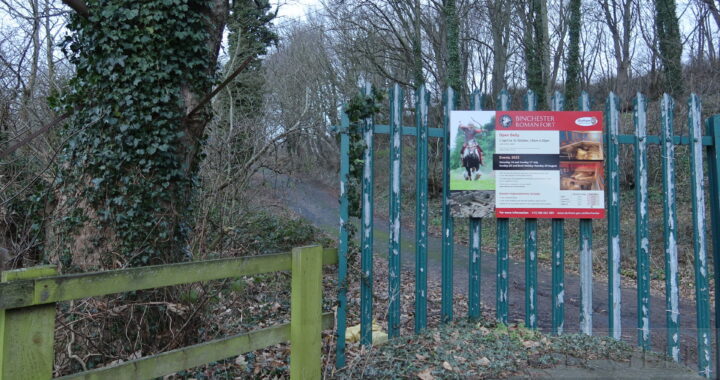
Photo and map: Binchester Roman Fort


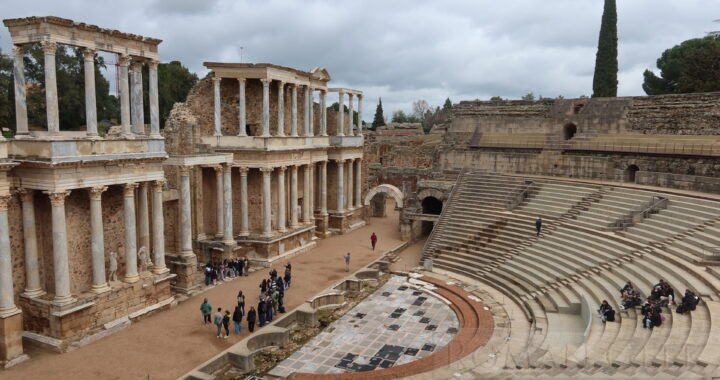
The Roman Theatre at Merida, (Emerita Augusta) in Spain.

Merida

  • Merida is a city located on the Guadiana and Albarrega rivers in the Autonomous Community of Extremadura in western Spain.
  • It was Emerita Augusta, the capital city of the Province of Lusitania. It is a Roman Archeological site noted worldwide for its collection of semi-intact buildings located in the city of Merida, and has been a UNESCO World Heritage Site since 1993.

History

The Ruins of Roman Emerita Augusta

  • Theatre
    • The Roman Theatre, which originally seated 6,000 spectators, has been restored to its original condition and is used for festivals.
  • Amphitheatre
    • The Roman Amphitheatre is also intact.
  • Circus
    • The area of the Circus is preserved in an enclosed Park, but is not open to visitors.
  • Guadiana Roman Bridge
    • At 2,598 feet (792m) it is the longest Roman bridge still standing today.
    • It carried the Via de la Plata from Seville to Gijon
  • Water Supply:
    • Proserpina Dam
    • Los Milagros Aqueduct
    • Castellum aquae, a water distribution point
  • Rabo de Buey, the San Lazaro Aqueduct
  • Temple of Diana, dedicated to the Cult of the Roman Emperor
  • Temple of Concordia
  • Trajan Arch
  • Mithraeum House
  • Forum Gate
  • San Lazaro Roman Baths
  • Roman Baths of Alange
  • Roman Baths and snow pit
  • Los Columbarios and part of the Necropolis

Museums

  • National Museum of Roman Art
    • This archeology Museum holds all the artefacts from Emerita Augusta including well preserved Roman statues and sculptures.

Roman Roads


Roman Theatre, Emerita Augusta

Springhead

  • Springhead is a suburb of Northfleet, Gravesend in Kent in the South East Region of England.
  • It was Roman Vagniacea, a Posting Station on Watling Street.

History

  • Springhead has been excavated to reveal an extensive Temple complex at the source of the river Ebbsfleet. It is not open to the Public.

Roman Roads


Springhead