Baths of Diocletian, Rome

Baths of Diocletian

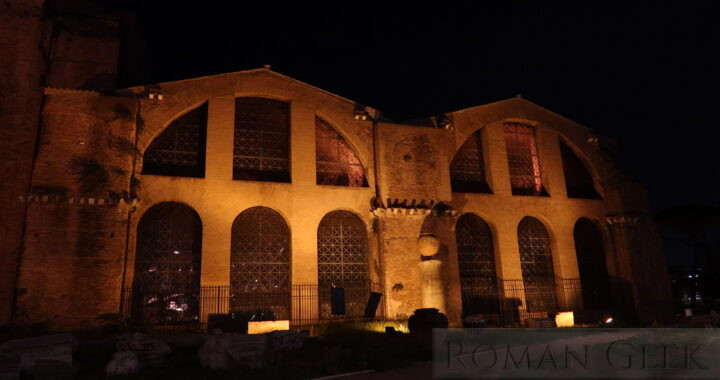
  • The Baths of Diocletian were the largest of all the Public Baths in Rome and could hold up to 3,000 people.
  • Known as Thermae, the Baths were built between 298-306 CE and dedicated by Diocletian in 306 CE. The Baths probably contained a Roman Library.

Getting There

  • Location: Viale Enrico de Nicola, 78, Rome.
  • Nearest Metro Station: Repubblica, Termini, Line A.

The Site today

  • The Baths are now incorporated into three buildings:
    • The Basilica of Santa Maria degli Angeli e dei Martiri (the Frigidarium).
    • The Church of San Bernardo alle Terme.
    • National Roman Museum


Photo and map: Baths of Diocletian, Rome

Baths of Caracalla, Rome

Baths of Caracalla

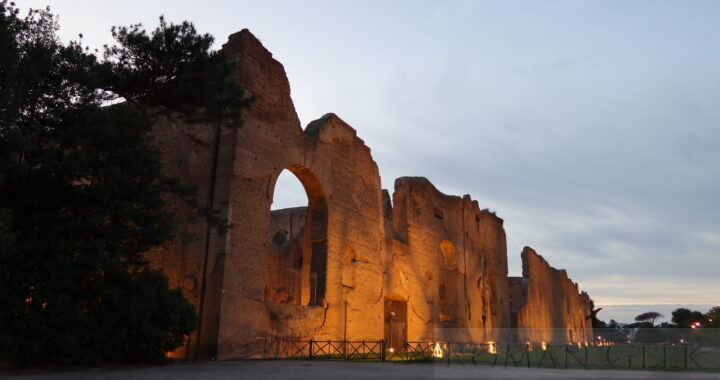
  • The Baths of Caracalla were Roman Baths completed by the Emperor Caracalla between 212-216 CE. They are located on the Viale delle Terme di Caracalla, Rome.
  • The Baths were the second largest Baths in Rome after the Baths of Diocletian. Olympiadorus of Thebes stated that the Baths could accommodate 1,600 people.

Description

The Site Today

  • The Site has been partially restored and visitors can tour the tunnels underneath the structure.

Roman Copies

Modern Copies

  • Grand Central Terminal, New York City (Built 1903-13)
    • Built by the New York Central Railroad, USA.
  • Pennsylvania Station in New York City (1910-demolished in 1963)
    • Built by the Pennsylvania Railroad, USA.
  • St. George’s Hall
    • Music Hall in Liverpool, England.


Photo and map: Baths of Caracalla, Rome

Battle of the Margus

The Reason for the Battle

  • After the sack of Ctesiphon in 283 CE, Carus had died of natural causes, leaving his two sons, Carinus and Numidian as co-emperors.
  • The returning Roman army stopped at Chalcedon where Numerian was found dead.
  • Diocletian then claimed Numerian‘s death had been an assassination, and his legions proclaimed him Emperor instead of Carinus.

The Battle

  • Carinus immediately set off to challenge Diocletian and the two armies met in Moesia at the river Margus, near Naissus, modern Nis in Serbia.
  • Despite Carinus‘ army appearing to gain the upper hand, Carinus was assassinated by his own Tribune, leaving Diocletian as undisputed Emperor.

The Outcome


Naissus, Nis, Serbia

Vichy

  • Vichy is a Spa town located on the River Allier in the Auvergne-Rhone-Alpes Region of central France.
  • During the Gallo-Roman Period it was known as Aquae Calidae or Vicus Calidus (town of hot waters) in the Province of Gallia Aquitania.

A Roman Spa Town

  • The hot waters were famed for their medicinal qualities.
  • Two hot springs today still retain their Roman construction.

Roman Sites

  • Source thermale de l’Hopital
    • This is a 34°C hot spring which rises in the original Gallo-Roman bath.
  • Hall des Sources
    • This has the ‘Source thermal Chomel’ which is a 43°C hot spring that rises in a Gallo-Roman concrete well.

Nearby Sites

  • Paleopolis Paleontology Park
    • Paleopolis is a Dinosaur Museum located in Ganat, 15 miles (24km) southwest of Vichy.

Roman Roads

  • Not known.


Vichy

Roman Beehives

  • Three intact examples of Roman Apiaries have been found near Xemxija in northern Malta.
  • Each Apiary consisted of rows of niches in a stone wall of a cave, filled with honeypots.

Description

  • The Hives are in caves where a stone wall has been built over the entrance. The caves are surrounded by an area full of wild thyme bushes.
  • The Apiaries consist of rows of small arched niches in the stone wall and each niche was a hive.
  • The bees entered the Hive through a hole at the back of these niches.
  • Inside the Apiary, a series of terracotta pots were placed on their side in the niches.
  • The Bees built their honeycombs in these pots, which could later be removed.

Beekeeping

  • The Beehive keeper could enter the Hive through a central doorway and tend to the Hives inside the cave.

The Bees

Honey


Xemxija, Malta

Istanbul

  • Istanbul is a Port city of 15 million people located on the Bosphorus and is in the Istanbul Province of Turkey.
  • It is the Financial Centre of Turkey and is home to several UNESCO World Heritage Sites.

Names

  • Istanbul was founded as Byzantium by the Ancient Greeks.
  • It was renamed Constantinople from c.330 CE onwards when it became the Capital of the Eastern Roman Empire, later known as the Byzantine Empire (395-1453 CE). Between 1453-1922 CE it was the Capital of the Ottoman Empire.
  • In 1930 CE Constantinople was renamed Istanbul.

History

Hellenistic Period (658-146 BCE)
  • In 658 BCE, the city was founded as Byzantium by the Greeks from Megara.
    • It was protected by a Wall with 27 Towers and 2 Gates on the landward side.
  • In 479 BCE, Pausanias the Spartan General, conquered Byzantium then rebuilt the Wall.
  • In 340 BCE, the Wall was rebuilt to prepare for an attack by Philip II of Macedon.
Roman Period (146 BCE-395 CE)
  • In 146 BCE, Greece officially became a Roman Province and the city continued to be called Byzantium.
  • Byzantium became the capital of the Roman Province of Thracia.
  • In 193-96 CE the city was besieged by Septimius Severus who destroyed the Walls, then rebuilt them.
  • In 324-336 CE, Constantine I also besieged then rebuilt the city.
  • In 330 May 11 CE, the city was Inaugurated as ‘Roma Nova’ (New Rome), and already during his reign it was called Constantinople.
  • The Senate of Constantinople. Constantine I created a second Roman Senate of Eastern Roman Senators, and also Roman Senators who wished to move to Constantinople. They were encouraged by a free gift of land and grain.
  • In 330 CE, the city had a population of c. 30,000, by 400 CE around 300,000 and by 565 CE around 750,000.
  • In 324 CE, Constantine I built a new single Wall to the west of the Severan Wall.
  • In 368 CE, Valens completed the Aqueduct of Valens.
Byzantine Period (395-1453 CE)
  • In 395 CE, the Eastern Empire split permanently from the Western Empire, with Constantinople as its capital city. Historians refer to it as the Byzantine Empire
  • In 413 CE, Theodosius II constructed the first Walls of Constantinople.
  • In 437, 447 and 448 CE Earthquakes destroyed the Constantinian and Theodosian Walls.
  • In 448 CE Theodosius II ordered the damaged Walls to be rebuilt in 60 days to deter Attila the Hun, who avoided the city and went into Greece instead.
  • Imperial Library of Constantinople. Very little is known about this Library, except that it seems to have contained Works in both Greek and Latin. It may have contained many of the Books or copies of the Books from the Great Library of Alexandria.
Ottoman Period (1453-1922 CE)
  • Constantinople was the capital of the Ottoman Empire, which at its peak collected Tribute from 32 Provinces and a number of Vassal states, located in southeastern Europe, western Asia and northern Africa.

Museums

  • Istanbul Archaeology Museums
    • Archeological Museum: Osman Hamdi Bey Yokuşu Sokak Sok 34122, Gülhane, Istanbul
    • The museum holds over 1,000,000 items from the Anatolian, Hellenistic, Roman, Byzantine and Ottoman Empire Periods.
    • The museum holds seven of the Porphyry Sarcophagi in which the Byzantine Emperors were buried.
  • Great Palace Mosaic Museum
    • The museum holds a series of excavated floor mosaics that decorated a peristyle court of the Palace, possibly dating to Justinian I (527-565 CE).

Roman and Byzantine Sites

  • Hagia Sophia (537 CE)
    • It was built as a Cathedral in 537 CE by Justinian I and was in use until 1453 CE. It was then used as a Mosque from 1453 until 1931 CE. Today it is a Museum and a Mosque.
  • Aqueduct of Valens (368 CE)
    • Valens (364-378 CE) completed the aqueduct in 368 CE. It has a dramatic viaduct between two hills in Constantinople which is still standing today.
    • The water system consisted of 160 miles (250km) of supply lines, three open reservoirs and one hundred underground cisterns.
  • Basilica Cistern
    • The Cistern is located under the Stoa Basilica, from which it derives it’s name, on the First Hill of Constantinople. The cistern featured in the James Bond film ‘From Russia with Love’.
    • It was completed before the Aqueduct of Valens was finished in 378 CE.
    • The Cistern is largest underground cistern in Constantinople, being approximately 450 x 210 feet (138 x 65m), with a capacity for 100,000 tons of water.
    • It has 336 marble columns are each 30 ft (9m) high and are arranged in 12 rows which support the ceiling. The cistern is lined by a brick wall sealed with waterproof mortar.
  • Obelisk of Theodosius
    • The Hippodrome is now Sultan Ahmet Square.
    • It was moved in 390 CE from Alexandria in Egypt to Constantinople by Theodosius I (379-395 CE), and positioned on the Spina of the Hippodrome, where it still stands today.
  • Harbour of Eleutherios (c.395 CE)
    • This is an excavation site which is not open to visitors. It is located under the Yenikapi district of Istanbul.
    • In 2005 whilst digging the East West Bosphorus Rail Tunnel, excavators uncovered the old Harbour of Eleutherios, built by Theodosius I (379-395 CE). It was also known as Harbour of Theodosius (Portus Theodosiacus).
    • Excavators unearthed sections of the Wall of Constantine I and 35 Byzantine Ship remains from the seventh to tenth centuries CE including Galleys.
  • Hippodrome of Constantinople (203 CE)
    • A U-shaped racetrack built by Septimius Severus and rebuilt by Constantine I in 324 CE, to accommodate 100,000 spectators.
    • Today, it is named Sultan Ahmet Square and contains several Monuments:
      • The Serpent Column made in 478 BCE, it is a bronze memorial to the Greek victory at the Battle of Plataea (479 BCE).
      • Obelisk of Theodosius
      • The Walled Obelisk
      • The statue of Porphyrius
  • Great Palace of Constantinople (no longer extant)
    • Located in Old Istanbul, only a few vestiges remain today, but some of the mosaics have been excavated and are now in the Great Palace Mosaic Museum.
    • In 330 CE, the Great Palace of Constantinople was built by Constantine I.
    • ‘The Porphyra’ was the official delivery room for pregnant Empresses, and was lined with red Porphyry marble from the Porphyry Mountain in Egypt (no longer extant).
  • Great Palace Mosaic Museum
    • The museum holds a series of excavated floor mosaics that decorated a peristyle court of the Palace, possibly dating to Justinian I (527-565 CE).
  • Church of the Holy Apostles (no longer extant)
    • The Church was built by Constantine I between 330-337 CE, and was the second most important church after the Hagia Sophia. The Church was destroyed in 1462 CE and no vestiges remain.
    • It was the Mausoleum for the Eastern Roman Emperors of the Byzantine Empire starting with Constantine I, in 337 Ce until 1056 CE with Theodora, after which there was no more space. The Emperors were placed in Porphyry Sarcophagi.
    • Seven of the Porphyry Sarcophagi are located in the Istanbul Archaeology Museums.

Roman Roads


Istanbul

Church of the Holy Apostles

  • The Church of the Holy Apostles (no longer extant) was located in Istanbul, Turkey, and was the second most important church in the Byzantine Empire after the Hagia Sophia.
  • It was the Mausoleum for the Eastern Roman Emperors of the Byzantine Empire from 337 CE, starting with Constantine I, until 1056 CE with Theodora, after which there was no more space.

The Building

  • The original building was commissioned and consecrated in 330 CE by Constantine I, but not completed until after 337 CE.
  • It was then completely rebuilt under Justinian I by the same architects who designed the Hagia Sophia.
  • It was finally demolished in 1462 CE by the Ottoman Turks and the site was used to build the Fatih Mosque.

The Tombs

  • The Tombs were looted for their Gold crowns and Jewels during the fourth Crusade of 1204 CE. Some of the treasures were brought back to Venice and are displayed today in Saint Mark's Basilica.
  • The Tombs are only known from a list in the Byzantine Emperor’s book of Protocol called ‘De Ceremoniis’.

Surviving Sarcophagi

  • Seven Porphyry Sarcophagi have survived. Two in the atrium of the Hagia Eirene, four outside the Archeological Museum and fragments of a fifth, possibly that of Constantine I, located in the ‘Istanbul through the ages’ Pavilion.

List of Emperors who were buried in the Mausoleum

  • 337 CE Constantine I
  • 361 CE Constantius II
  • 363 CE Julian the Apostate
  • 364 CE Jovian and his wife Charito.
  • 375 CE Valentinian I and his wife Marina Severa.
  • 395 CE Theodosius I
  • 457 CE Marcian and his wife Pulcheria.
  • 515 CE Ariadne
  • 518 CE Anastasius I
  • 565 CE Justinian I and his wife Theodora.
  • 593 CE Ino Anastasia
  • 641 CE Heraclius
  • 612 CE Eudokia
  • 668 CE Fausta
  • 711 CE Anastasia
  • c.703 Eudokia, wife of Justinian II (685-695 CE)
  • 912 CE Leo VI the Wise and his three wives.
  • 882 CE Eudokia Ingerina
  • 969 CE Nikephoros II
  • 1028 CE Constantine VIII
  • 1050 CE Zoe Porphyrogenita
  • 1056 CE Theodora
  • Two Patriarchs of Constantinople were also buried here:
    • Nikephoros I
    • Cyriacus II


Istanbul Archeology Museums

Nag Hammadi

  • Nag Hammadi is a city in Upper Egypt, 50 m (80 km) northwest of Luxor.
  • It was known as ‘Chenoboskion’ in antiquity and is the location where the Nag Hammadi library was found.

The Nag Hammadi library

  • The Nag Hammadi Library, also known as the Gnostic Gospels, are a collection of Codices which contain the only complete works of the Gospel of Thomas, amongst other writings.
  • In December 1945 a farmer discovered a sealed earthenware jar containing 13 codices bound in leather. 12 Books survive today. They consist of 52 Gnostic tractates.
  • The Codices are written in Coptic, but are thought to have been a translation from the Greek.
  • Today, the Nag Hammadi Library is located in the Cairo Museum in Cairo, Egypt.

Athanasius, Bishop of Alexandria (328-373 CE)

  • The Codices date from the second century CE, and are thought to have been hidden by monks from the nearby Monastery of Saint Pachomius, after such works were banned as Heretical and holding them considered an offence.
  • They were possibly buried after 328 CE, when Athanasius was a forceful Bishop of Alexandria from 328-378 CE.
  • Athanasius was a Trinitarian who opposed Arianism, and was exiled four times by different Emperors starting with Constantine I, for continually opposing Arianism.


Nag Hammadi, Egypt:

Constantine Basilica, Trier, Germany

Constantine Basilica

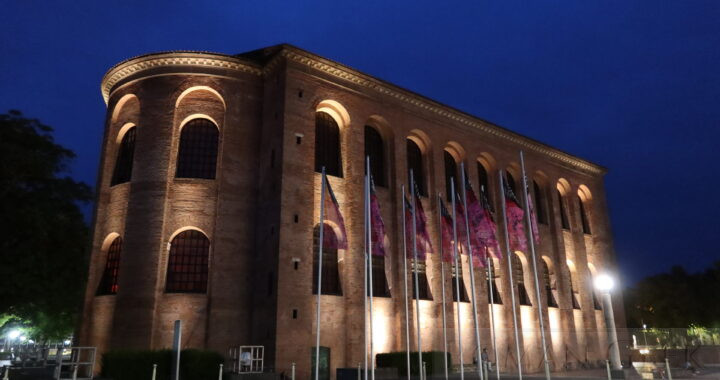
  • The Constantine Basilica, also known as the Aula Palatina, is a Roman building that is still standing in Trier, Germany.

History

  • The Basilica had the largest hall in the Ancient World and is on the same scale as a Medieval Cathedral.
  • It was built between 307-310 CE by Constantine I.
  • Constantine used it as an Imperial Audience Hall and Palace, from where he conducted his Court.
  • It was later converted into a Christian Church and today is used as a Protestant Church.

The Roman Sites in Trier

  • Porta Nigra (Black Gate)
  • Trier Imperial Roman Baths
  • Constantine Basilica
  • Trier Roman Amphitheatre
  • Trier Roman Bridge


Constantine Basilica, Trier

Mausoleum of Hadrian, Rome

Mausoleum of Hadrian

Getting there

  • Location: Lungotevere Castello, 50, Rome.
  • Nearest Metro Station: Ottaviano, Lepanto, Line A. Then Bus 23, 913.

Description

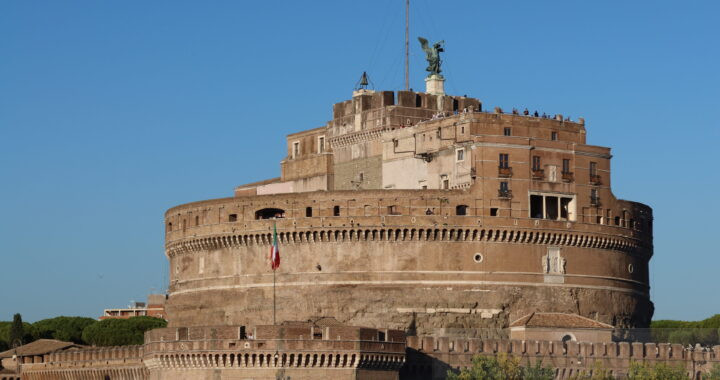
  • It is a circular building. Originally it had a roof garden and a golden Quadriga on top.
  • In 134 CE Hadrian built the Aelian Bridge or Pons Aelius across the Tiber to reach it.
  • In 401 CE it was turned into a fortress by Honorius as part of the defenses of Rome.
  • 410 CE During the Sack of Rome by Alaric and the Visigoths, the Mausoleum was desecrated and the ashes scattered.

Emperors ashes once held in the Mausoleum


Photo and Map: Mausoleum of Hadrian (Castel Sant’Angelo)