Ancona

  • Ancona is a port and cathedral city located on the Adriatic in the Marche Region of central Italy.
  • It was a Roman city of the same name in Italia, noted for its sheltered harbour, which Trajan (98-117 CE) redeveloped.

Roman Sites

  • Roman Amphitheatre
  • Roman Arch of Trajan
  • Archeological area of Trajan’s Port
  • Archeological area with Roman Ruins

Museums

  • National Archeological Museum of the Marche Region
    • Located at Via Gabriele Ferretti, 6, 60121, Ancona.
    • Collections from Classical Antiquity are located on the first floor.

Roman Roads


Ancona

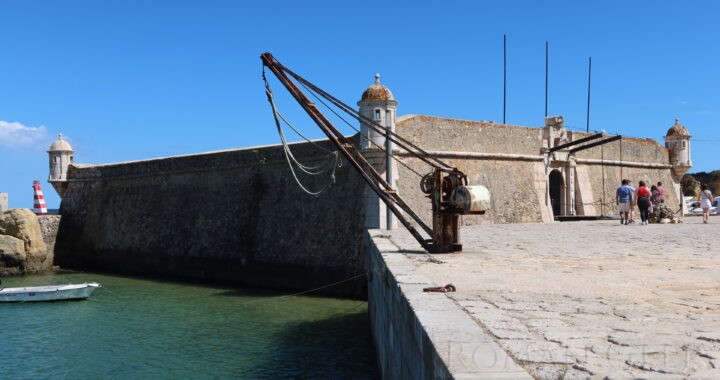
Lagos Fortress, Lagos, Algarve in Portugal.

Lagos

  • Lagos is a cathedral city located on the mouth of the river Bensafrim in the Algarve Region of southern Portugal. It is 56 miles (90km) west of Faro.
  • It was the Roman city of Lacobriga and was in the Province of Lusitania. The Roman city is just outside Lagos at Monte Moliao, but the site is not open to visitors.

Roman Sites

  • Oceanus Mosaic
    • The mosaic is located in the Municipal Museum Lagos.
  • Lagos ‘Roman Bridge’
    • Although it is called a ‘Roman Bridge’, its date of construction is much more recent.
    • The structure is a high arched bridge that connects the scenic cliffs at Ponta de Piedade in Lagos.

Museums

  • Municipal Museum Lagos
    • It is located at R. Gen. Alberto da Silveira 1,8699-594, Lagos.
    • The museum holds the Oceanus Mosaic and other Roman artefacts.

Other Sites

  • Lagos Fortress (Forte da Ponta da Bandeira)
    • Built in c.1690, the Fort was built to protect the town from pirate attacks.
    • It is protected by a moat and drawbridge.
    • Inside is a small museum about Portugal’s maritime history.


Lagos

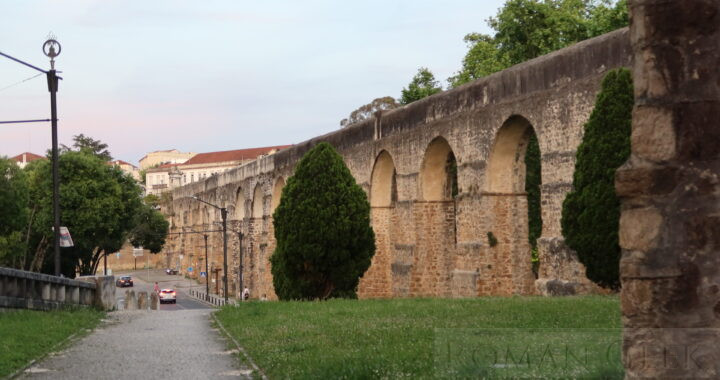
San Sebastian Aqueduct, Coimbra, Portugal

Coimbra

  • Coimbra is a cathedral city and former capital of Portugal between 1129-1255 CE, located on the river Mondego in the Centro Region of western Portugal.
  • It was the Roman city of Aeminium in the Province of Lusitania, and is located 8 miles (15km) from the Roman city of Conimbriga.

History

  • The inhabitants of the nearby Roman city of Conimbriga fled to Aeminium in 468 CE, when their city was razed by the Suebi. They renamed Aeminium to become Conimbriga. The name was later changed again to Colimbria, and finally to Coimbra.

Roman Sites

  • San Sebastiao Aqueduct
    • This is not a Roman structure, but was built in the 1560’s CE. However, the modern aqueduct is actually a continuation of a Roman aqueduct.
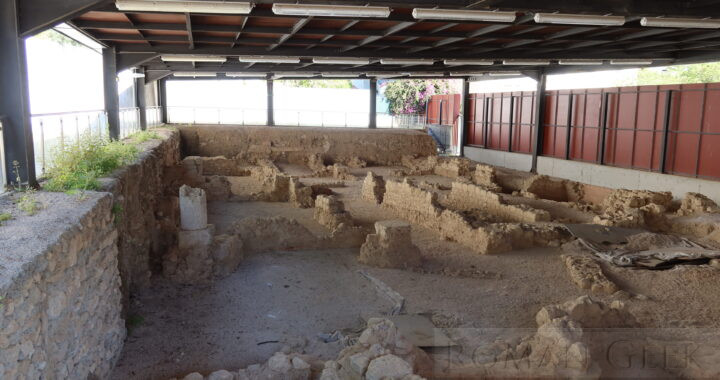
  • Roman Cryptoporticus
    • This was part of the Roman Forum and is now located under the Museo Nacional de Machado de Castro.

Museums

  • Museo Nacional de Machado de Castro
    • It is located in the Alta de Coimbra (old city).
    • The museum is built over the site of the Roman Forum of Aeminium, under which the Roman Cryptoporticus can be visited on the lower levels.

Roman Roads


Coimbra

Santarem Roman Ruins, Portugal

Santarem

  • Santarem is a city located above the river Tagus in the Centro-Alentejo Region of western Portugal.

History

  • It became a Roman city in 138 BCE and was named Scallabis Praesidium Julium in 61 BCE by Julius Caesar and was in the Province of Lusitania.
  • Vestiges of a 1st century BCE Roman Temple, Theatre and Baths were found during excavations.

Jardim das Portas do Sol

  • These gardens occupy the site of the Moorish citadel. There are magnificent views of the plains below, the road bridge over the river Tagus, winding into the distance and the railway line running far below under the cliff edge. The station is below in the plain with a one and a half mile (3km) walk uphill into the town.
  • The medieval character of the town is preserved.

Museums

  • Art and Archeology Museum
    • Located in S. Joao de Alporao Church (the Church of St. John of Alporao).

Roman Roads


Jardim do Portas do Sol, Santarem

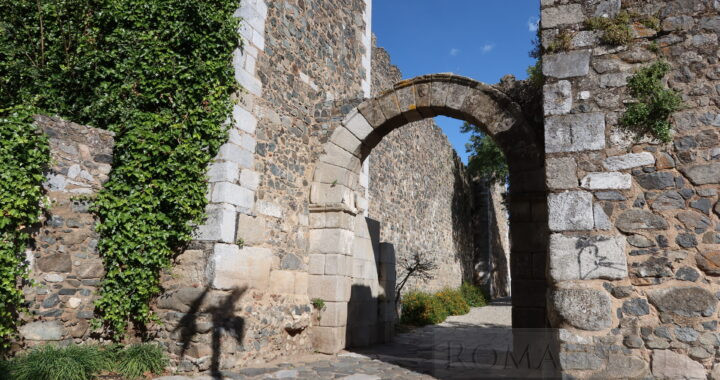
Roman Arch in the Evora Gate, Castle of Beja, Beja, Portugal

Beja

  • Beja is a cathedral city located near the river Guadiana in the Alentejo Region of southern Portugal.
  • It was founded as Pax Julia by Julius Caesar in 48 BCE, becoming Pax Augusta under Augustus and was in the Province of Lusitania.

Roman Sites

  • A Roman Arch
    • The Arch is still standing at the Evora Gate attached to the Castle of Beja.
  • Castle of Beja
    • The Walls of the Castle are constructed out of the walls of the Roman City of Pax Julia.

Museums

  • Museum of Queen Eleanor
    • Located at Largo da Conceicao 5, 7800-131, Beja.
    • The Museum holds an archeological collection of artifacts which includes the Roman period.
  • Centro de Archeologia e Artes
    • Located at Praca da Republica 42,7800-426, Beja.
    • The museum is currently closed, but will display remains of the Roman Temple and Roman Forum.

Roman Roads

  • A Roman Road connected Beja with Merida (Emerita Augusta).

Other Roman Sites Nearby

  • Roman Ruins of Pisoes
    • These are the remains of an unusually well preserved 1st century CE Villa rustica, which is located 6 miles (10km) to the west of Beja.
    • The villa mosaics are intact as are a large part of the baths.
  • Roman Bridge
    • The bridge is over the river Odivelas, and is located on the N 258-1, 20 miles (33km) north of Beja.


Beja Castle, Beja

Salamanca

  • Salamanca is a university and cathedral city located on the river Tormes in the Autonomous Community of Castilla y Leon in western Spain. Salamanca university is the third oldest in Europe, established in 1134 CE.
  • It was the Roman city of Salamantica in the Province of Lusitania.

Roman Sites

  • Roman Bridge
    • The Puente mayor de Tormes has 26 arches, 15 of which are Roman. It is now a bridge for pedestrians only.
    • It carried the Via de la Plata across the river Tormes. The road was completed in 19 BCE.

Museums

  • Sedes Antigua Castrorum
    • This Archeological Museum is located at Cta. de Carvajal, 1, 37008, Salamanca.
    • It holds a 4th century BCE pre-Roman Defensive Wall, with viewing access restricted to certain days only.

Roman Roads


Salamanca

Porto

  • Porto, also known as Oporto, is a port and cathedral city on the mouth of the river Douro in Norte Region of northern Portugal.
  • The Roman city of Portus Cale was founded in 136 BCE and was in the Province of Lusitania.

Roman Sites

  • Roman Wall known as Cerca Velha (Old Wall)

Museums

  • Porto Archeology Museum
    • The Museum is on the site of various Roman ruins which are on display.

Roman Roads


Porto

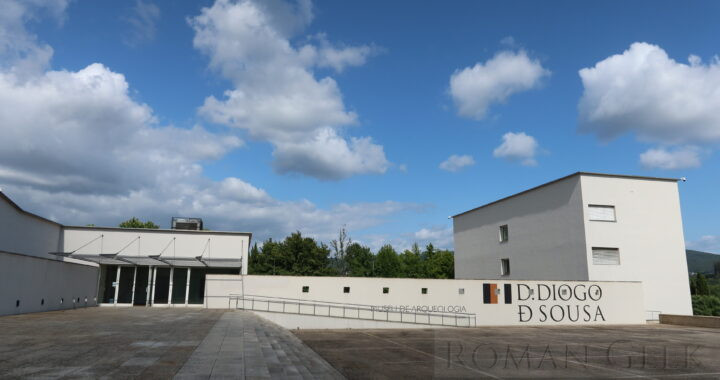
Dom Diogo De Sousa Regional Museum of Archeology, Braga, Portugal

Braga

  • Braga is a cathedral city located on the source of the river Este in northern Portugal.
  • It was founded in 20 BCE as the Roman town of Bracara Augusta in the Province of Hispania Tarraconensis.

Roman Sites

  • Roman Baths of Maximinus
  • Ponte de Prado Roman Bridge, Vila de Prado, Braga
    •  Reconstructed in 1616 after the original Roman bridge was swept away.

Museums

  • Dom Diogo De Sousa Regional Museum of Archeology
    • The Museum is located in the centre of the Roman Ruins of Bracara Augusta and holds Finds from excavations of the city..

Roman Roads


Dom Diogo De Sousa Regional Museum of Archeology, Braga

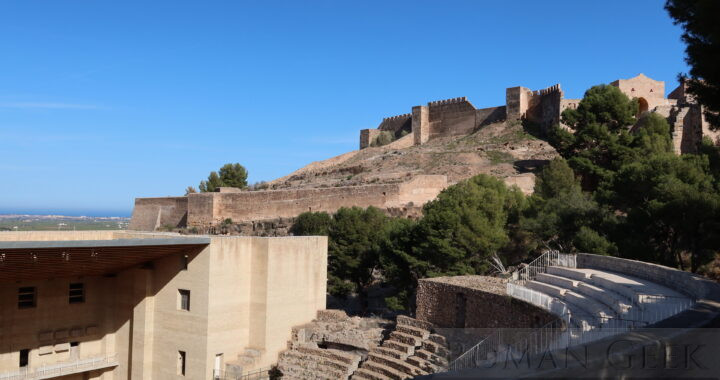
Sagunto Roman Theatre

Sagunto

  • Sagunto is a port city located on the river Palancia, 18 miles (30km) north of Valencia, in the Autonomous Community of Valencia in northeastern Spain.
  • It is noted for the archeological remains of the Roman city of Saguntum, located in the Province of Hispania Tarraconensis.  It was on the Via Augusta

History

  • It was founded in the 5th century BCE by the Greeks, and had an Acropolis, Temple and Theatre which have survived from this period. The city was known as Arse.
  • Hannibal besieged the city in 219 BCE, a city loyal to Rome, which began the Second Punic War (218-202B CE).
  • The Romans retook the city and renamed it Saguntum in 214 BCE after which it became a Roman city with its own Mint and many Roman civic buildings.
  • From the 12th century CE onwards, the Saguntum declined and Valencia became the main city.

Roman Sites

  • Sagunto Castle
    • The walled Ramparts are built on the Roman and Moorish Walls.
  • Roman Theatre
    • Seating for 8,000 spectators.
  • Roman Circus
  • Roman Forum

Museums

  • Sagunto History Museum (MUHSAG)
    • Located at C/ del Castell, 23, 46500, Sagunto, Valencia.
    • All the Finds from Saguntum are held in the Museum.

Roman Roads


Sagunto Roman Theatre

Pamplona

  • Pamplona is a cathedral city located on the river Arga in the Autonomous Community of Navarre in northern Spain.
  • It was the capital of the Vascones Iberian Tribe, founded as Roman Pompaelo in c.74 BCE by Pompey, who it is named after. It was in the Province of Hispania Tarraconensis.

History

  • Pamplona is famous throughout the world for its week long San Fermin Festival and the Running of the Bulls through the streets. At 8 o’clock each morning, crowds race ahead of 6 bulls and 6 steers down a half mile (825m) series of narrow streets that lead into the Pamplona Bullring, which seats over 19,500 spectators. The run take just 3 minutes.
  • Saint Fermin was the Bishop of Pamplona who was martyred in 303 CE during the Diocletianic Persecution (303-313 CE), possibly by being dragged through the streets by a bull.

Roman Sites

  • Roman Temple
    • Located below the cloister of Pamplona Cathedral.
  • ‘Noain Aqueduct’
    • Although it resembles one, this is not a Roman Aqueduct. It was completed in 1792 CE.

Museums

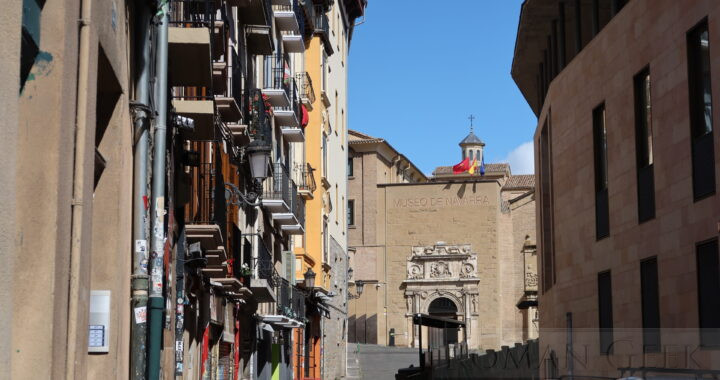
  • Museum of Navarre
    • Located at C. de Santo Domingo, 47, 31001, Pamplona.
    • The museum holds the ‘Triumph of Bacchus’, a Roman Mosaic from the Roman town of Andelos (Mendigorria).

Roman Roads


Pamplona