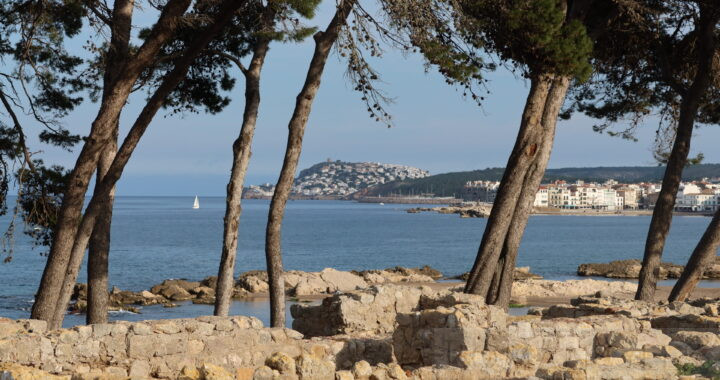
Ampuries, L'Escala, Girona

Ampuries

  • Ampuries, also known as Ampurias, is a Greek and Roman Archeological Site which was uncovered in 1908 CE, and has been excavated in stages ever since.
  • It is located on the coast, 42 miles (67km) northeast of Gerona in the Autonomous Community of Catalonia in Northeastern Spain.

History

  • It was founded by the Greeks in c.550 BCE, close to a local city called Indike, and remained an independent Greek city state until the Great Roman Civil War (49-45 BCE), when it became a Roman Colonia called Emporiae.
  • After this it became subordinate to Tarragona and was in the Province of Hispania Tarraconensis.

Greek City ‘Neapolis’

  • Agora with ruins of various public buildings
  • Temple of Artemis
  • Temple of Asclepius
  • Temple of Zeus-Serapis
  • Houses with mosaics and wall paintings
  • Necropolis

Roman Site

  • Only 20% of the Roman Municipium has been excavated.
  • The Roman town abuts to the west of the Greek city of Neapolis and its Ruins include:
    • Forum
    • Temple
    • Basilica
    • Curia
    • Houses with Mosaics and Paintings
    • Roman Wall
    • Amphitheatre
    • Palaestra (wrestling school)

On Site Museum

  • Archeology Museum of Catalonia
    • The Museum has five branches, with one located inside the Ruins of Ampuries.
    • A 7 foot (2.15m) high marble Statue, thought to be of Asclepius, the Greek God of Healing, stands in a dedicated room in the museum. It was created in the 2nd century BCE by an unknown sculptor.
    • It is considered to be the most important work of art from Ancient Greece in the Western Mediterranean.

Roman Roads


Empuries

Castro Urdiales

  • Castro Urdiales is a port town in the Autonomous Community of Cantabria in northern Spain. It lies 19 miles (31km) west of Bilbao.
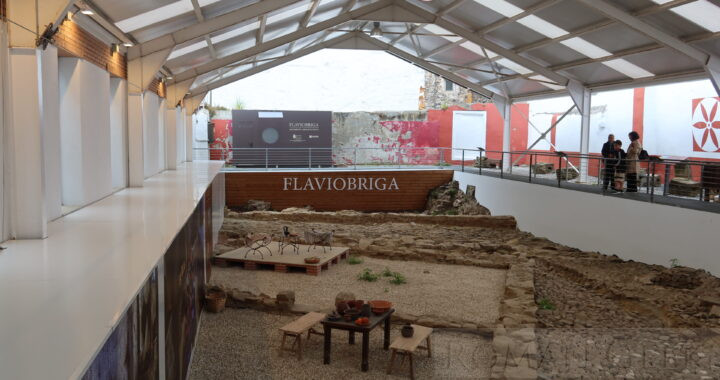
  • It was the Roman port of Flaviobriga, the main port linking Roman Spain to Gaul, in the Province of Hispania Tarraconensis. Today, the main port is Bilbao, which was founded much later during the 14th century CE.

Roman Sites

  • Roman Milestone,
    • Located opposite the church of Santa Maria, with an inscription, and showing 180 miles to Pisoraca (Herrera de Pisuerga).
  • The Roman town is located 6 feet (2m) below the Old Town.
    • Finds from Flaviobriga are in the Regional Museum of Prehistory and Archaeology of Cantabria in Santander.

Museums

  • Ruinas Romanas Flaviobriga
    • The Archeological Museum is located at 2 Calle Flaviobriga, Castro Urdiales.
    • The museum is built over part of the excavated city.

Roman Roads


Flaviobriga Archeological Site, Castro Urdiales

Astorga

  • Astorga is a city located between the river Tuerto and the river Jerga in the Autonomous Community of Castilla y Leon in northwestern Spain.
  • It was the Roman town of Asturica Augusta in the Province of Hispania Tarraconensis. Founded in 14 BCE by Augustus it became the main Roman city in northwestern Spain.

Roman Sites

  • Roman Baths
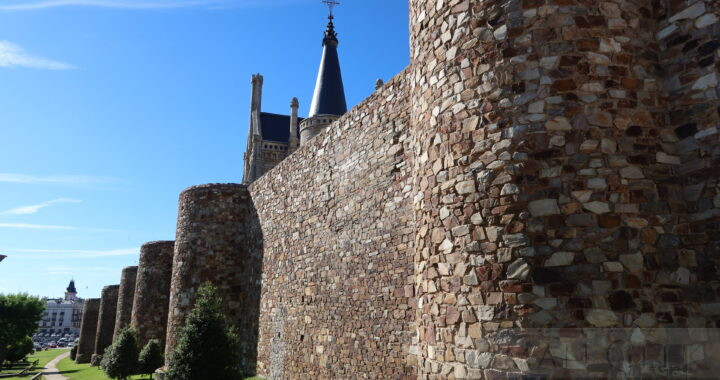
  • Roman Walls
    • 3rd century CE, visible as part of the Medieval walls.
  • Roman prison
    • (Ergastula) located in the Museum

Museums

  • Museo Romano La Ergastula
    • The Museum is located on the site of a Roman Prison (Ergastula) and explains the history of Roman Astorga.

Roman Roads


Astorga

Almunecar

  • Almunecar is a Port town in Andalucia, Province of southern Spain.
  • It was the Roman town of Firmium Julium Sexi dating from the 1st century CE and located in the Province of Baetica.

Roman Sites

  • Fish Salting Factory located in the Majeulo Botanical Gardens
    • The factory required large quantities of fresh Fish, Sea Salt and running Water.
  • Roman Aqueduct
    • There were Five Roman Aqueducts, with 4 still in use, built to supply the fish factory.
  • Roman Baths
    • Near to the aqueduct.
  • Roman Palace
    • Now part of the Museum
  • Roman Bridge
    • Located 3 miles (5km) west at Cortobo
  • Roman Tombs
    • In various locations
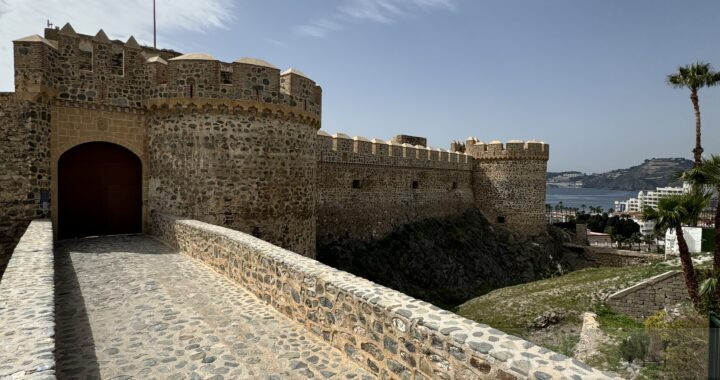
  • Castillo de San Miguel
    • Underneath was a Roman Fort (remains not visible) connected over the gorge by a Roman Bridge which has now been lost.

Museums

  • Archeological Museum of Almunecar
    • The Museum is housed in the ruins of a Roman Palace.

Roman Road

  • A Roman Road ran along the coast to Malaga.

Nearby Sites

  • Motril:
    • The port town of Motril lies to the east of Almunecar is noted for its Sugar Museum and Rum factory.
    • Motril was the site of the only sugar cane plantation in Europe and several sugar refineries begun after 1814 CE.
  • Salobrena:
    • Salobrena Old Town is perched on a small mountain near the sea and consists of ancient houses in narrow streets dominated by a 10th century Moorish castle.

Almunecar

Le Pantheon, Paris

Le Pantheon

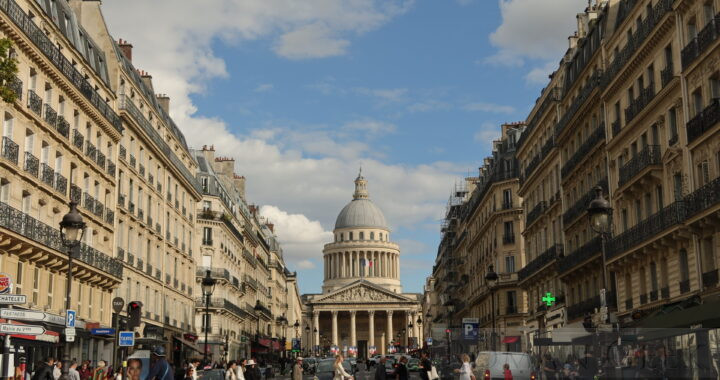
  • The Pantheon is a Mausoleum in Paris built in the Neoclassical style for French Citizens who were noted for their achievements. It was completed between 1758-1790 CE.
  • It is located in the Latin Quarter of Paris and is modelled on the Pantheon in Rome.

History

  • The Pantheon lies on the Montagne Saint Genevieve, and was first conceived as a Church dedicated to St. Genevieve to house her relics by Louis XV of France. By the time it was completed in 1790, the French Revolution had taken power.
  • Instead of a Church. the Marquis de Vilette suggested it become a Temple to Liberty, modelled on the Pantheon in Rome, with the ashes of the great men of France laid inside it.
  • Consequently, the National Constituent Assembly voted in 1791 to change the Church into a Mausoleum.
  • Notable French Citizens in the Mausoleum are: Voltaire, Victor Hugo, Emile Zola, Leon Gambetta, Jean Jaures, Jean Moulin, Jean Monnet, Marie Curie, Pierre Curie, Andre Malraux and Josephine Baker.


Photo and map: Le Pantheon, Paris

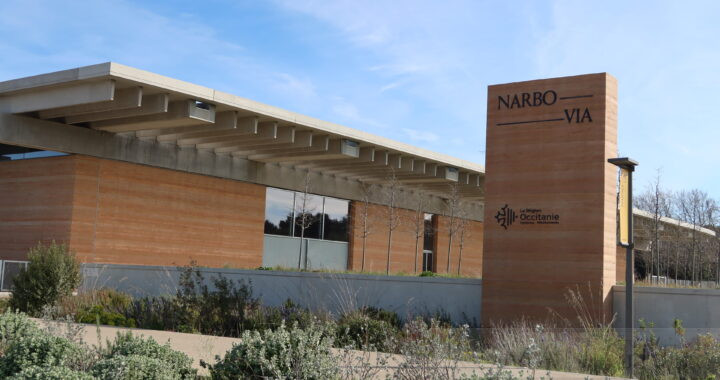
Narbo Via Museum, Narbonne

Narbo Via

  • The Musee Narbo Via opened on 21st May 2021 and houses a history of Roman Narbonne which combines collections from five separate locations.
  • Amongst the 15,000 artefacts in the Musum are 1,000 funerary stones that were reused in the medieval city wall. The Museum has arranged the Artefacts into several Themes.

Description

  • The Museum is located at 2 Avenue Andre Mecle, 11100 Narbonne, near the Theatre du Grand Narbonne and the Canal de la Robine.
  • The Museum is set in its own grounds and has 8,000 square metres of space set on one level, with areas for the Permanent Exhibition, the Temporary Exhibitions, and a workshop for the Restoration and Research of the collections.

Contents

  • A Lapidary Wall
    • This is a display of a selection of the carved Roman stones. It has a unique automatic retrieval system that changes the stones on display at regular intervals.
  • Funerary Reliefs
  • Residential Art
    • wall and ceiling paintings, Mosaics and Statues.
  • Port la Nautique
    • excavated artefacts from the Roman harbour, including a giant ship’s Anchor
  • Sarcophagii (Early Christian)


Photo and map: Musee Narbo Via

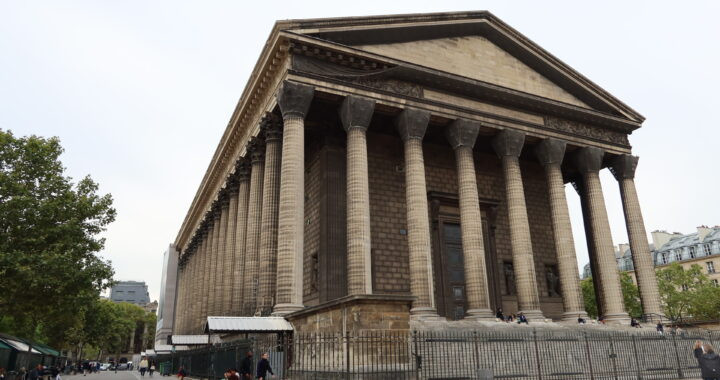
L' Eglise de la Madeleine, Paris

L’Eglise de la Madeleine

  • The Church of Saint Mary Magdalene, also known as La Madeleine, is a Catholic Church which resembles a Roman Temple and is located at the far end of Rue Royale opposite La Concorde in Paris.
  • It was commissioned in 1806 CE by Napoleon Bonaparte as a memorial ‘Temple to the Glory of the Great Army’ and was finally consecrated in 1842 CE.

History

  • The Church was designed by Pierre Alexandre Vignon in the Neo-Classical Style based on La Maison Carre in Nimes. Vignon died in 1828 and was succeeded by Jacques-Marie Huve who completed the project.


Photo: L’Eglise de la Madeleine, Paris

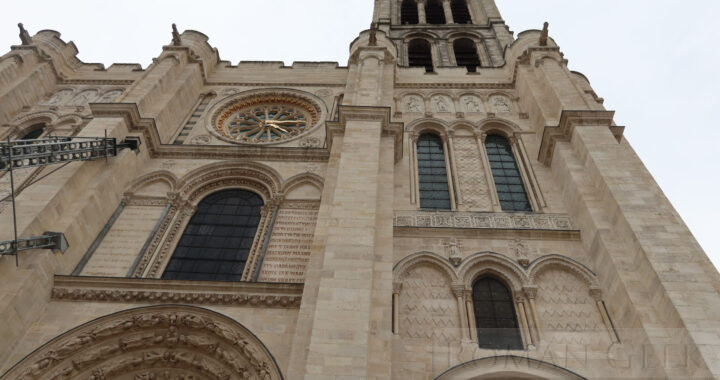
Basilica of Saint Denis

Basilica of St. Denis

  • Now known as the Basilica cathedral of St. Denis, the Basilica is located 6 miles (10km) north of Paris,
  • It was built on the Site where St. Denis was buried. All but four of the Kings of France were subsequently buried here.

St. Denis (died c.250 CE)

  • St. Denis, also known as Dyonisius, is the Patron Saint of France and one of the Patron Saints of Paris. He was martyred in c. 250 CE. His Feast Day is celebrated on October 9th.

History of the Basilica

  • In c. 313 CE, a Martyrium was built on the site. The number of Pilgrims increased each century.
  • St. Genevieve (c.419-c.512 CE) developed the shrine into a Basilica..
  • In 632 CE, Dagobert I converted the site into the Abbey of St. Denis, a Benedictine monastery, with a new Mausoleum for the remains of St. Denis.
  • In 775 CE, the Abbey was rebuilt and consecrated by Charlemagne.
  • In 832 CE a second Crypt was added.
  • Between 1135-1161 CE, Abbot Suger reconstructed the Abbey in the Gothic style. And during the following centuries various extensions were added.
  • After the French Revolution in 1789, the Benedictine Order of Monks was abolished on 15th September 1792, the Abbey deconsecrated and used as a warehouse, but allowed to remain standing, whereas the monastic buildings were demolished.
  • Between 1813-1843 CE, the Abbey was restored by Debret. He was then replaced by Viollet-le-duc who continued the restoration until 1879 CE.

Oriflamme (1124-1415 CE)

  • Oriflamme is from the Latin, Aurea Flamma, meaning Golden Flame. The Oriflamme was a sacred Banner of orange-red silk flown from a lance by the Kings of France during the Middle Ages. It was eventually replaced on Standards by the Fleur de Lys.
  • It was kept at the Abbey of St. Denis, north of Paris. When raised, it was a symbol that no quarter was to be given, no prisoners taken.
  • It was first used in 1124 by Louis VI, and last used in the Battle of Agincourt in 1415.

Decian Persecution (249-251 CE)

  • In early 250 CE the Emperor Decius (249-251 CE) passed an Edict which started the Decian Persecution.
  • According to Gregory of Tours, Pope Fabian (Pope between 236-250 CE) had sent seven Bishops from Italy with the aim of converting Gaul to Christianity. One of the seven was St. Denis who was sent to become the Bishop of Paris.
  • As a result of the Edict, Pope Fabian was martyred on the 20th January 250 CE.
  • St. Denis was also martyred, by beheading on a hill, later named after his martyrdom, ‘Montmartre’ (Mount of the Martyr). His two friends, Rusticus and Eleutherius who had accompanied St. Denis were also martyred with him.


Basilica of St. Denis

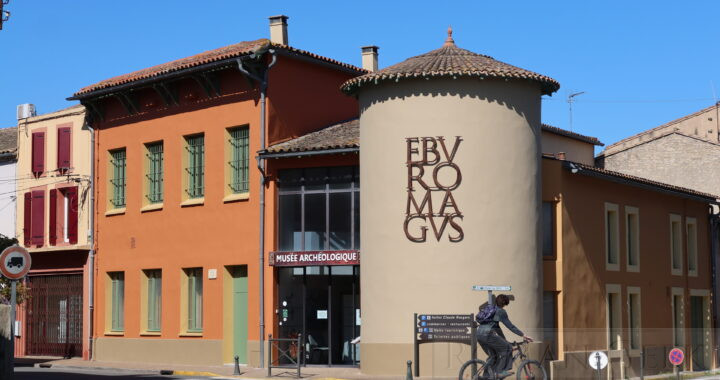
Eburomagus Archeological Museum, Bram

Bram

  • Bram is a town located on the river Fresquel in the Occitanie Region of southern France. The Canal du Midi runs near the town.
  • The old Medieval town, which is intact, was built to a circular plan centred on the church.

Museums

History

  • Bram was the Roman vicus of Eburomagus, located in the Province of Gallia Narbonensis. The vicus has been excavated and the Finds are in the local Eburomagus Archaelogical Museum.

Roman Roads


Eburomagus Archeological Museum, Bram