Lillebonne (Juliobona) was an important military and commercial port that traded with Britannia. The Roman Artefacts from Lillebonne are mostly in the Rouen Museum of Antiquities.

Lillebonne

  • Lillebonne is a town located on the river Commerce or Bolbec, 3.5 miles (5km) north of the river Seine and 24 miles (38km) east of Le Havre. It is in the Normandy Region of France.
  • It was originally the Oppidum of the Caletes Gallic Tribe. It became Juliobonna under the Romans and in 22 BCE became part of the Province of Gallia Lugdunensis.

History

  • Lillebonne (Juliobona) was an important military and commercial port that traded with Britannia.
  • The Roman Artefacts from Lillebonne are mostly in the Rouen Museum of Antiquities.
  • A Bronze head of Apollo from Lillebonne is displayed in the Louvre in Paris.

Roman Sites

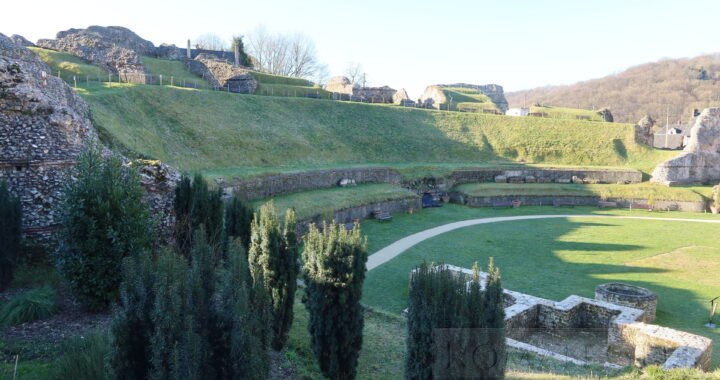
  • Roman Amphitheatre
    • A half Amphitheatre with seating for 3,000 spectators.
  • Roman Baths

Museums

  • Juliobona, Gallo-Roman museum
    • Located opposite the Roman Amphitheatre.
    • It holds archeological Finds from the excavations of Roman Juliobona, including the Tomb of Marcus.

Roman Roads

Nearby Sites

  • Harfleur (Caracotinum)
    • The town is located 3 miles (5km) east of Le Havre, and was the Roman Port of Caracotinum, capital of the Caletes Gallic Tribe, which was linked by the River Seine and Roman Roads to Rouen, Paris and Troyes.


Roman Amphitheatre, Lillebonne

Vannes, medieval port city, Brittany, France

Vannes

  • Vannes is a Cathedral city and port located on the Gulf of Morbihan at the confluence of the river Marle and the river Vincin in the Brittany Region of France.
  • Vannes was the Oppidum of the Veneti Gallic Tribe and was called Darioritum or Civitas Venetorum when it became part of Roman Gaul in 50 BCE. It was located in Gallia Lugdunensis.

History

Roman Sites

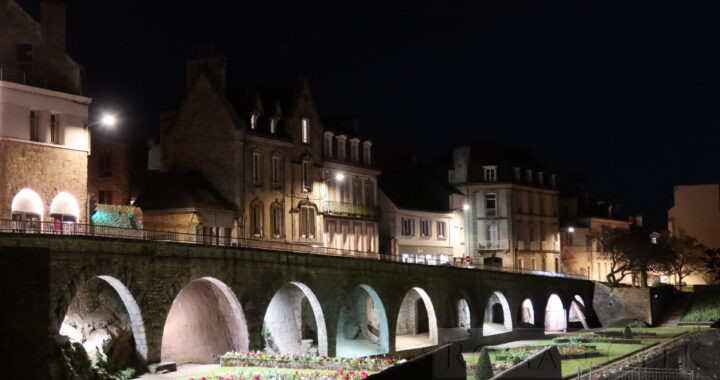
  • Roman Ramparts de Vannes
    • 3rd century CE walls near la Tour Joliette.

Museums

  • Chateau Gaillard
    • A Museum of History and Archeology which holds some Roman Artefacts.

Roman Roads

  • Vannes-Carhaix Plouguer


Vannes

Externsteine

  • The Externsteine is a group of thirteen tall naturally occurring sandstone rocks that rise in the Teutoburg Forest, near Hom-Bad Meinberg, North Rhine-Westphalia, Germany.
  • The site is a major tourist destination.

History

  • The stones are not linked to Bronze Age activity, with most archeological excavations producing evidence from the tenth century CE onwards.
  • Despite this, they became known during the twentieth century as the German Stonehenge.

Nearby Sites


The Externsteine

Temple of Portunus, Forum Boarium, Rome

Temple of Portunus

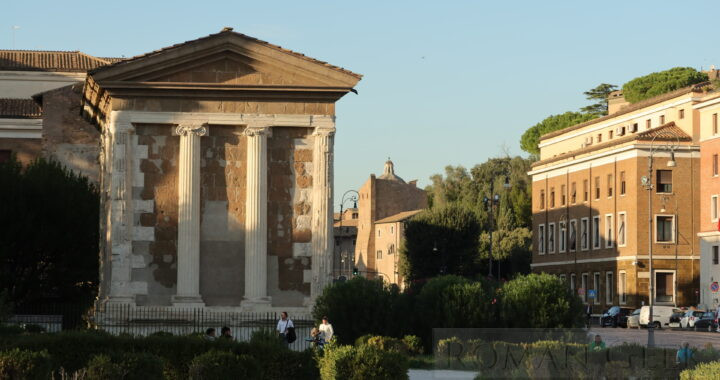
  • The Temple of Portunus, also known as the Temple of Fortuna Virilis, is one of the best preserved Temples of Ancient Rome. Portunus was the Roman God of keys and doors.
  • It is located in the Forum Boarium in Rome and was built between the 4th to 3rd century BCE.

Getting There

  • Location: Piazza Bocca del Verita, Rome.

Roman Keys

  • The Ancient Romans made many keys of all sizes, not only for locks on doors to houses but also Temples.
  • Temples were used to store valuables and the doors were were locked when not in use.


Photo and map: Temple of Portunus, Forum Boarium

Pula Arena

  • The Pula Arena (27 BCE-68 CE) in Croatia is the sixth largest Amphitheatre in the Roman Empire and could accommodate 23,000 spectators.
  • It is the only Roman Amphitheatre where all four side towers are intact. The outer wall is also intact.


Pula Arena, Pula, Croatia

Oman

  • Oman is a country located in south Arabia at the entrance to the Persian Gulf.
  • It has Copper Mines that began extraction in 3,000 BCE.

Copper Mines

  • The Sumerian clay tablets refer to two countries where Copper came from, one called called Dilmun (Bahrain) and the other called Magan, thought to be Oman.
  • The Sumer Civilisation received all its Copper from this area.

Archeological Sites of Bat, Al-Khutm and Al-Ayn

  • The three Sites are Necropolises located in or near a Palm Grove in Oman which date from c.3,000 BCE and are a UNESCO World Heritage Site. Copper and stone were extracted locally and traded with the Sumerian Civilisation in Mesopotamia.
  • Bat consists of 100 graves and circular stone beehive shaped buildings in a Palm Grove. These buildings have no entrance and their function is not yet understood.
  • Al-Khutm is thought to be the ruins of a fort and is located 1.2 miles (2km) west of Bat.
  • Al-Ayn is another necropolis located 14 miles (22km) southeast of Bat.

Iram of the Pillars

  • Iram of the Pillars, also known as Ubar, is one of the Lost cities of antiquity mentioned in the Quran.
  • Opinion is divided as to whether Iram refers to a city or a region and its people.

Ptolemy

  • Ptolemy's Geographia refers to a city called Omanum Emporium, the capital of the ancient Kingdom of Oman, and which is thought to have possibly been Ubar or Iram of the Pillars. Its location remains unknown.


Oman

Battle of Ebro River

  • The Battle of the River Ebro (217 BCE) took place during the Second Punic War (218-201 BCE).
  • It was a Naval battle between the Roman Republic and the Carthaginian Navy resulting in a defeat for Carthage.

Date and Location

  • Spring 217 BCE The mouth of the River Ebro, Spain.

The Reason for the Battle

  • Hasdrubal commanded the Carthaginian Army which had crossed the River Ebro to attack the Roman positions. Himilco commanded the Fleet which followed the Army up the coast, both camping together on the beach at night.
  • The Roman Commander, Gnaeus Scipio Africanus, knew that his army was outnumbered, so instead, he decided to defeat the Carthaginian Navy by a surprise attack, helped by 20 Quinqueremes from Marseille.

The Adversaries

  • The Roman Republican Navy.
    • versus:
  • The Carthaginian Navy.

The Winner

  • Winner: The Roman Republic.
  • Loser: Carthage.

The Commanders

  • Rome: Gaius Cornelius Scipio Calvus, later known as Scipio Africanus.
    • versus:
  • Carthage: Himilco under the Commander for Iberia, Hasdrubal Barca.

The Strength of Forces under the Roman Republic

  • Warships: 55 Quinqueremes and Triremes.
  • Losses: Unknown.

The Strength of Forces under Carthage

  • Iberian Fleet in 218 BCE: 32 Quinqueremes manned out of a total of 55.
  • Warships in 217 BCE: 40 Quinqueremes manned
  • Casualties and Losses: 29 Lost, 4 Sunk and 25 Captured.

How the Navies were Deployed

  • Hasdrubal anchored his Fleet in the River Ebro and sent the sailors to forage for supplies, but he did not post scouting vessels along the coastline.
  • The Fleet was discovered by two vessels from Marseille who reported back to Scipio, unseen by the Carthaginians. The Roman Fleet was based in Tarragona, and Scipio placed units of experienced Legionaries on each vessel before sailing south.

How the Battle was Fought

  • The Carthaginian Army scouts were the first to observe the Roman Fleet and send an alarm back to Hasdrubal by fire signals.
  • The sailors ran back to their ships which set sail in complete disarray to meet the Roman Fleet which was, by now, waiting in the mouth of the River Ebro. The Carthaginian vessels were undermanned and a quarter were new recruits. Hasdrubal drew up the Carthaginian Army along the coastline to give its Navy support.
  • The Roman Fleet was positioned in two lines, with the 35 Roman vessels in front and the 20 vessels from Marseille behind.
  • As the Carthaginian vessels emerged, the Roman vessels successfully used the tactic of Ramming against four vessels and Boarding against two others. The rest of the Carthaginian vessels beached themselves and their crews joined the waiting army.
  • The Roman Fleet then grappled 23 beached vessels and towed them away.

The Outcome

  • It was the end of Carthaginian Sea Power in Iberia.
  • Hasdrubal was forced to abandon his invasion north of the Ebro, instead withdrawing his army south to Cartagena.
  • The Roman Fleet now had command of the Iberian coastline and conducted a series of sea borne raids.
  • Some of the Iberian Tribes rebelled which distracted Hasdrubal to fight them instead of the Romans.
  • The loss of naval control of the Iberian coastline by Carthage led to the eventual defeat of the Carthaginian Army, and to Spain becoming a Roman Province.

Sources


River Ebro Delta

Battle of Lilybaeum

  • The Battle of Lilybaeum in 218 BCE was the first Naval Battle fought between Rome and Carthage during the Second Punic War (218-202 BCE).
  • The Carthaginians attempted to establish a base in Roman Sicily, but the result was a defeat for the Carthaginian Navy and they then lost Malta shortly afterwards.

Date and Location

  • Summer 218 BCE near Lilybaeum, modern Marsala, on the western tip of Sicily.

The Reason for the Battle

  • Between 237-218 BCE, Carthage, under Hannibal Hasdrubal and Hamilcar, had conquered Iberia as far as the River Ebro, a limit set by the Romans.
  • But when Hannibal attacked the city of Saguntum, a Roman ally, the Roman Senate declared War on Carthage.

The Adversaries

  • The Roman Republican Navy.
  • The Carthaginian Navy.

The Winner

  • Winner: Roman Republic.
  • Loser: Carthage.

The Commanders

  • Roman Praetor of Lilybaeum: Marcus Aemilius Lepidus acting for Consul Tiberius Sempronius Longus.
  • Carthage: Hannibal directed a portion of his Fleet in Spain, the Commander is not known.

The Strength of Forces under the Roman Republic

  • Warships: 20 ships each carrying a force of Legionaries.
  • Losses: Unknown.

The Strength of Forces under Hannibal

  • Warships: 35 Quinqueremes with at least 1,000 soldiers.
  • Casualties and Losses: 7 Quinqueremes and 1,700 men taken prisoner.

Why the Battle was Significant

How the Navies were Deployed

  • The Roman Navy:
    • 220 Quinqueremes in Italy held in readiness from the Illyrian Wars.
    • Hiero II of Syracuse in Sicily had a Fleet based at Messina.
    • Lilybaeum had 20 ships.
  • The Carthaginian Navy:
    • 55 Quinqueremes remained in Carthage and 50 Quinqueremes and 5 Triremes were posted off the Iberian Coast.

The Battle

  • The Carthaginian Navy
    • Twenty vessels conducted a surprise attack on the Lipari Islands (218 BCE) and another eight vessels attacked nearby Vulcan Island. When a storm blew some of these vessels towards the Strait of Messina, three were captured by the Syracusan Navy based in Messina.
    • They prisoners warned of a forthcoming attack on Lilybaeum, so Hiero sent a warning message to Lepidus.
  • The Roman Navy
    • Lepidus immediately prepared his 20 ships for a prolonged period at sea, posted Legionaries on each vessel and advised his coast watchers to warn of a surprise attack. When the Carthaginian ships were seen approaching Lilybaeum, the Roman Fleet sailed out to meet them and both sides moved into the open sea.
    • The Carthaginian Fleet outnumbered the Roman Fleet and their Tactic was to attack by Ramming.
    • The Roman tactic was to grapple the enemy ship and use Boarding by their superior Legionaries.
    • The Romans boarded and captured seven Carthaginian vessels, taking 1,700 prisoners. The Roman Losses were not recorded.

The Outcome

  • The Carthaginian Fleet was forced to withdraw, having failed to capture Lilybaeum.
  • The Consul Tiberius Sempronius Longus then arrived in Sicily with a Fleet and Army and proceeded to invade and capture Malta.
  • He then left 50 vessels and part of the army in Sicily and having secured Italy’s southern Flank moved up to Northern Italy to help Scipio against Hannibal.

Sources


Lilybaeum (Marsala), Sicily

Battle of the Aegates Islands

  • The Battle of Aegates Islands (241 BCE) was the final Naval Battle during the First Punic War (264-241 BCE).
  • The result was an overwhelming defeat for the Carthaginian Fleet and ended the First Punic War.

The Buildup

  • By 243 BCE the war had ruined both Rome and Carthage in terms of manpower as well as economically.
  • Unable to finance replacement vessels, the Senate asked wealthy aristocrats to fund one warship each. A new fleet was built and all Carthaginian ports on Sicily were blockaded.
  • The Carthaginians had also built a new fleet designed to relieve the Blockade by bringing supplies to the Carthaginian Armies.

The Battle

  • In 241 BCE, the Roman Fleet of c. 200 Quinqueremes met the Carthaginian Fleet of c.250 Quinqueremes off the Aegates Islands, the westernmost point of Sicily.
  • For the second time, the Romans dispensed with the Corvus, instead relying on their mobility and experience.
  • When the Roman commander spotted the Carthaginian Fleet, he embarked as many soldiers as he could, stripped away all his masts and sails for lightness and manoeuvrability, and intercepted the Carthaginian Fleet by rowing in line astern towards them.
  • The ill-prepared Carthaginian Fleet was still under sail and its sailors were poorly trained with few marines.
  • 50 Carthaginian galleys were sunk and 70 captured.

The Outcome


Aegadian Islands, Sicily

Saintes

  • Saintes is a cathedral city located on the River Charente in the Nouvelle Aquitaine Region of Southwestern France.
  • During the Gallo-Roman Period it was known as Mediolanum Santorum, capital of the Santones Gallic Tribe. It was originally the capital of the Province of Gallia Aquitania, before being replaced by Bordeaux (Burdigala).

The Roman Sites

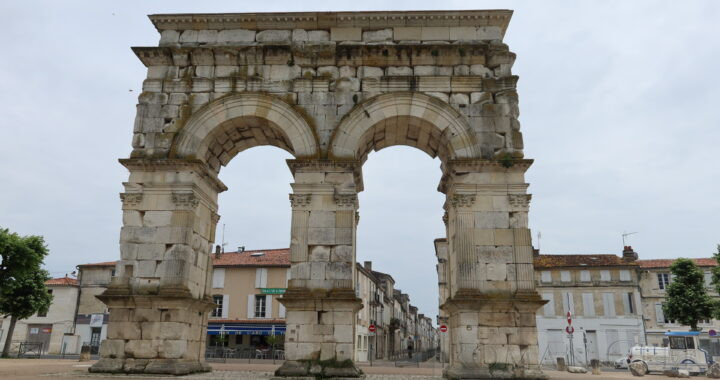
  • Arch of Germanicus (c.18 BCE)
    • This was the main entrance to a Roman bridge (now lost) that carried the Roman Road across the Charente River.
  • Saintes Roman Amphitheatre (Ruins)
  • Saintes Roman Walls
    • 3rd century CE Ruins in the Place des Recollets.
  • Roman Baths and Aqueduct (Ruins)

Museums

  • Saintes Archeological Museum
    • Holds a reconstruction of a Roman Entablature, meaning the upper part of a building supported by columns bearing the architrave, frieze and cornice. It was created using existing Roman materials.

Roman Roads


Saintes