Empty Quarter

  • The Rub’ al Khali, which means ‘Empty Quarter’, is the largest area of continuous sand desert in the world, and occupies the southern third of the Arabian Peninsular.
  • It forms the southern part of the larger Arabian Desert, which includes the Yemen, Oman, the U.A.E. and part of Saudi Arabia.

Description

  • The desert is 620 miles (1,000km) long and 310 miles (500km) wide. The elevation varies from sea level to 2,600 ft (800m).
  • It consists of Sand dunes which get their red and gold colour from elements of feldspar. Some dunes can reach a height of 820 ft (250m).
  • There are also plains made of gravel or gypsum. The plains are the dried up beds of former lakes that existed in antiquity, some as recently as 2,000 years ago.
  • It was crossed by Camel Caravans on the Incense Road that ended c. 300 CE.
  • Because of the existence of Oases, the desert is inhabited by four main Arabian Tribes, the Al Murrah, Al-Ahsa, Banu Yam and the Banu Hamdan. The latter are the direct descendants of the Sabaean Kingdom.
  • The desert is the location of Iram of the Pillars, one of the Lost cities of antiquity.


The Empty Quarter
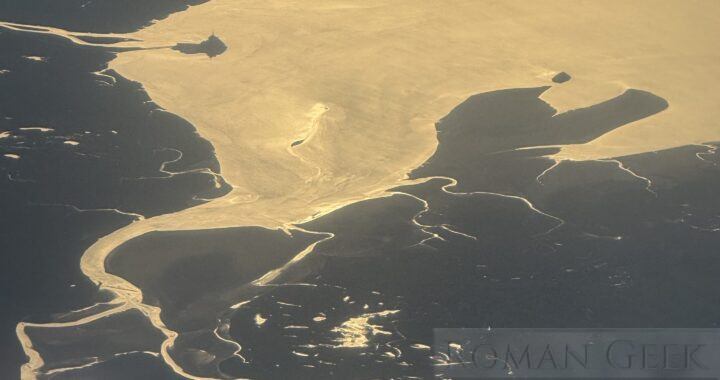
Mont Saint-Michel is a tidal island in the Bay of Mont Saint Michel in Normandy.

Mont Saint-Michel

  • Mont Saint-Michel is a tidal island with a walled town and Abbey that lies in the Bay of Mont Saint-Michel, 1 mile (0.6km) off the coast of Normandy.
  • The first Abbey was constructed above the town in the 8th century CE.
Mont Saint-Michel Tidal Island in Normandy has a hazardous tidal range of 46 feet (14m).

Mont Saint-Michel Tidal Island

Description

  • It was accessed by a very low causeway at low tide, which was raised above the tide in 1879 CE.
  • The Tidal Range can vary up to a maximum of 46 ft (14m) and is a hazard for those attempting to walk across the sands at low tide.
  • The Romanesque Abbey that stands today was built in the 11th century CE and has since been reconstructed several times.
  • The Benedictine Order was installed in 966 CE, and was later linked to St. Michael's Mount in Cornwall until 1424 CE.
  • During the Middle Ages the Abbey was a Site of Pilgrimage from all over Europe.

St. Michael's Mount, Cornwall

  • The Benedictine Monastery at Mont Saint-Michel was given the tidal island of St. Michael's Mount in Cornwall, along with its monastery, by Edward the Confessor (1042-1066 CE).
  • The relationship ended in 1424 CE.

Other Tidal Estuaries

  • A similar Tidal Estuary with paths emerging at low tides is located between England and Scotland in the Solway Firth in Cumbria, England.
  • Drumburgh Fort controlled a ford known as the Sandy wath, which crossed the Solway Firth at low tide from Drumburgh to Dornock in Scotland.


Mont Saint-Michel in the Bay of Mont Saint-Michel.

Lorelei Rock, Rhine Gorge

Lorelei

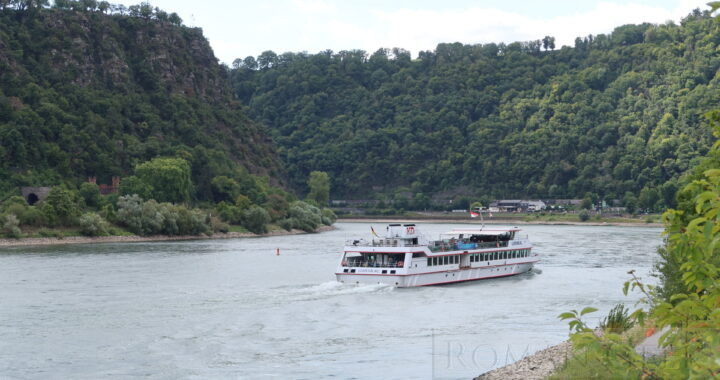
  • The Lorelei Rock is on the east bank of the Rhine and is the most famous landmark on the Rhine Gorge in Germany.
  • It is a 393 ft (120m) high rock overlooking dangerous rocks and strong currents.

In Legend

  • The legend of the Lorelei rock maiden is an integral part of German Folklore, Literature and Music.
  • Lorelei was a German Maiden who after becoming rejected in love, drowned herself in the Rhine, and was transformed into a Siren whose singing and music lured unwitting sailors to shipwreck their vessels on the rocks.

Burg Katz

  • The Burg Katz (Cat Castle) is a restored medieval castle above the town of St. Goarshausen, which is adjacent to the Lorelei harbour and Lorelei statue.
Burg Katz near Lorelei Rock

Burg Katz near Lorelei Rock


Burg Katz near the Lorelei Rock

Battle of Cape Hermaeum

  • The Battle of Cape Hermaeum (255 BCE) was a Naval battle between Rome and Carthage during the First Punic War (264-241 BCE).

The Roman Army invades Africa (256 BCE)

  • After defeating the Carthaginian Navy at the Battle of Cape Ecnomus, the Roman Fleet landed its army in Africa, led by Regulus, which forced Carthage to withdraw Hamilcar and his army of 5,500 men from Sicily.
  • After several successes, the Carthaginians agreed to a Peace, but Regulus’ terms were so harsh, they went back to war, forcing the Roman Fleet to evacuate Regulus and his army.

Battle of Cape Hermaeum (255 BCE)

  • When the Roman Fleet arrived it was met off Cape Hermaeum (Cape Bon) by the Carthaginian Fleet in 255 BCE at the Battle of Cape Hermaeum.
  • The Roman Fleet consisted of 350 Quinqueremes equipped with the Corvus accompanied by 300 transports.
  • They were met by 200 Carthaginian Quinqueremes. Outnumbered, the Carthaginian Fleet tried to fight with their back to the beaches, but were overwhelmed and the Romans won the battle.
  • The Carthaginians lost 114 vessels.

The Outcome

  • The victorious Roman Fleet then sailed back to Rome, but all 384 vessels and 100,000 men, were lost in a storm.


Cape Hermaeum or Cape Bon (Ras ed-Dar), Tunisia

Battle of Cape Ecnomus

  • The Battle of Ecnomus (256 BCE) took place near Licata in Sicily and was a Naval war fought between Rome and Carthage during the First Punic War (264-241 BCE).
  • It was one of the largest Naval Battles of the Ancient World with at least 680 vessels involved. The Carthaginians lost the battle.

The Planned Roman Invasion of Africa (256 BCE)

  • A Fleet of 330 Roman vessels carrying the Corvus accompanied by 26,000 legionaries, set sail from Ostia accompanied by a fleet of transport ships and headed towards Africa.
  • When the Carthaginians heard of this force they assembled a Fleet of 350 warships and intercepted the Roman Fleet off the coast of Sicily.

The Fleets meet

  • The Romans were sailing west in a highly organised and compact group of 4 squadrons sailing in an east to west direction.
  • The Carthaginians opposed them with 3 squadrons blocking them in a line from north to south.
  • The Carthaginian centre appeared to yield, encouraging the first two Roman squadrons to pursue them, which succeeded in separating them from the rear two squadrons and their transports.
  • The two flanking Carthaginian squadrons then broke off and each pursued a rear Roman squadron.

The conflict divided into three separate battles.

  • One of the rear Roman squadrons quickly rowed to the Sicilian coast, pointed their sterns against the beach and kept their bows together with the Corvus ready to trap any advancing Carthaginian galley. This resulted in a stalemate.
  • The second rear Roman squadron was in open water and had difficulty defending itself.
  • Meanwhile, the two front Roman squadrons had successfully engaged the Carthaginian centre squadron and forced it to break away and disperse. They then turned back to help their two fellow beleaguered squadrons.
  • Each Roman squadron arrived behind one of the two attacking Carthaginian squadrons.
  • One Carthaginian squadron left the battle, and the attacking Roman squadron then turned north to help crush the remaining Carthaginian squadron against the Sicilian coast.
  • The result was a massive Roman victory with a loss of only 24 vessels compared to the Carthaginian loss of 30 vessels sunk and 64 captured. The Carthaginians lost 30,000 men compared to the Roman loss of 10,000 men.

The Outcome

  • Regulus then landed the Roman Fleet unopposed at Aspis (Kelibia). Hamilcar left Sicily with 5,500 soldiers to reinforce the Carthaginian Army, but Regulus’ successful campaigns led eventually to the Carthaginians offering a Peace Treaty.
  • When Regulus tried to impose harsh terms, the Carthaginians went to war again almost defeating Regulus and a Roman Fleet was sent to withdraw Regulus from Africa.
  • The Carthaginian Fleet opposed this Roman Fleet at the Battle of Cape Hermaeum in 255 BCE but was completely defeated, losing 114 vessels.
  • A storm then devastated the returning Roman Fleet with the loss of 384 vessels and 100,000 men.


Cape Ecnomus, near Licata, Sicily

Battle of Drepanum

  • The Battle of Drepanum (249 BCE) was a Naval Battle between Rome and Carthage during the First Punic War (264-241 BCE).
  • This Battle resulted in the greatest victory of the war for Carthage which gave them complete naval dominance for the next seven years.

The Buildup

  • In 250 BCE, a large Roman Army laid siege to Lilybaeum and Drepana, the last two Carthaginian fortress cities in Sicily.
  • Lilybaeum was sealed off by land but the Romans were unable to close the harbour.
  • A Roman Fleet of 200 vessels was positioned outside Lilybaeum to blockade the harbour.
  • Despite this, a Carthaginian Fleet of 50 vessels bypassed the blockading Fleet unloaded their supplies, embarked the Carthaginian cavalry and left under the cover of darkness.

The Roman Fleet attempts a Blockade

  • Pulcher, the Roman Consul, was given an additional force of 10,000 inexperienced sailors.
  • With this reinforced Fleet Pulcher decided he would risk an attack on the Carthaginian Fleet based at Drepana 16 miles (25 km) to the north of Lilybaeum.
  • Pulcher embarked his marines and set off at night with between 120-200 vessels, to surprise the Carthaginians, but in the dark his Fleet became disoriented and broke formation.

The Battle

  • When dawn came, Adherbal, the Carthaginian commander, although completely taken by surprise, nonetheless immediately embarked his marines on between 100-130 vessels and escaped out of the harbour before the Roman Fleet could block it.
  • Having lost the chance to bottle up the Carthaginian Fleet, Pulcher gave the order to turn and form up in a line with their sterns to the shore to prevent being outflanked by the Enemy galleys. In the confusion several Roman Galleys collided with each other and sheared off their oars.
  • Having safely emerged from the harbour, Adherbal ordered the Carthaginian Fleet to form a parallel line in front of the Roman Fleet with five galleys in echelon to the south blocking the Roman escape route.

The Corvus was absent

  • This time the Roman Fleet did not have the Corvus, and so was unable to board the enemy galleys. It had to remain in close formation for protection.
  • The Carthaginians were in a position to pick off each galley as it became vulnerable. As the day progressed, they were winning by attrition. Some Roman Galleys were even reversed onto the beach and their crews fled.
  • Finally, Pulcher broke out with 30 galleys and escaped, leaving 93 galleys captured or sunk and losing 20,000 men either dead or as prisoners.

The Outcome

  • The Carthaginian Navy won its greatest victory of the war and went on to sweep the Roman Navy from Sicily for the next seven years.
  • In 242 BCE, another Roman Fleet was eventually built, also without the Corvus, but which this time ended in a Roman victory at the Battle of the Aegates Islands, ending the First Punic War.


Drepanum or Trapani, Sicily

Battle of Sulci

  • The Battle of Sulci (258 BCE) was a Naval Battle between Rome and Carthage during the First Punic War (264-241 BCE).

The Battle

  • After the success of the Battle of Mylae, the Roman Navy pursued the Carthaginian Fleet to Sardinia.
  • The two Fleets met and the Romans, again using the Corvus, succeeded in sinking a large number of vessels with the remaining vessels escaping by beaching themselves on Sardinia.

The Outcome

  • The Carthaginian garrison managed to repulse the ensuing Roman invasion.
  • Although the Romans failed to capture the island, the Carthaginian garrison was effectively prevented from reinforcing its counterpart in Sicily.


Sulcis, Sardinia

Battle of Tyndaris

  • The Battle of Tyndaris (Tindari) (257 BCE) was a Naval Battle between Rome and Carthage during the First Punic War (264-241 BCE).

The Battle

  • Tindaris was occupied by a Carthaginian Garrison which was besieged by a Roman Fleet that lay anchored in front of the town.
  • When a Carthaginian Fleet sailed passed, the Roman Commander gave orders to pursue it, but the fleet didn’t wait to assemble. The first Roman ships to make contact were quickly overwhelmed and 9 vessels were sunk.
  • However, the rest of the Roman Fleet succeeded in assembling and forming into a line astern, then attacking the Carthaginians and sinking 8 vessels whilst capturing 10.

The Outcome

  • The Roman Navy continued its ascendency over the Carthaginian Navy.


Tindari

Battle of the Lipari Islands

  • This was the first Naval Battle in 260 BCE of the First Punic War (264-241 BCE) between Rome and Carthage.

The Battle

  • The Roman Navy was a new concept, created almost overnight in 261 BCE, with the construction of 100 Quinqueremes and 20 Triremes
  • The Romans experienced their first Naval defeat when 17 Roman galleys were easily captured by 20 Carthaginian galleys in the Lipari Islands off the coast of Sicily.


Aeolian Islands or Lipari Islands