
Battle of Mylae

  • The Battle of Mylae (Milazzo) was the first victory of the new Roman Navy created in 261 BCE during the First Punic War (264-241 BCE).
  • It is notable for its introduction of a Boarding device known as the Corvus.

Tactics

  • Galley Tactics consisted of Ramming and sinking the enemy vessel.
  • After the earlier disaster of the Battle of the Lipari Islands in 260 BCE, where 17 Roman galleys were captured by 20 Carthaginian galleys, the Romans decided on a Tactic of Boarding.

The Corvus

  • The Corvus was invented to rapidly place a boarding party of marines onto an enemy vessel.
  • The Corvus was a heavy gangplank with a spike positioned in the ship’s prow in a raised position. When it was dropped on the enemy’s deck, the two galleys were locked together allowing the marines to board and overpower the enemy vessel.

Mylae, Sicily

  • Using this device, the two Fleets met at Mylae, Sicily, and the Romans succeeded in overwhelming the Carthaginian Fleet which was forced to withdraw.
  • An Inscription on a victory column in honour of the Consul Duilius states that 31 ships were captured and 13 sunk. The inscription is now in the Capitoline Museums in Rome.

The Outcome

  • The new Roman Navy had made Rome a Sea Power.
  • In 258 BCE the Roman Fleet went on to win another victory over the Carthaginian Fleet at the Battle of Sulci off Sardinia.


Mylae or Milazzo, Sicily
Beirut

  • Beirut is a port city situated on a peninsular and is the capital of Lebanon. It has been continously occupied since c. 1,500 BCE.
  • It was named Berytus by the Romans and was located in the Province of Syria.

History

  • Pompey conquered the Phoenician town of Biruta in 64 BCE, and settled it with legionary veterans.
  • Berytus was made a Colonia in 14 BCE and unusually, was exempt from Imperial Taxation.
  • Its possessions included Heliopolis (Baalbeck) and the rich agricultural lands of the Bekaa Valley.
  • It became an important Colonia and was the most Romanised city in the Eastern Empire.
  • Berytus had an Amphitheatre, Theatre, Porticos and Baths. However, only the site of one of the Baths is visible today.

Roman Sites

  • Roman Baths.
    • A small part of one of the Baths has been excavated and can be visited.
    • Originally there were four Roman Baths, with construction beginning under Augustus (27 BCE-14 CE).

Museums

  • National Museum of Beirut
    • Located on Damascus Street at VGH8+928, Beirut
    • The Museum houses Collections from all Ages including the Roman Period which includes notable Sarcophagii, Statues and Mosaics.
  • Archaeological Museum of the American University of Beirut
    • Founded in 1868 CE, it is located in the American University of Beirut at VFXM+QH6.
    • The Museum holds Collections from all the Ages inclufing the Roman Period.


Beirut Roman Baths

Arrezo

  • Arrezo is a cathedral city near the rivers Chiani and Arno in the Tuscany Region of central Italy.
  • It was conquered by the Romans in 311 BCE and known as Arretium, located in Italia and famed for its Arretine Ware.

Arretine Ware

  • Arretium was the centre for the manufacture of red glazed Roman Pottery known as either Arretine Ware, Samian Ware or Terra Sigillata.
  • Production first started in the middle of the 1st century BCE.
  • Potteries produced dishes, plates and bowls with a pleasing red finish that was often decorated with a motif.
  • The potteries supplied the Roman Empire and were exported as far away as India.
  • Subsidiaries were set up in Gaul, whilst the eastern Provinces and North Africa produced a similar style of pottery.

Roman Sites

  • Roman Amphitheatre
    • It was constructed during the 1st century CE, and held up to 10,000 spectators.
    • The Archeological Museum is built into the side of the Amphitheatre.

Museums

  • Archeological Museum of Arrezzo
    • Via Margaritone, 10, 52100, Arezzo.
    • The museum is built into the side of the Amphitheatre with the Roman collection on the first floor.

Roman Roads


Arrezo Roman Amphitheatre

Temple of Pietas

  • The Temple of Pietas (Piety) was a Temple in Rome dedicated to the Goddess Pietas.
  • It was built in 191 BCE in the Forum Holitorium, the vegetable market, and dismantled in 44 BCE.


Forum Holitorium, Rome

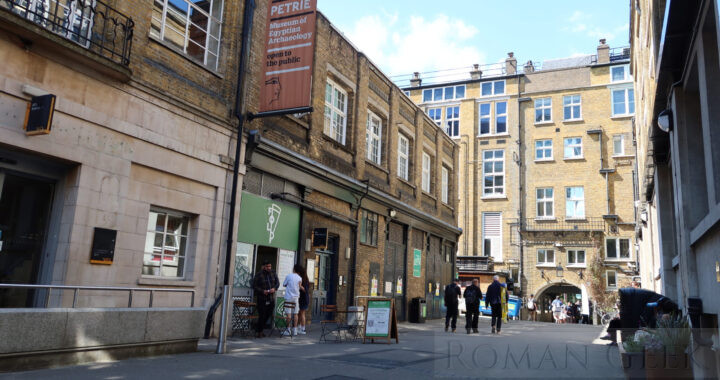
Petrie Museum of Egyptian Archeology, London

Petrie Museum of Egyptian Archaeology

  • The Petrie Museum of Egyptian Archaeology holds a total of 80,000 Egyptian and Nubian objects, which were collected by the pioneering Egyptologist Flinders Petrie (1853-1942).
  • The Museum is part of the University College London, which owns the Collection.

Location

  • University College London (UCL), Malet Place, near Gower Street, London.

Opening Times

  • Tuesday to Saturday 1-5 pm. Free Admission.

Links


Petrie Museum of Egyptian Archaeology, London

Strait of Hormuz

  • The Strait of Hormuz is the gateway into the Persian Gulf from the Gulf of Oman and the Indian Ocean.

Description

  • It is 21 nm (39km) at its narrowest point and was described in the Periplus of the Erythraean Sea (1st century CE).
  • Navigation in the days of sail was difficult because a vessel had to manoeuvre through a bend of 180° against prevailing winds and fast running tides.

Callanish Standing Stones

  • The Callanish Standing Stones are a stone circle located in Lewis in the Outer Hebrides of Scotland.
  • The Stones are made from local rock called Lewisian Gneiss which is over 3,000,000,000 years old.

Description

  • Between 2,900-2,600 BCE, thirteen stones were arranged in a circle with a Monolith near the centre and five rows of stones radiating outwards from this circle in the form of a cross. Two rows form an Avenue. None of the rows point directly to the centre of the circle. A chambered Tomb was later added to the centre.
  • Sometime around 800 BCE the area was abandoned and the stones covered in turf.
  • Just over 0.5 mile (1km) from the main Site lie two more stone circles, Callanish I and Callanish II, which originally each consisted of at least 8 Standing Stones. The remains of a fourth stone circle and a number of other Standing Stones lie nearby.

Similar Monuments


Villa Poppaea

  • The Villa Poppaea was a luxurious Roman Villa located in Oplontis, a Roman town next to Pompeii.
  • It was buried in the eruption of Mount Vesuvius in 79 CE. The Villa is a UNESCO World Heritage Site open to visitors.

Description

  • Parts of the Villa Poppaea have been excavated and can be visited.
  • Amongst the Finds was an inscription with the name Poppaea Sabina, Nero's second wife, leading to the conclusion that the villa belonged to Nero.
  • The villa is therefore named after her.

Museums


Villa Poppaea, Oplontis

Sheba

  • Sheba was a kingdom mentioned in The Bible which was ruled by the Queen of Sheba.
  • The location of Sheba is unknown, but it may have been the Ancient Sabaean Kingdom in the Yemen, with its capital city at Marib.


Yemen